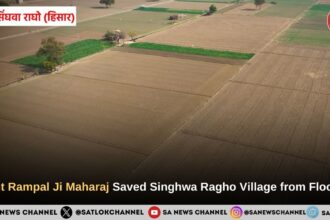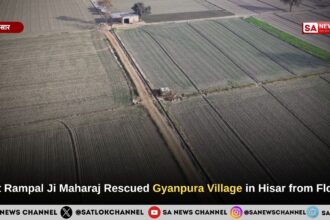


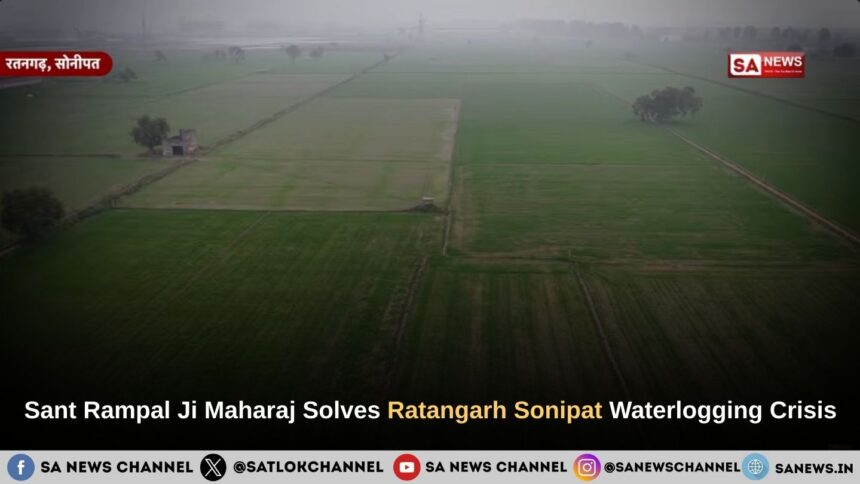
Ratangarh village is located in the Sonipat district of Haryana. For several months, the village had been submerged under floodwaters that had reached depths of 3 to 4 feet, described by locals as “chest-high.” This stagnant water had begun to rot, creating a severe stench that made breathing difficult for the inhabitants. The accumulation of toxic, putrid water posed an immediate threat of a pandemic, with diseases already beginning to spread among the villagers.
The local Sarpanch, Sanjay, along with various village elders and residents, reported that they had made numerous attempts to seek assistance from the government and the District Commissioner (DC). Despite repeated visits and official requests, no administrative action was taken, and the villagers’ applications remained unprocessed within government files.
Intervention via Annapurna Muhim
When the state administration failed to provide relief, the villagers approached Sant Rampal Ji Maharaj for assistance. Sant Rampal Ji Maharaj, through the Annapurna Muhim, initiated a relief operation within two to three days of the request. To address the drainage crisis, Sant Rampal Ji Maharaj provided substantial technical resources and machinery to the village.
The specific items and equipment provided by Sant Rampal Ji Maharaj included:
- 13,000 feet of 8-inch diameter piping.
- Two high-capacity 10 HP (Horsepower) electric motors.
- All necessary technical accessories including starters, electrical wiring, nuts, bolts, bands, and adhesive solution (Fevicol).
The delivery was structured to be comprehensive, ensuring that the village had every component required for immediate installation and operation without further delay.
Technical Execution and Permanent Infrastructure Development
Following the arrival of the equipment, volunteer workers (Sevadars) and villagers worked to install the system. The 10 HP motors operated continuously to expel the toxic water beyond the village boundaries. To ensure a long-term solution to the recurring waterlogging problem, the villagers decided to bury the 13,000-foot pipeline permanently underground.
The pipeline has been strategically connected to:
- The local canal (Nahar).
- The regional drain (Drain).
This permanent infrastructure now serves a dual purpose. While it was initially installed for floodwater drainage, it is now being utilized by farmers for irrigation, allowing them to draw water from the canal directly to their fields.
Agricultural Recovery and Economic Impact
Before the intervention, approximately 500 to 600 acres (kille) of agricultural land in Ratangarh were completely submerged. The inability to drain the water in time would have resulted in the total loss of the paddy (rice) crop and the inability to sow the wheat crop for the next season, potentially leading to a cycle of debt for the farmers.
As a result of the resources provided by Sant Rampal Ji Maharaj:
- Farmers were able to harvest approximately 50% of their paddy crop that had been previously submerged.
- Nearly 450 to 500 acres of land have been successfully cleared of water.
- Wheat sowing has been completed on the majority of the land, with only about 40 to 50 acres remaining to be cleared at the time of the report.
- The land is now dry, and wheat crops are visible in the fields where stagnant water previously stood.
Summary of Relief Resources and Results
| Category | Details |
| Location | Ratangarh Village, Sonipat, Haryana |
| Machinery Provided | Two 10 HP Motors |
| Piping Provided | 13,000 Feet of 8-inch Pipe |
| Land Reclaimed | Approximately 500-600 Acres |
| Crop Beneficiaries | Paddy (50% saved) and Wheat (successfully sown) |
| Infrastructure | Permanent Underground Drainage and Irrigation System |
| Contributors | Sant Rampal Ji Maharaj via Annapurna Muhim |
Testimonials from Local Beneficiaries and Stakeholders
Several residents provided detailed accounts of the impact of the relief work. Sanjay, the Sarpanch of Ratangarh, stated that Sant Rampal Ji Maharaj performed the work of a deity for the village. Resident Sandeep noted that the permanent installation of the pipes ensures that any future heavy rainfall will no longer result in long-term waterlogging. Vijender Singh highlighted that without this timely help, the farmers would have faced extreme financial ruin and debt.
Muneer Singh, another local farmer, explained that the drainage route had been blocked previously, and the new pipeline connected to the canal and drain has resolved the conflict of water disposal. Jasveer, a village resident, mentioned that the situation had become so dire that people were packing their belongings to migrate due to water entering their homes. Ramesh Kumar, a contractor working in the area, observed that for 20 to 25 days, there had been no viable way to drain the water until the arrival of the 13,000-foot pipeline.
Transition from Disaster Zone to Productive Agricultural Land
The intervention by Sant Rampal Ji Maharaj has transformed the landscape of Ratangarh. The area, which was characterized by 4 feet of toxic water and the threat of disease, is now a site of active agriculture. The villagers noted that where the Prime Minister or Chief Minister’s administration failed to act over several months, Sant Rampal Ji Maharaj provided a solution in a matter of days. The fields are now green with sprouting wheat, and the local economy has been stabilized through the preservation of the sowing season.