

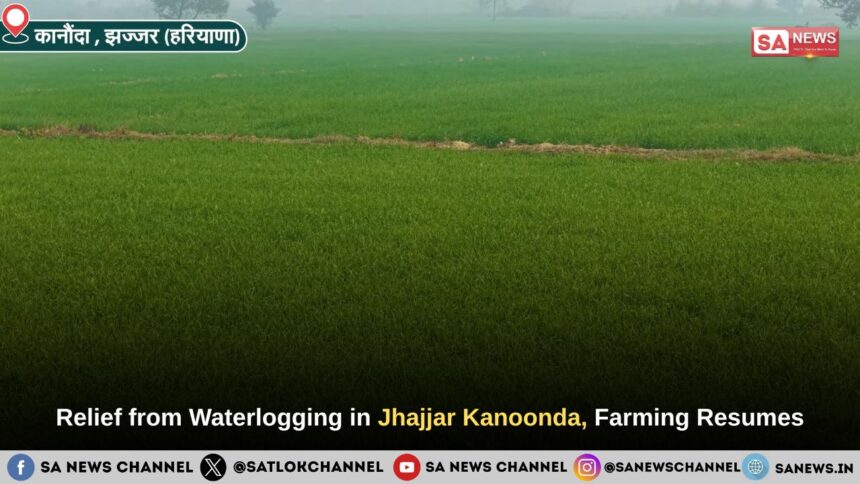
Kanoonda village of Bahadurgarh tehsil in Jhajjar district, Haryana, had been struggling with a severe waterlogging problem for several years. This was not just a seasonal issue, but had turned into a permanent crisis that deeply affected farming, livelihoods, and the social structure of the village. In this ground report, we understand the entire situation—how floods devastated the village, what condition the farmers were in, and how a coordinated relief effort changed the circumstances.
- Waterlogging for Years: 300–400 Acres of Land Useless
- Failure at Administrative Level: Complaints but No Solution
- Economic Impact on Farmers: Up to 90% Loss
- Ground Reality: Farmers Forced to Quit Farming
- Relief Materials and Technical Setup
- Operation Drainage: Continuous Work and Fast Results
- Voices of Farmers: Ground-Level Reactions
- Social and Economic Impact
- From Crisis to Solution: Support of Sant Rampal Ji Maharaj Ji
Waterlogging for Years: 300–400 Acres of Land Useless
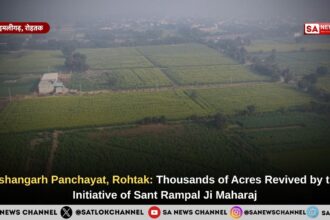
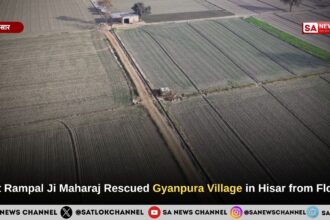
Approximately 300 to 400 acres of farmland in Kanoonda village remained submerged in water continuously for 3 to 4 years. In many areas, the water depth reached up to 4 to 5 feet. This water was not just from rainfall but accumulated due to lack of drainage, leading to stagnation and affecting soil fertility.
According to villagers, the standing water in the fields completely halted the agricultural system. Paddy crops rotted, wheat sowing could not be done, and many fields began to look completely barren.
Failure at Administrative Level: Complaints but No Solution
Villagers approached the administration multiple times regarding this issue. Written complaints were submitted, and departments were visited, but no permanent solution was provided.
Local farmers say they were repeatedly sent to different officials—sometimes SDO, sometimes other departments—but even after months of effort, neither drainage arrangements were made nor any concrete plan was presented.
This situation became even more frustrating for farmers as losses kept increasing every year.
Economic Impact on Farmers: Up to 90% Loss
Waterlogging directly affected farmers’ income. Many farmers’ crops were completely destroyed
Some farmers had taken loans for farming, which got wasted Attempts to drain water using diesel pumps also failed
According to one farmer, “Last year, not even a single grain was produced. The entire field remained empty.” Another farmer stated that losses reached nearly 90%, making it difficult to run their households.
Ground Reality: Farmers Forced to Quit Farming
The situation became so severe that many farmers stopped cultivating their land altogether. Some leased their land, while others left it unused.
Villagers say that continuous losses and uncertainty led to a loss of trust in farming. The village economy, which was entirely dependent on agriculture, gradually weakened.
When no solution was found at the administrative level, some villagers took an alternative route and contacted Sant Rampal Ji Maharaj.
According to villagers, the response from there was immediate. After understanding the problem, a decision was made to send relief resources, and arrangements were made in a very short time.
Also Read: Kanonda Village’s 4-Year Flood Crisis Ends as Sant Rampal Ji Maharaj Delivers Miraculous Relief
Relief Materials and Technical Setup
The assistance provided in the village was not merely symbolic but based entirely on a technical solution.
Main resources provided:
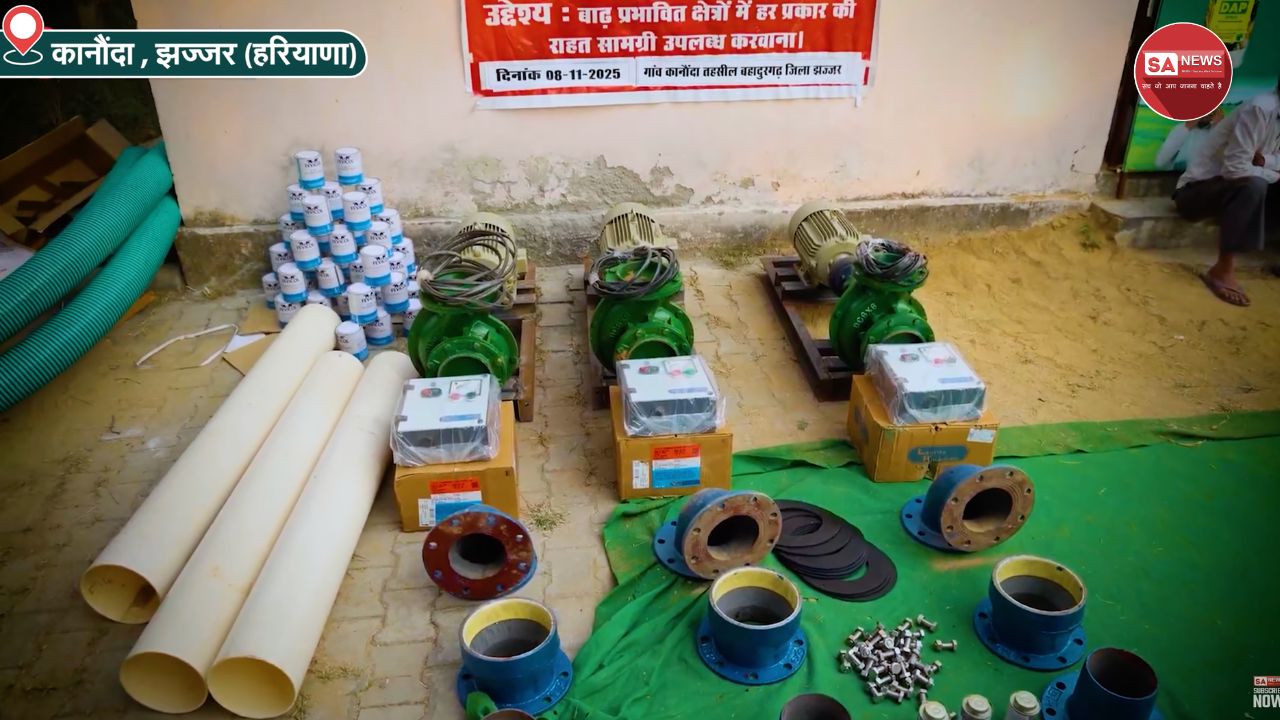
- 310 HP capacity motors
- Approximately 7500 feet long pipelines of 8-inch diameter
- Starters, nuts-bolts, and other necessary equipment
These resources were arranged in such a way that water could be drained from the lowest points.
Operation Drainage: Continuous Work and Fast Results
The motors were installed and operated continuously. Due to this round-the-clock effort, water accumulated over years was drained out in a short time.
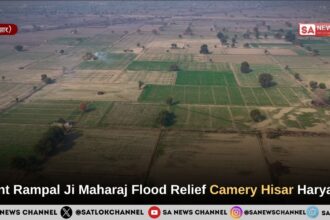
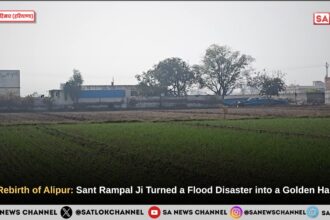
During the ground visit, it was observed that fields which earlier had 4–5 feet of water are now being ploughed with tractors.
After the relief work, approximately 150 to 200 acres of land became cultivable again.
Around 80% area has been sown with wheat
Crops have started growing in some places
Farmers have begun preparing for the next crop
This change has proven to be a significant turning point for the village.
Voices of Farmers: Ground-Level Reactions
During ground reporting, it was clearly felt that this change is not just a technical improvement but a life-changing transformation for the farmers. Different farmers shared their experiences, expressing both past pain and present relief.
Farmer Narendra says that last year the situation was so bad that not even a single grain was harvested. The entire land remained useless. But now, with complete drainage of water, the same land has become cultivable again. According to Him, this time the village will gain direct economic benefit and farming will return to normal.
Shyam questions the administrative process, saying that He visited government offices for months but received no response. Each time He was sent to a different official or department. In contrast, when He sought help through another medium, a solution was provided within just one day. According to Him, this difference was the biggest experience.
Kulwant says that this time water was not just temporarily removed, but a pipeline system has been arranged to prevent future waterlogging. This means farmers will not have to face this issue every year.
Manjeet says that earlier crops would rot in water and never reach harvest stage. But now that the fields are dry, there is full hope of a good wheat crop. According to Him, this time production will be better and instead of loss, profit will be seen.
Social and Economic Impact
The impact of this entire development was not limited to agriculture.
- Economic activities in the village resumed
- Farmers regained confidence
- Hope of repaying loans emerged
- A positive atmosphere developed in the village
According to a local school operator, some farmers were so distressed that their lives were in crisis, but now their condition has improved.
Villagers also considered this assistance important because it was provided without any discrimination. They say that all farmers—regardless of caste or class—received equal help. This has also strengthened social unity in the village.
From Crisis to Solution: Support of Sant Rampal Ji Maharaj Ji
The situation in Kanoonda village shows that problems like waterlogging are not only natural but also related to management and systems. Although no administrative solution was found initially, later organized efforts proved that with proper resources and planning, the problem can be solved. Today, farming has resumed in the village, farmers are optimistic about the future, and a long-standing crisis has largely been resolved.
In this entire development, villagers repeatedly emphasized one more important point—that the service spirit of Sant Rampal Ji Maharaj is not bound by any discrimination. According to the villagers, He stood with every needy person without considering caste, status, or social divisions. While many so-called saints are accused of taking money from people, villagers say that here the flow of help was in the opposite direction—support was provided to the poor, helpless, and needy in basic needs like medical treatment, house construction, education, and food.
Along with this, farmers also received financial and technical assistance during times of crisis. In the words of villagers, this contribution was not limited to a religious or spiritual role but emerged as real support for the weaker sections of society—an effort they consider extraordinary and beyond the capacity of ordinary individuals.