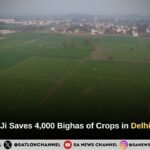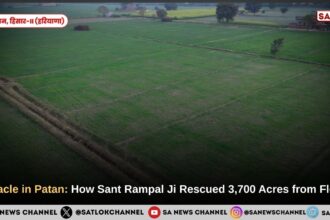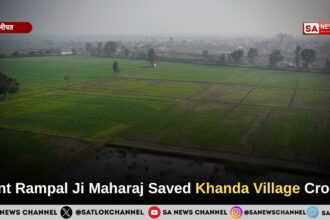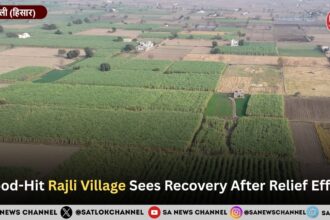


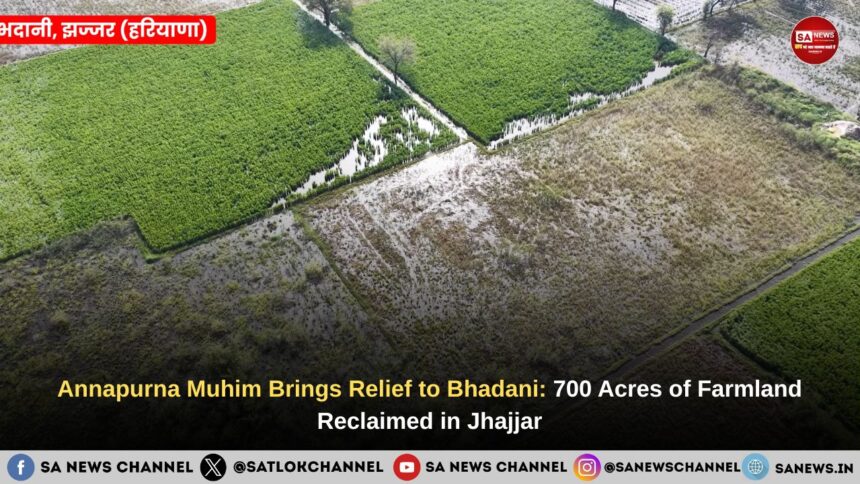
For years, the fields of Bhadani village in Jhajjar district, Haryana, told a silent story—one of stagnation, loss, and fading hope. Nearly 700 acres of farmland remained submerged under water—not for days or weeks, but for years. Farming had almost come to a halt, and with it, a way of life that generations depended upon slowly began to disappear.
What the village needed was not just attention—it needed a solution that could work effectively on the ground. That turning point came under the guidance of Sant Rampal Ji Maharaj through the Annapurna Muhim.
A Crisis That Went Beyond Agriculture
The issue was not limited to waterlogging alone. It had deeper consequences. Farmers watched their land become unusable season after season. Fields that once supported families were now covered in stagnant water and wild vegetation.
Over time, the impact extended beyond agriculture—affecting livelihoods, weakening confidence, and disrupting the overall rhythm of village life.
A Practical Solution Under Sant Rampal Ji Maharaj’s Direction
As the situation reached Sant Rampal Ji Maharaj, immediate directions were issued under His guidance to provide a practical and lasting solution through the Annapurna Muhim. Instead of temporary relief, a structured drainage system was arranged.
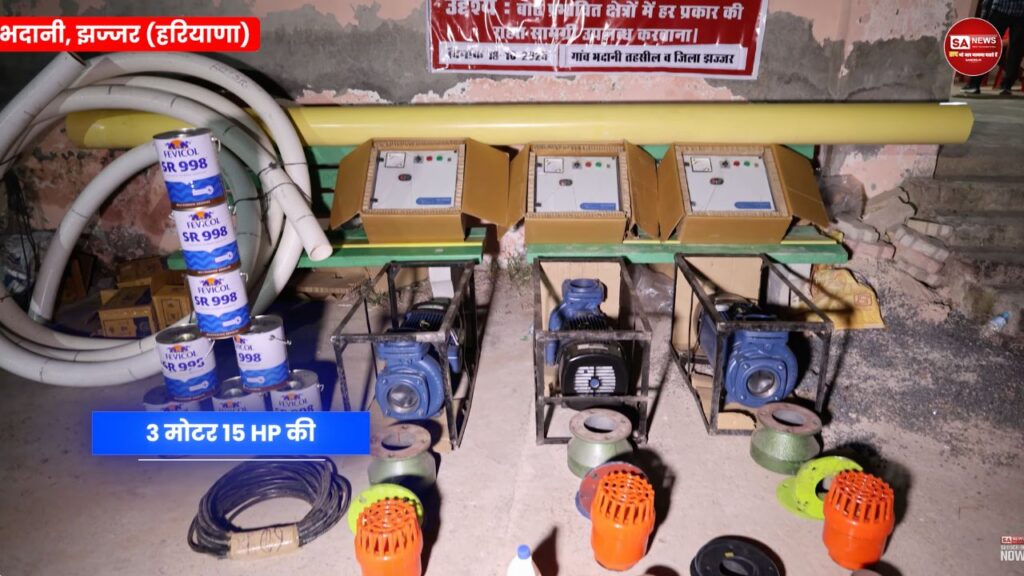
The village was provided with:
- A 10,000-foot-long pipeline (8-inch diameter)
- Three high-capacity 15 horsepower motors
- Supporting equipment including starters, cables, and pipe fittings
Every essential component was delivered together to ensure that the drainage process could begin immediately without any interruption or additional burden on the farmers.
Also Read: The Irony of the Capital and the Miracle of ‘Annapurna Muhim’; A New Lease of Life for Kair Village
When Change Began to Appear
As the system was put into operation under the guidance of Sant Rampal Ji Maharaj, the first signs of change began to emerge. Water levels started to recede gradually. Patches of land, unseen for years, began to reappear.
For a village that had witnessed the same condition for such a long time, even this gradual transformation carried deep significance.
More Than Infrastructure—A Step Toward Self-Reliance
What made this initiative different was not just the technical setup, but its long-term approach. The resources were not withdrawn after use. Instead, they were entrusted to the village, enabling residents to manage similar challenges independently in the future.
This was not just assistance—it was a step toward self-reliance under guided support.
A Change Felt Across the Bhadani Village
The transformation did not come with announcements—it reflected quietly in everyday life. Farmers began visiting their fields again. Discussions returned to crops, planning, and cultivation. The visible change in land conditions brought back a sense of normalcy that had been missing for years.
A Second Beginning for Farmers
Many farmers had reached a point where continuing agriculture no longer seemed viable. Now, as the land gradually recovers, they are preparing to return—not with complete certainty yet, but with something equally powerful: belief. The possibility of cultivation has returned, and with it, the foundation of their livelihoods.
Where Hope Returns with the Land
As the water recedes from the fields of Bhadani, something equally important is returning—confidence. Under the guidance of Sant Rampal Ji Maharaj, Bhadani is no longer just a story of prolonged hardship.
It has become a powerful example of how timely intervention, practical solutions, and committed service can transform even the most persistent challenges. This transformation began when seva reached the fields—not as a concept, but as action.