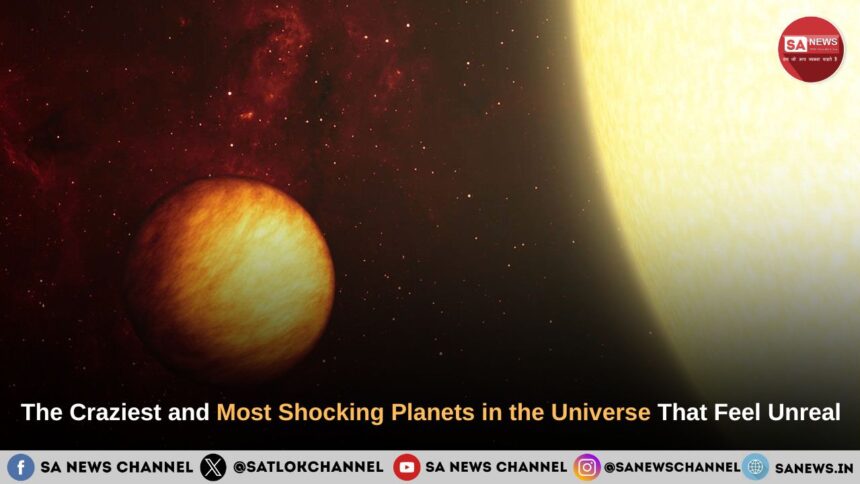
The Universe manufactures impossibilities as standard procedure. Diamond rain falls from alien skies. Planets darker than coal orbit distant stars. Entire worlds made of crystallized carbon drift through space. These aren’t science fiction concepts, they’re documented realities that make Earth’s physics seem quaint by comparison. What follows is a catalog of the most bizarre cosmic phenomena that exist right now, operating under conditions so extreme they redefine what’s possible.
- Planets Where It Literally Rains Diamonds
- TrES-2b: The Darkest Planet in the Known Universe
- 55 Cancri e: A Planet Made of Diamond Worth $26.9 Nonillion
- PSR J1719-1438 b: A Star Compressed Into a Diamond Planet
- Rogue Planets: Trillions of Worlds Drifting in Eternal Darkness
- WASP-12b: A Planet Being Devoured by Its Star
- HD 189733b: Where Glass Rain Falls Sideways at 5,400 MPH
- Gliese 436 b: A Planet Covered in Burning Ice
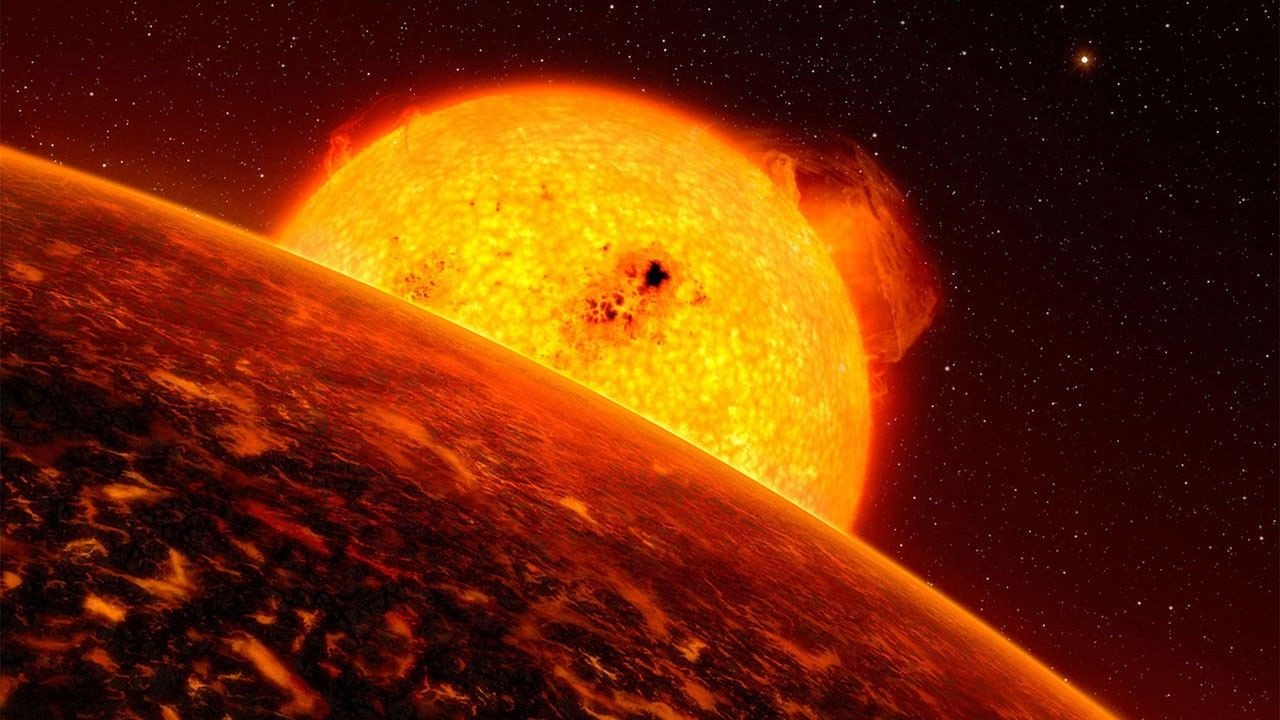
- CoRoT-7b: Where Rock Vaporizes and Rains From the Sky
- Haumea: The Egg-Shaped Dwarf Planet With Rings and Two Moons
- Conclusion: The Universe’s Casual Impossibilities
- When the Cosmos Points Beyond Matter
Planets Where It Literally Rains Diamonds
Neptune and Uranus aren’t just ice giants, they’re diamond factories. Deep within their atmospheres, pressures reach millions of times Earth’s surface pressure and temperatures soar to thousands of degrees. Under these conditions, methane in the atmosphere breaks apart, and carbon atoms crystallize into diamonds.
These aren’t microscopic particles. Scientists estimate diamond chunks the size of hailstones, some potentially weighing millions of carats, rain down through these planets’ interiors, sinking slowly through layers of liquid metallic hydrogen. The phenomenon occurs approximately 8,000 kilometers below the cloud tops, where pressure reaches 200 gigapascals.
Source : Space.com
Laboratory experiments recreating these conditions confirmed the process. Researchers used powerful lasers to simulate the pressure and temperature, watching in real-time as hydrocarbon compounds transformed into diamond rain. The same process likely occurs on thousands of similar planets throughout the galaxy.
Saturn experiences this phenomenon too, possibly producing 10 million tons of diamonds per year. These gems eventually sink to the planets’ cores, forming vast seas of liquid diamond around a solid diamond core.
The unforgettable fact: Neptune and Uranus likely have oceans of liquid diamond thousands of kilometers deep, with diamond icebergs floating on the surface.
TrES-2b: The Darkest Planet in the Known Universe
Most planets reflect at least some light. TrES-2b reflects less than 1% of the light that hits it, making it darker than coal or black acrylic paint. This Jupiter-sized exoplanet orbits a star 750 light-years from Earth, locked in a death spiral that brings it closer to its sun than Mercury is to ours.
The planet’s temperature exceeds 1,100°C, hot enough to glow faintly red like burning embers. Yet despite orbiting so close to its star and radiating its own heat, TrES-2b appears almost completely black when observed through telescopes. Something in its atmosphere absorbs virtually all incoming light.
Scientists suspect the atmosphere contains vaporized sodium, potassium, and titanium oxide, creating clouds of light-absorbing chemicals. The planet doesn’t have reflective clouds like Jupiter, instead, its atmosphere acts like a cosmic black hole for visible light, trapping and absorbing photons with terrifying efficiency.
Standing on this world would mean experiencing something no human has ever known: being on a planet orbiting a sun, yet existing in near-total darkness as the atmosphere devours the light before it reaches the surface.
The unforgettable fact: TrES-2b is so dark that if you replaced our Moon with it, you would barely see it in the night sky despite it being the same size.
55 Cancri e: A Planet Made of Diamond Worth $26.9 Nonillion
Located 40 light-years from Earth, 55 Cancri e is a super-Earth twice our planet’s width but eight times its mass. Its interior isn’t composed of silicon and oxygen like Earth, it’s primarily carbon. Under the planet’s immense pressure and temperature, much of that carbon exists as diamond.
The planet’s estimated value, based purely on its diamond content, exceeds $26.9 nonillion, that’s 26.9 followed by 30 zeros. Its mass contains more diamond than exists in every jewelry store, mine, and vault on Earth combined, multiplied by trillions.

Source : NASA Science
Surface temperatures reach 2,400°C, hot enough to melt the graphite on the surface while the interior remains solid crystallized carbon. The planet orbits its star in just 18 hours, completing a full year faster than Earth rotates once. Tidal forces from this proximity likely keep one face perpetually molten while the other cools slightly, creating a world of extreme temperature gradients across a surface made of humanity’s most valued gemstone.
These shocking space facts challenge economic assumptions, diamond’s value derives entirely from scarcity on Earth. In cosmic terms, entire planets made of diamond render the gemstone as common as rock.
Also Read : Explore Universe’s Deadliest Objects
The unforgettable fact: If 55 Cancri e could be mined and brought to Earth, it would contain enough diamond to give every person on the planet 340 trillion tons each.
PSR J1719-1438 b: A Star Compressed Into a Diamond Planet
This planet was once a star. PSR J1719-1438 b orbits a pulsar, a rapidly spinning neutron star, at a distance of just 600,000 kilometers. The planet is all that remains of a white dwarf star that the pulsar slowly consumed over millions of years.
As the pulsar stripped away the white dwarf’s outer layers through gravitational forces and radiation, the stellar core was compressed and crystallized. What remains is a planet-sized diamond: 60,000 kilometers in diameter, composed almost entirely of crystallized carbon and oxygen, with a density 20 times greater than water.

Source : NASA Science
The planet orbits its pulsar companion every 2 hours and 10 minutes, locked in a gravitational embrace with the stellar corpse that devoured it. The pulsar’s intense radiation bathes the diamond planet continuously, making it one of the most extreme environments in the galaxy, a compressed stellar remnant orbiting another stellar remnant in perpetual high-energy bombardment.
This bizarre cosmic phenomenon reveals how stellar evolution can create objects that defy categorization, not quite planet, not quite star, but something stranger: the diamond heart of a cannibalized sun.
The unforgettable fact: PSR J1719-1438 b is what’s left after a pulsar ate an entire star, compressing the remains into a planet-sized diamond denser than any natural material on Earth.
Rogue Planets: Trillions of Worlds Drifting in Eternal Darkness
Not all planets orbit stars. Rogue planets were either ejected from their solar systems during formation or formed independently in interstellar space. They drift through the galaxy at tens of thousands of kilometers per hour, completely dark, with surface temperatures approaching absolute zero.
Current estimates suggest the Milky Way contains more rogue planets than stars. With approximately 200 billion stars in the galaxy, that implies potentially trillions of planet-sized objects wandering through the void, invisible unless they pass directly between Earth and a background star.

Source : Scientific American
These aren’t small bodies. Many are Jupiter-sized gas giants. Some likely harbor rocky moons that, heated by tidal forces, maintain subsurface liquid oceans, entire biospheres adrift in eternal night, orbiting planets that will never experience a sunrise.
The strangest things in space include worlds where the sky contains no sun, no stars visible through thick atmospheres, and no fixed point of reference beyond the planet’s own rotation. Any life that evolved there would have no concept of solar systems, day and night cycles, or seasons, just eternal cold darkness.
The unforgettable fact: A rogue planet could pass through our solar system and we might never detect it unless it happened to block light from a distant star, invisible intruders moving through cosmic darkness.
WASP-12b: A Planet Being Devoured by Its Star
WASP-12b orbits so close to its star that it completes a full orbit in just 26 hours. The star’s gravity is literally tearing the planet apart, stretching it into an egg shape and pulling its atmosphere away in a continuous stream of evaporating gas.
The planet loses approximately 6 billion tons of mass every second. At this rate, it will be completely consumed within 10 million years, a cosmic eyeblink. The host star feeds on its planet like a vampire, growing brighter as it absorbs the planetary material.
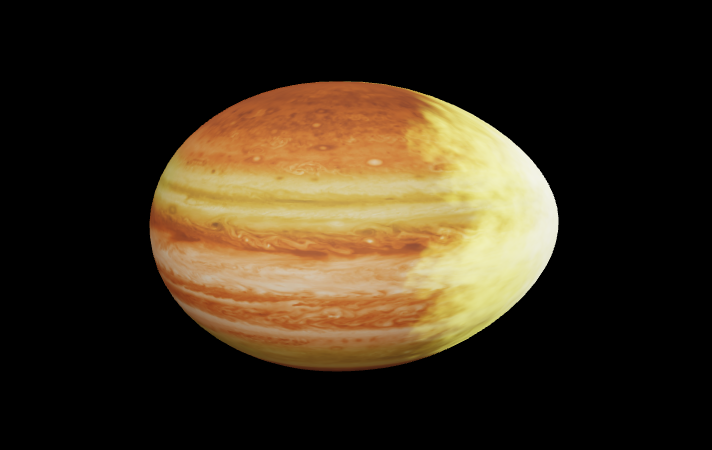
Source : NASA Science
WASP-12b is already deformed beyond recognition. Its day side reaches 2,500°C, hot enough to vaporize iron and titanium. These metals exist as gases in the upper atmosphere, raining down as liquid metal droplets at lower altitudes. The planet appears darker than charcoal due to light-absorbing molecules in its scorching atmosphere.
These unbelievable universe facts document worlds in their death throes, orbital relationships so extreme they result in planetary cannibalism on timescales astronomers can measure within human lifetimes.
Also Read : The Frontier of Space Technology
The unforgettable fact: WASP-12b is being eaten by its star and has less than 10 million years left before it’s completely destroyed, we’re watching a planet die in real-time.
HD 189733b: Where Glass Rain Falls Sideways at 5,400 MPH
This cobalt-blue planet looks deceptively beautiful from a distance. Up close, it’s one of the most hostile worlds ever discovered. Wind speeds on HD 189733b reach 8,700 kilometers per hour, seven times the speed of sound. The atmosphere contains silicon particles that, under the planet’s conditions, condense into glass.
Glass rain forms in the upper atmosphere and falls sideways due to the hypersonic winds, creating horizontal storms of molten silicate shards moving at speeds that would vaporize anything in their path. The day-side temperature reaches 1,200°C while the night side drops to 800°C, creating temperature differentials that drive the apocalyptic wind speeds.
Source : NASA Science
The planet’s blue color doesn’t come from water, it comes from the atmosphere’s silicate particles scattering blue light, the same mechanism that makes Earth’s sky blue but taken to a terrifying extreme. Where Earth has gentle breezes and water rain, HD 189733b has hypersonic winds and glass storms.
The unforgettable fact: Standing on HD 189733b would mean being simultaneously sliced apart by glass shards traveling at 5,400 mph and incinerated by temperatures hot enough to melt lead.
Gliese 436 b: A Planet Covered in Burning Ice
Gliese 436 b violates intuition at a fundamental level. This Neptune-sized planet has a surface covered in water ice, but the ice is burning hot, reaching temperatures of 439°C. The ice doesn’t melt despite being far above water’s boiling point.
This occurs because of the planet’s immense gravitational pressure. The pressure is so extreme, about 20 million times Earth’s atmospheric pressure, that water molecules are crushed together into a solid state called Ice X or “hot ice.” The molecules can’t move freely enough to become liquid or gas despite the intense heat.
Source : NASA Science
The planet’s interior contains more bizarre physics: a dense, super-compressed ice layer surrounds a rocky core, while the upper atmosphere consists of hydrogen and helium. This creates a world where ice burns, water stays solid at temperatures that should vaporize it instantly, and standard phase diagrams cease to apply.
These weirdest things in the universe emerge from extreme conditions that force matter into configurations impossible under Earth-like circumstances. The laws of physics remain the same, but their outcomes become unrecognizable.
The unforgettable fact: Gliese 436 b has ice that stays frozen at 439°C because the pressure is so intense it crushes water into a solid state regardless of temperature, physics creating “impossible” ice.
CoRoT-7b: Where Rock Vaporizes and Rains From the Sky
CoRoT-7b is a rocky planet orbiting so close to its star that its day-side temperature reaches 2,500°C. The surface is molten lava, and the atmosphere consists of vaporized rock. Silicate rock evaporates from the lava oceans, rises into the atmosphere, cools slightly, and falls back to the surface as pebble rain.
The atmosphere contains vaporized quartz, sodium, potassium, and monoxide gases. As these gases cool in the upper atmosphere, they condense into solid particles that rain down as small rocks. The planet essentially has a rock cycle that operates like Earth’s water cycle, evaporation, condensation, precipitation, but with stone instead of water.
The night side of CoRoT-7b reaches only 200°C, creating extreme temperature gradients that drive brutal winds carrying vaporized rock from the day side to the night side, where it condenses and potentially falls as solid rock rain. The planet’s surface is a global lava ocean punctuated by solidified rock islands that melt and reform constantly.
Also Read : Big Ongoing Steps for India Space Centers in Terms of Funding
The unforgettable fact: CoRoT-7b has weather forecasts that include pebble rain, with small rocks precipitating from an atmosphere made of vaporized stone, a rock cycle instead of a water cycle.
Haumea: The Egg-Shaped Dwarf Planet With Rings and Two Moons
Beyond Neptune, in the Kuiper Belt, spins Haumea, a dwarf planet so bizarre its existence challenges planetary formation theories. Haumea rotates once every 3.9 hours, faster than any other known object of comparable size in the solar system. This extreme rotation has deformed it into an ellipsoid shape, stretched like a cosmic egg approximately 2,300 kilometers long but only 1,000 kilometers wide.
The dwarf planet’s rapid spin resulted from a massive collision billions of years ago, an impact so violent it sent fragments flying that became Haumea’s two moons and left the parent body spinning frantically. The surface is almost pure water ice, reflecting 70% of incoming sunlight, giving it one of the brightest surfaces of any object in the solar system.
In 2017, astronomers discovered something unprecedented: Haumea has rings. It’s the only known dwarf planet with rings and the first trans-Neptunian object confirmed to possess them. The ring system orbits at the planet’s Roche limit, suggesting it might be the remnants of an even more recent collision or material slowly being stripped from the planet’s surface by its extreme rotation.
The unforgettable fact: Haumea spins so fast it’s shaped like an egg, has two moons, possesses rings, and its day lasts only 3.9 hours, one of the most dynamically violent dwarf planets in the solar system.
Conclusion: The Universe’s Casual Impossibilities
Diamond rain. Burning ice. Glass storms moving at 5,400 mph. A planet being eaten by its star. These aren’t anomalies, they’re standard astronomical observations that happen to operate under conditions Earth never experiences.
The craziest things in the Universe aren’t crazy because they break physics. They’re crazy because physics, when applied to extreme conditions, produces outcomes that feel fictional but are brutally, documentably real. Every phenomenon described here follows from the same fundamental forces that govern chemistry and planetary formation. The Universe simply operates on scales where familiar rules create unfamiliar results.
What makes these shocking space facts genuinely disturbing isn’t their distance. It’s their normalcy. Right now, somewhere in the galaxy, glass rain falls sideways at hypersonic speeds. Hot ice covers a planet’s surface. Diamond hailstones the size of boulders sink through layers of metallic hydrogen. Entire worlds drift through eternal darkness, unconnected to any solar system.
The Universe doesn’t optimize for human intuition. It simply exists, vast and indifferent, creating conditions so extreme they force matter into configurations that seem impossible until you remember: impossible just means we haven’t experienced it yet on Earth. Out there, in the darkness between stars, impossible is routine.
When the Cosmos Points Beyond Matter
The universe confronts us with diamond rain, burning ice, and worlds dissolving under their own extremes, quietly reminding us how small human certainty really is. When physics stretches intuition to its limits, a deeper question emerges: if creation is this vast and precise, what anchors existence itself? Cosmic wonder naturally bends the mind toward reflection, purpose, and the search for truth beyond matter. Science explains how the universe behaves, but not why awareness longs for meaning within it.
That search finds resonance in spiritual wisdom offered by texts like “Gyan Ganga” and “Way of Living” by Saint Rampal Ji Maharaj, which explore authentic worship, conscious living, and humanity’s relationship with the divine, not as belief, but as disciplined understanding of existence itself.