


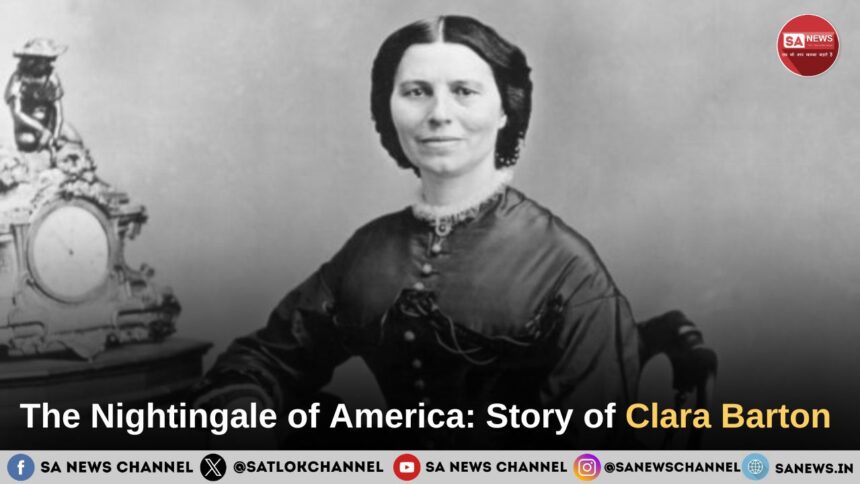
The story of Clara Barton is a perfect tale of indomitable strength, unwavering determination, and pioneering spirit. Born in North Oxford, Massachusetts, in 1821, Clara turned from a shy child into a dedicated nurse and humanitarian who transformed American social justice and healthcare.
- The Early Story of Clara Barton: Foundations of a Humanitarian Life
- Childhood Days of Clara Barton: Nursing Her Brother and Playing with Cousins
- The Story of Clara Barton’s Journey as a Teacher and Advocate for Equality
- The Story of Clara Barton’s Teaching Career: Opening a School and Breaking Boundaries
- The Story of Clara Barton as a Victim of Gender Discrimination
- The Story of Clara Barton : A Courageous Nurse During the Civil War
- The Story of Clara Barton’s Role in Reuniting Families Through the Office of Missing Soldiers
- The Story of Clara Barton and the Founding of the American Red Cross: A Humanitarian Vision
- The Story of Clara Barton’s Expanding Mission: Disaster Relief and International Aid
- The Story of Clara Barton’s Advocacy for Women’s Rights and Social Justice
- Saint Rampal Ji Maharaj Ji’s Annapurna Muhim : The Greatest Humanitarian Deed
Her early life experiences, from nursing her injured brother to laying the foundation of the first free public school in New Jersey, only strengthened her spirit to fight against gender discrimination and adversity. Most important of all was the American Civil War, when Clara earned the title “Angel of the Battlefield.” Delve into the blog to discover how the story of Clara Barton is a powerful example of advocacy, selfless love, and the strength to fight for the suffering and marginalized.
The Early Story of Clara Barton: Foundations of a Humanitarian Life
The story of Clara Barton began with her birth on December 25, 1821, in North Oxford, Massachusetts. Clara Barton was born to Stephen Barton and Sarah Stone Barton. Her father, Stephen Barton, was a captain in the local militia of the Massachusetts town. He shaped Clara’s childhood and instilled in her the qualities of discipline and commitment to duty.
Her mother, Sarah Stone Barton, was a religious woman who taught her daughter the importance of selflessness and dedication to helping others. The story of Clara Barton starts with a shy and timid child who would eventually be inducted into the National Women’s Hall of Fame.
Childhood Days of Clara Barton: Nursing Her Brother and Playing with Cousins
The story of Clara Barton as a humanitarian started back when she was just ten. During this time, Clara’s brother David fell from the barn roof and developed a severe head injury. At such a tender age, Clara took the responsibility of nursing her brother. She would prescribe medications and perform medical treatments like bloodletting using leeches, a prevalent practice during that time. Despite lacking formal education as a nurse, Clara’s caregiving helped her brother to a full recovery within two years. This experience laid the foundation of the nurse in her, which later helped her to form the American Red Cross.
In the early 1830s, Clara Barton’s family shifted from North Oxford to Oxford Village to help the widow of Clara’s cousin manage the farm and her four children. At this time, Clara was a child of nearly twelve years. During this time, Clara enjoyed the company of her brother’s cousins and used to play with them and often go on horseback rides with them. Although she was a shy and timid child to people outside the house, her family and cousins offered Clara the companionship, encouragement, and the opportunity to learn new skills through shared activities.
The Story of Clara Barton’s Journey as a Teacher and Advocate for Equality
Determined to overcome her shyness, Clara, under her family’s guidance, started to teach children to build her confidence. To further refine her skills as a teacher, Clara attended the Clinton Liberal Institute in New York to further improve her knowledge.
The Story of Clara Barton’s Teaching Career: Opening a School and Breaking Boundaries
The story of Clara Barton took a turn in 1852 when she founded the first free public school of the state in New Jersey, Bordentown. Clara faced initial skepticism by the local school board but did not stop and continued her work. In no time, she was able to grow her school from six to 600 students. Clara’s success was recognized in the region but was short-lived. The school committee, who were of the view that the important role of principal was not for women, appointed a male principal for the school, replacing Clara. Clara was given the post of this new male principal’s subordinate and lesser pay.
Disappointed with this gender discrimination, Clara resigned from her teaching job and attained another groundbreaking achievement by becoming the first U.S. woman to hold government clerkship at the U.S. Patent Office. This opened the gateway for other women to work for the federal government and set the stage for Clara’s later humanitarian work.
The Story of Clara Barton as a Victim of Gender Discrimination
The story of Clara Barton is incomplete without the mention of her gender discrimination struggles. During her job in the U.S. Patent Office she faced severe gender discrimination. In 1855 she was demoted to the post of a copyist with lower salary. In 1857, following political reasons including her “Black Republicanism,” she was finally fired from the job.
Also Read: Francis Crick: The Scientist Behind DNA’s Greatest Discovery
Later after Abraham Lincoln’s election, she returned to her job as a temporary copyist in 1860 but faced severe gender discrimination in her job. All these difficulties did not let her spirit down and she continued with her work at the U.S. Patent Office until she devoted herself to nursing during the American Civil War.
The Story of Clara Barton : A Courageous Nurse During the Civil War
The story of Clara Barton found its main destiny amidst the American Civil War when she played the brave and compassionate role of a nurse. When the war started in 1861, Clara started to help the wounded soldiers arriving at Washington, D.C., giving them personal care, food, vital medical supplies, and clothing. She would quickly arrange and distribute bandages, medicines, and other necessities to the soldiers in the war.
Clara worked alongside surgeons and soldiers during the war. At times, she would deliver vital supplies to the front lines in wagons, arriving at times during active battles. Her dedication to helping the soldiers during the war earned her the nickname “Angel of the Battlefield.”
The story of Clara Barton explores how she started to work as a nurse and then later continued to organize field hospitals and her other humanitarian works.
The Story of Clara Barton’s Role in Reuniting Families Through the Office of Missing Soldiers
After witnessing the firsthand grief of the families eager to know about the fate of their loved ones during the Civil War, Clara Barton committed herself to the cause of reuniting families. In 1865, she opened the Office of Missing Soldiers in Washington, D.C. She worked day and night and answered over 63,000 letters from families desperate to know about the missing Union soldiers.
Clara Barton’s team was successful in identifying 22,000 missing soldiers and provided families with reunion or closure. Through their publication of the “Rolls of the Missing Men,” her office kept the hope of many families alive. Clara’s compassion towards the soldiers and the families post-war solidified her image and proved to be an emotional part of the story of Clara Barton.
The Story of Clara Barton and the Founding of the American Red Cross: A Humanitarian Vision
Clara Barton finally closed the Office of the Missing Soldiers in 1868 on the recommendation of her physician to look after her deteriorating health. Later, she traveled to Europe to take care of her health.
In 1870, during the Franco-Prussian War, Clara Barton volunteered with the International Red Cross in Europe. There, she attained invaluable experience in hospital organization and wartime relief. She also earned a Prussian Iron Cross, which was a rare honor for a non-combatant and woman.
Upon arriving in the U.S. in 1873, Clara Barton began advocating for the establishment of the American branch of the Red Cross. She spent years attaining public support and urging the U.S. government. This finally led to the formation of the American Red Cross in 1881, which, under her leadership, attained a Congressional Charter in 1882.
The Story of Clara Barton’s Expanding Mission: Disaster Relief and International Aid
Under her leadership, the American Red Cross did major humanitarian work, including responding to the Michigan forest fires in 1881, the Mississippi River floods of 1882, and numerous tornadoes in the South. The American Red Cross responded by providing medical care, shelters, and supplies to the people affected by the devastating Johnstown Flood in 1889, where more than 2,000 lost their lives.
The American Red Cross also worked at an international level by providing aid to famine-struck Russia, Armenia, and Turkey, and aided the victims of hurricanes in Texas and South Carolina. Not only this, the American Red Cross also helped the soldiers of both sides during the Spanish-American War, writing the legacy of helping mankind at a broader level and breaking the prevalent boundaries.
The Story of Clara Barton’s Advocacy for Women’s Rights and Social Justice
The story of Clara Barton includes her pivotal role in supporting women during the women’s suffrage movement and civil rights. With leaders like Susan B. Anthony and Elizabeth Cady Stanton, Clara Barton raised her voice for women’s personal rights and liberties, only solidifying her commitment to social justice. This story of Clara Barton is not only of a woman of humanitarianism but a woman of advocacy, selfless love for the people, and suffering for those in pain.
Saint Rampal Ji Maharaj Ji’s Annapurna Muhim : The Greatest Humanitarian Deed
Saint Rampal Ji Maharaj has emphasized true equality in spiritual practice by giving women the same rights and dignity in bhakti as men. His teachings highlight that all souls are equal, and therefore no discrimination can exist in the path of devotion.
Through His simple yet powerful spiritual knowledge, He has encouraged society to move away from harmful practices such as female foeticide, dowry, and gender-based injustice. By promoting a Satya Bhakti, and value system rooted in compassion, respect, and truthful devotion, Saint Rampal Ji Maharaj has helped many followers adopt a more humane and progressive way of life. One can witness the kind acts of saint rampal ji maharaj at the beginning of Satyug in Kalyug. For more details visit www.jagatgururampalji.org.