


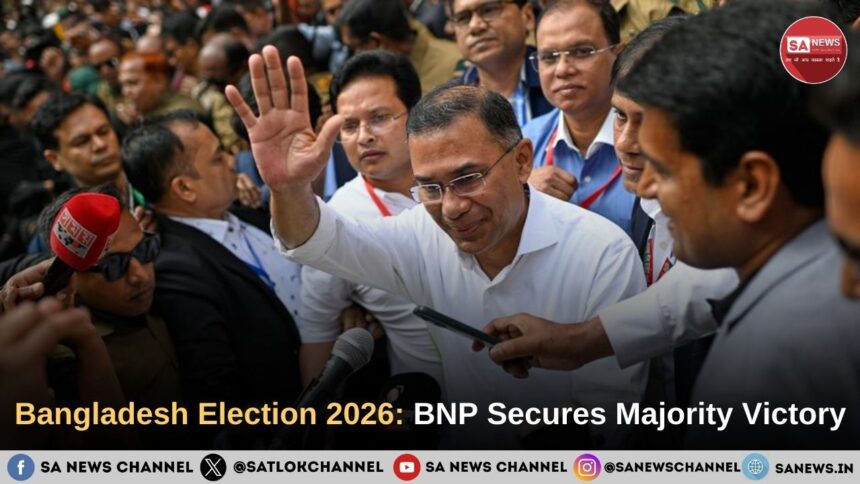
Bangladesh’s parliamentary election – held on February 12, 2026, with counting continuing into February 13 – has produced a decisive outcome: the Bangladesh Nationalist Party (BNP) has crossed the simple-majority threshold in the 300-seat legislature, with 151 seats reported in local media tallies carried by international outlets.
The vote is being widely framed as a turning point because it is the first national election since the 2024 political upheaval that ended the previous government’s rule and triggered a turbulent transition.
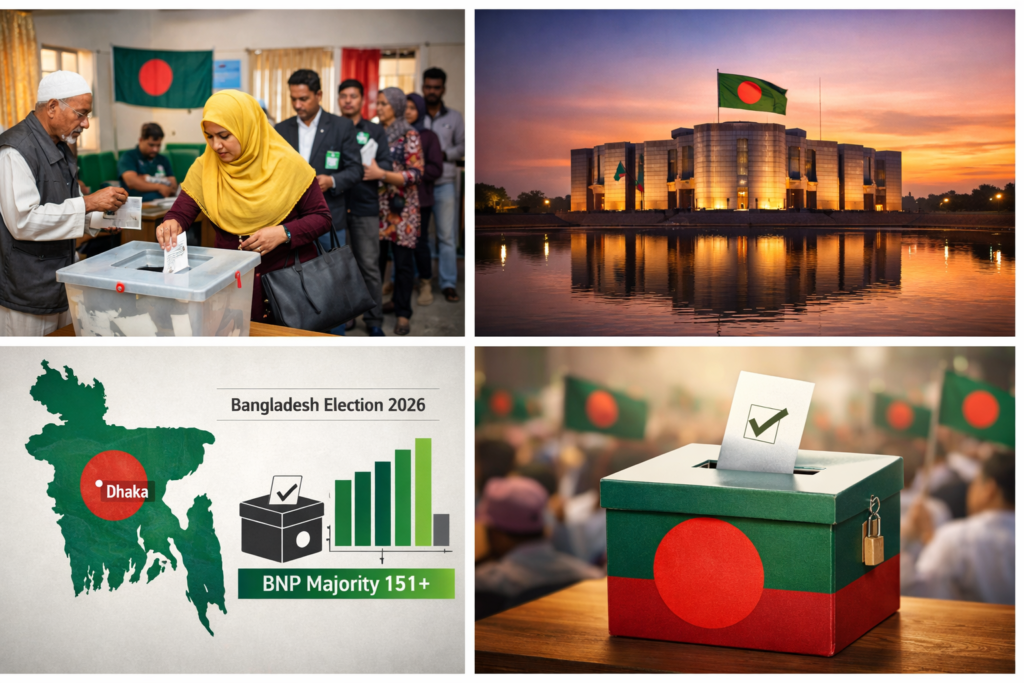
Result snapshot
Majority mark reached: BNP reported at 151 seats in the 300-member Jatiya Sangsad (151 is the minimum for a simple majority).
Who leads BNP: Tarique Rahman is positioned as the central political figure of the party’s post-election leadership push.
Official announcement timing: Some outlets noted that full official results were expected after counting, even as parties claimed victory based on tallies.
Why this election matters
1) First national vote after a major rupture (2024)
This is the first nationwide parliamentary election since mass protests in 2024 pushed former Prime Minister Sheikh Hasina out of power; AP reports she went into exile in India.
2) A legitimacy stress-test
The interim administration led by Muhammad Yunus emphasized credibility and transparency, with international observers present (including delegations linked to the European Union and the Commonwealth, per AP).
3) The “who comes second” question
AP describes BNP’s main challenger as an 11-party alliance led by Jamaat-e-Islami, and notes concerns among some groups – particularly women and minorities – about the growing influence of Islamist politics since 2024.
What happened on voting day
Turnout and scale
More than 127 million people were eligible to vote, including roughly 5 million first-time voters, according to AP’s election-by-the-numbers brief.
By 2 p.m., the Election Commission cited 47%+ turnout (AP).
Polling took place across tens of thousands of stations with large-scale security deployment (AP).
Security incidents
While voting was described as largely peaceful in many areas, there were reported incidents including crude-bomb attacks at polling centers in at least two locations, according to The Times of India report citing officials and local accounts.
Immediate reactions and fault lines
Claims of a “new chapter”: AP reports that Yunus framed the day as a historic milestone and described it in celebratory terms.
Pushback from excluded forces: AP also reports that the Awami League – barred from participating – rejected the election as illegitimate.
As Competing narratives: Even with a majority figure circulating (151 seats), some coverage emphasized that official results were still being finalized or awaited as counting proceeded.
What India and the region will watch next
Even when a parliamentary majority is clear, the bigger regional question is governance stability: whether the next government can quickly restore predictable institutions, reduce street-level volatility, and avoid a slide into polarizing identity politics. AP flags recent turbulence including mob violence and community tensions in the broader transition period – signals that foreign partners will watch closely.
For India in particular, the near-term focus typically lands on:
- Border stability and security coordination
- Trade and transit continuity
- Protection of minorities and internal law-and-order (often a proxy for overall stability)
What happens next
Here are the near-term milestones to track:
- Final official seat-by-seat certification by the election authority (timing highlighted as imminent in some coverage).
- Government formation and leadership signaling – particularly cabinet direction and security posture in the first 30–60 days.
- Reform pathway: AP reports that a referendum on reform proposals was held alongside the election, with the idea that a newly elected parliament could pursue constitutional changes via a reform council.
Values Lens, Not Politics
No matter who wins an election, a society’s real progress is not decided by political victory alone – it is decided by truthfulness in public life, justice, compassion, restraint, and safety for ordinary people. True spiritual knowledge, as taught by Enlightened Sant Rampal Ji Maharaj, repeatedly emphasizes that ego, hatred, violence, deception, and showmanship weaken society from within, while ethical conduct and social reform create durable peace.
From this values lens, the most important questions after any political transition are simple and human:
- Are citizens becoming fearless and secure in daily life?
- Is justice equal and timely for everyone?
- Are women, the poor, and minorities safer and more respected?
- Is society moving toward harmony, discipline, and service, instead of provocation and division?
The purpose of power should be public welfare and service, not dominance – and the responsibility of citizens is to rise above rumors and hatred, and choose peace, truth, and constructive social work.
Watch Sant Rampal Ji Maharaj’s Satgyan on social media:
- Facebook: Spiritual Leader Saint Rampal Ji Maharaj
- YouTube: Sant Rampal Ji Maharaj
- Twitter/X: @SaintRampalJiM
FAQs: BNP Wins Majority In Bangladesh
1) What does “BNP wins majority” mean in seat terms?
In Bangladesh’s 300 directly elected seats, 151 is the simple-majority threshold. BNP reaching 151 means it can form a government without needing a coalition partner for the bare majority.
2) Who is expected to lead the next government?
Reporting describes Khaleda Zia’s son, Tarique Rahman, as a key figure likely to shape leadership, as BNP is projected to form the next government.
3) Was the election considered peaceful?
AP described voting as largely peaceful in many places, but there were also reported violent incidents, including crude-bomb attacks at polling stations in separate locations.
4) Why is this election being called “historic”?
It is the first national election since the 2024 upheaval that removed the prior government, and it’s being treated as a test of whether Bangladesh can return to stable democratic governance.
5) What role did international observers play?
AP reports that hundreds of international observers and foreign journalists were present, including delegations linked to the EU and the Commonwealth, as part of a credibility push.