



Artificial intelligence is no longer a distant vision of the future. It writes content, supports medical research, powers customer services, and influences decisions that affect millions of people. Yet, as AI becomes more powerful, an important question emerges: who ensures that these machines operate responsibly? Governments and international organisations are responding by developing rules, treaties, and ethical frameworks for artificial intelligence.
- Why Does the World Need International AI Ethics Treaties?
- The First International Legally Binding AI Treaty
- What makes this treaty different?
- Does the treaty apply to every AI system?
- The EU AI Act: Turning AI Ethics into Practical Rules
- How does the risk-based approach work?
- 1. Prohibited AI practices
- 2. High-risk AI systems
- 3. Transparency requirements
- 4. General-purpose AI models
- What is the EU AI Act timeline?
- UNESCO’s AI Ethics Framework: A Global Foundation
- The United Nations and the Search for Global AI Governance
- The Biggest Challenges Facing International AI Regulation
- 1. Different countries have different priorities
- 2. AI technology moves faster than legislation
- 3. Who is responsible when AI causes harm?
- 4. The digital divide could become a fairness problem
- What Does Responsible AI Mean for Ordinary People?
- The Future of AI Ethics Treaties: What Comes Next?
- The Spiritual Soul of Technology
- FAQ on AI Ethics
One major milestone is the Council of Europe Framework Convention on Artificial Intelligence, opened for signature in September 2024. This article explores international AI ethics treaties, their real-world impact, recent developments, and why human values must guide technological progress.
Why Does the World Need International AI Ethics Treaties?
Imagine applying for a job and being rejected by an automated system without knowing why?Imagine a fake video of a public leader spreading across social media, influencing public opinion before anyone can verify whether it is real. Or imagine a hospital using an AI system that produces inaccurate recommendations for patients.
These are not simply technological problems. They raise questions about fairness, responsibility, privacy, safety, and human rights.Artificial intelligence offers enormous benefits. It can help doctors analyse medical information, assist teachers in personalising lessons, improve disaster forecasting, and make public services more accessible. However, poorly designed or misused AI can also reinforce discrimination, spread misinformation, expose private information, and concentrate power in the hands of a few organisations.
This is why international AI ethics treaties matter. They provide a foundation for countries to cooperate on shared principles and responsibilities rather than relying entirely on disconnected national rules.The goal is not to stop technological progress. It is to make sure that innovation respects people, protects democratic institutions, and delivers benefits without creating unacceptable harm.
Also Read: The Death of Privacy: Does AI Know You Better Than You Know Yourself?
The First International Legally Binding AI Treaty
One of the most significant milestones in global AI governance is the Council of Europe Framework Convention on Artificial Intelligence and Human Rights, Democracy and the Rule of Law.Opened for signature in Vilnius, Lithuania, on 5 September 2024, it is the first international legally binding treaty specifically focused on AI and its relationship with human rights, democracy, and the rule of law.
The Convention aims to ensure that activities throughout the AI lifecycle remain consistent with fundamental rights while allowing technological progress and innovation.
What makes this treaty different?
Unlike voluntary ethical guidelines, a legally binding treaty creates international legal obligations for countries that become parties to it, subject to its terms and implementation arrangements.Its approach is also technology-neutral. Instead of attempting to regulate only one AI model or product, it establishes principles that can remain relevant as technology changes.
The Convention addresses several core areas:
Human dignity and autonomy: AI should
respect people’s ability to make meaningful choices.
Equality and non-discrimination: Systems should not unfairly disadvantage individuals or communities.
Privacy and data protection: Personal information must receive appropriate safeguards.
Transparency and oversight: AI decisions and uses should be subject to meaningful scrutiny.
Accountability: Responsibility for AI-related decisions and harms must not disappear behind automated systems.
Reliability and safe innovation: AI should be developed and used with appropriate attention to safety and risks.
Does the treaty apply to every AI system?
Not in exactly the same way.The Convention covers activities involving AI within its scope, including public authorities and private actors, while providing certain distinctions and exceptions. For private-sector activities, it allows parties different approaches to meeting the Convention’s requirements, subject to their international obligations.
It is therefore important not to interpret the Convention as a universal ban on AI or as a single identical compliance checklist for every company.Its central purpose is to establish a shared human-rights-based foundation for AI governance.
The EU AI Act: Turning AI Ethics into Practical Rules
International treaties are only part of the story. Regional legislation can translate broad ethical commitments into more detailed requirements for developers, businesses, and public authorities.
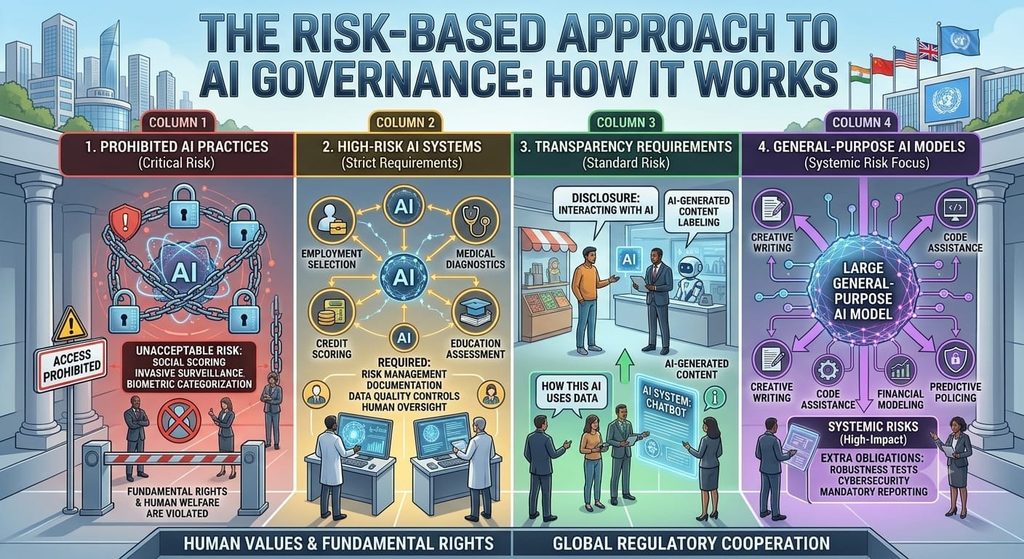
The European Union AI Act is an important example.The Act entered into force on 1 August 2024 and introduced a risk-based approach to AI regulation. Rather than treating every AI application as equally dangerous, it distinguishes between different uses and levels of risk.
How does the risk-based approach work?
1. Prohibited AI practices
Certain AI practices are prohibited because of the risks they pose to fundamental rights and human welfare, subject to the law’s precise definitions and exceptions.
2. High-risk AI systems
Some systems used in areas such as employment, education, essential services, and other sensitive settings face additional requirements. Depending on the application, these can include risk management, documentation, human oversight, and
data-quality controls.
3. Transparency requirements
People should receive relevant information in certain circumstances, including when interacting with AI or encountering AI-generated content covered by applicable rules.
4. General-purpose AI models
The legislation also establishes obligations for providers of general-purpose AI models, with additional requirements for models presenting systemic risks.The details matter because the same underlying technology can be used for a low-impact creative task or a high-impact decision affecting someone’s livelihood.
What is the EU AI Act timeline?
As of 29 October 2026, the EU’s published implementation timeline identifies 2 August 2026 as a major milestone when most of the Act’s remaining provisions begin to apply, subject to specific exceptions and transitional arrangements.The Commission’s timeline also identifies 2 December 2027 for certain additional prohibitions and transition requirements, and 2 August 2028 for the application of rules covering AI embedded in regulated physical products. High-risk AI rules are subject to the applicable sector-specific dates and any legally adopted amendments.
This distinction is important: announcing a law, bringing it into force, applying its provisions, and enforcing those provisions are separate stages.For companies, the lesson is clear. AI compliance is not something to consider only after a product launches. It should be integrated into product design, data management, testing, deployment, and monitoring.
UNESCO’s AI Ethics Framework: A Global Foundation
Not every important international AI initiative is a legally binding treaty.The UNESCO Recommendation on the Ethics of Artificial Intelligence, adopted in November 2021, provides a global ethical framework that complements legal regulation. It was adopted by UNESCO’s 193 Member States, establishing a widely shared reference point for responsible AI. The framework considers AI’s impact on human rights, education, gender equality, social justice, cultural diversity, the environment, and human well-being.Its importance lies in recognising that AI ethics cannot be reduced to technical accuracy alone.
A system might produce fast and consistent results yet still be unfair if its training data excludes certain groups. A chatbot might be useful but harmful if it encourages users to share sensitive personal information without understanding the consequences. An automated service might save money but leave people unable to appeal an incorrect decision.UNESCO’s approach encourages countries and institutions to examine such questions before problems become widespread.Its recommendation is not itself a binding international treaty. Instead, it serves as a normative framework for policy development, institutional practice, and international cooperation.
Also Read: Artificial Intelligence in Healthcare: Can AI Be Trusted with Our Health?
The United Nations and the Search for Global AI Governance
The United Nations has also been building a more inclusive approach to AI governance.
The Global Digital Compact, adopted in September 2024 as part of the Pact for the Future, sets out commitments to international digital cooperation, human rights, safer digital spaces, and AI governance. It was negotiated by all 193 UN Member States. The broader challenge is straightforward: countries have different levels of technological capacity, different legal systems, and different priorities. A global approach must recognise these differences without abandoning common protections.
The UN’s scientific panel and global dialogue
Two important developments followed in 2025.
First, the UN General Assembly established an Independent International Scientific Panel on AI in August 2025. Its purpose is to strengthen the evidence available to policymakers about AI’s opportunities, risks, and impacts.
Second, the General Assembly established the Global Dialogue on AI Governance through Resolution A/RES/79/325, adopted on 26 August 2025. The dialogue is designed to bring governments together with relevant stakeholders, including researchers, businesses, civil society, and technical experts.
These initiatives are significant because global AI policy needs more than political declarations. It also needs independent evidence, practical cooperation, and participation from countries that may otherwise have limited influence over technological decisions.The UN’s work complements other initiatives rather than replacing national regulators or existing treaties.
The Biggest Challenges Facing International AI Regulation
Despite these developments, creating international AI rules is only the beginning. The real challenge is making them work across different countries, industries, and technologies.
1. Different countries have different priorities
Some governments prioritise national security and economic competitiveness. Others focus heavily on privacy, civil liberties, or consumer protection. Developing countries may also be concerned about gaining access to computing infrastructure, training, funding, and skilled workers.A successful international framework must balance these priorities without allowing basic human rights to become optional.
2. AI technology moves faster than legislation
A law may take years to negotiate, adopt, and implement. Meanwhile, AI models can change significantly in a matter of months.
Rules that focus on a particular product or technical feature may become outdated quickly. This is one reason why international frameworks often combine broad principles with more specific, adaptable requirements.
3. Who is responsible when AI causes harm?
Consider an AI recruitment system that unfairly rejects qualified applicants. The model developer, the company using the system, the data provider, and the organisation that configured the software may all have played a role.Clear accountability is essential. People affected by automated decisions need meaningful ways to question errors, seek explanations where applicable, and access appropriate remedies.
4. The digital divide could become a fairness problem
Countries with advanced computing infrastructure and substantial investment can develop sophisticated AI systems more easily than countries with fewer resources.If international AI governance focuses only on restrictions, it may overlook the need to share expertise, build local capacity, and improve access to useful technology.Ethical AI governance should therefore address both preventing harm and distributing benefits more fairly.
What Does Responsible AI Mean for Ordinary People?
International treaties can sound distant from everyday life, but their principles affect decisions that people encounter regularly.
When a bank uses an automated system to assess a loan application, fairness and accountability matter. When a school introduces AI-powered learning tools, student privacy and educational quality matter. When a social media platform recommends content, transparency and the spread of misinformation matter.
Here are five practical ways to approach AI responsibly.
- Check important information. AI-generated answers can contain errors, even when they sound convincing.
- Protect personal data
Avoid sharing passwords, financial information, confidential documents, or other sensitive details with AI services unless you understand the service’s protections and have a legitimate reason.
- Question consequential decisions
Where applicable, ask whether a decision was automated and what review or appeal options are available.
Verify images and videos. Look for trustworthy reporting and original sources before sharing content that could mislead others.
- Support accountability
Encourage organisations to explain how they use AI, assess risks, protect privacy, and provide appropriate human oversight.
These actions cannot replace government regulation. However, they help create a culture in which responsible technology is expected rather than treated as an optional extra.
The Future of AI Ethics Treaties: What Comes Next?
The future of international AI governance will depend on whether shared principles become practical safeguards.
First, countries will need to implement their existing commitments through domestic laws, institutional procedures, and effective oversight. A treaty cannot protect people simply because its language is ambitious; the relevant obligations must be put into practice.
Second, governments will need to cooperate on cross-border challenges. AI-generated fraud, impersonation, misinformation, and certain forms of cybercrime can affect people in multiple jurisdictions. Information-sharing and compatible legal approaches can make responses more effective.
Third, the international community will need better ways to evaluate increasingly capable AI systems. Independent research, risk assessments, incident reporting, and technical standards can help regulators understand emerging problems without relying entirely on claims made by developers.
Finally, the public must have a voice. Students, workers, teachers, researchers, consumers, and communities affected by automated decisions should be included in discussions about how AI is designed and used.The most effective framework will not necessarily be the one with the longest list of rules. It will be the one that protects people in practice, adapts to technological change, supports beneficial innovation, and makes it possible to hold the right parties accountable.
The central question is no longer simply what AI can do. It is what AI should do, who should decide, and how society can ensure that those decisions remain responsible.
The Spiritual Soul of Technology
While international treaties establish legal penalties and regulatory oversight, law alone cannot eliminate greed, bias, or loopholes. True governance of technology requires inner moral transformation through Satgyaan, the spiritual teachings of Sant Rampal Ji Maharaj.
Sant Rampal Ji Maharaj teaches that technology is a neutral medium granted by Supreme God Kabir. Its moral character reflects the builder’s inner state. Guided by the principle—”Jeev Hamari Jaati Hai, Manav Dharm Hamara” (Humanity is our religion, all living beings are our family)—developers grounded in Satgyaan create algorithms free of bias. Ultimately, treaties provide external rules, but spiritual wisdom provides the internal conscience ensuring AI serves universal peace and human welfare.
FAQ on AI Ethics
1. What is the first international AI ethics treaty?
The Council of Europe Framework Convention on Artificial Intelligence and Human Rights, Democracy and the Rule of Law is the first international legally binding treaty specifically addressing AI in relation to human rights, democracy, and the rule of law. It was opened for signature on 5 September 2024.
2. What is the purpose of international AI governance?
International AI governance aims to ensure that artificial intelligence is developed and used responsibly. It promotes cooperation between countries, protects human rights, addresses AI-related risks, and encourages transparency, accountability, and safe innovation.
3. Is the EU AI Act an international treaty?
No. The EU AI Act is a regional regulation of the European Union, not an international treaty. It establishes legal requirements for AI systems within its scope, using a risk-based approach. The Council of Europe’s AI Convention is a separate international legal instrument.
4. How do AI ethics treaties protect human rights?
Depending on the applicable instrument, protections can include requirements or commitments relating to privacy, equality, transparency, human oversight, risk assessment, and accountability. The Council of Europe’s AI Convention also addresses safeguards and avenues for challenging certain AI-related decisions.
5. What is the future of responsible AI and global AI regulation?
The future will depend on how effectively countries implement legal commitments, cooperate across borders, and respond to emerging AI risks. International scientific cooperation, public participation, technical safety measures, and clear accountability will be important to ensuring that AI benefits society.