

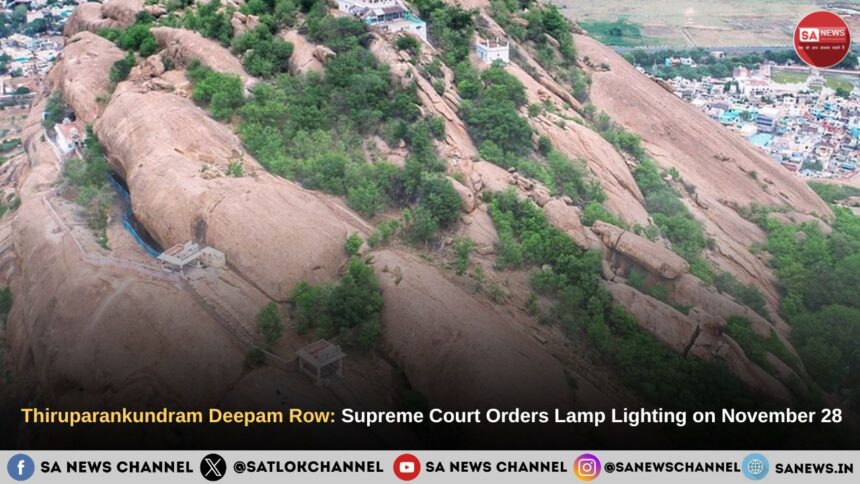
India’s Supreme Court has reacted firmly to the Thirupparankundram Karthigai Deepam dispute. It has instructed that the Deepathoon should be lit on Saturday, November 28 and has even served contempt notices to Tamil Nadu officials and temple authorities, stating that it believes they have not complied with previous court orders.
Following the November 24 incident, the Deepathoon was not lit even though the SC had previously approved that the Deepathoon should be lit. The court was highly concerned about this apparent non-compliance and stressed that government bodies and organisations are expected to comply with judicial decisions.
Thiruparankundram Deepam Row: Key Highlights
1. Supreme Court Allows Devotees to Light Deepathoon Under Security
2. SC Seeks Explanation from Tamil Nadu Officials Over Alleged Violation of Judicial Orders
3. SC Disbands Thiruparankundram Temple Board, Appoints Two Former Judges as Receivers
4. Thiruparankundram Deepam Controversy Escalates After Supreme Court Order Goes Unimplemented
5. Supreme Court Slams Tamil Nadu Authorities Over Judicial Order Violation, Warns of Contempt Proceedings
6. Supreme Court Order, November 28 Lighting and Contempt Proceedings Ahead
SC orders Deepathoon to be lit
A two judge bench, consisting of Justices Aravind Kumar and Vipul M. Pancholi, has instructed that Deepathoon must be lit on November 28. If the Deepathoon flame lit at Uchipillaiyar Mandapam is still alight, this can be utilised, although different provisions can also be put in place.
Furthermore, the SC instructed that devotees are allowed to light the Deepathoon lamp but must do so from a minimum radius of 50 metres away from the Sikandar Badusha Dargah. Both the temple and Dargah were also to be provided with security so that there is no law and order problem.
Central Reserve Police Force (CRPF) personnel have been instructed to offer security for both the temple and Dargah.

Contempt notices serve officials
After considering that there had apparently been non-compliance with previous judicial orders, the SC has served show cause notices to various Tamil Nadu officials and temple authorities. These officials and authorities have been asked to state why contempt action should not be taken against them.
Those identified in the notices are:
Tamil Nadu Chief Secretary
Director General of Police (DGP), Tamil Nadu
Secretary and Commissioner, Hindu Religious and Charitable Endowments Department
Madurai District Collector
Madurai Superintendent of Police
Temple Executive Officer
Board of Trustees of the temple – chairman and members.
The SC has also told the Tamil Nadu Chief Secretary to file an affidavit providing information about the sequence of events and details of correspondence between officials – such as emails – relating to how the SC’s order has been handled.
Temple board removed; ex-High Court judges named as Receivers
In separate news, the Supreme Court has disbanded the Arulmigu Subramania Swamy Temple’s Board of Trustees. It has also named retired Madras High Court judges, Justice S. Vaidyanathan and Justice V. Parthiban, as receivers for the temple. These individuals will manage the temple and ensure that the SC’s orders are followed.
Separately, the SC has lifted its previous interim order which had accepted the Madras High Court’s conclusions regarding the Deepathoon. However, the SC has continued to impose protective measures for the adjacent Dargah.
Why the Thiruparankundram Deepam dispute intensified
The dispute worsened following the SC’s November 20 decision which allowed the Deepathoon on Thiruparankundram hill to be lit for the Karthigai Deepam on a temporary basis. The Madurai District Collector was responsible for overseeing the Deepathoon lighting and ensuring compliance with the court’s decision.
Nevertheless, on November 24, the Deepathoon was not lit. Instead, the lamp was lit at the usual site close to the Uchipillaiyar Mandapam. The temple authorities stated that they adhered to traditional practice. The State government, however, argued that the temple management had not worked with officials to ensure SC decisions were complied with.
As the Deepathoon was not lit at the place stipulated in the SC’s previous order, contempt petitions were then presented to the SC. They claimed that officials and temple authorities had willfully failed to follow the court’s orders.
SC admonishes non-compliance with judicial orders
The SC was highly irritated by recent events and commented that there appeared to be poor administration, especially in Madurai district. The judges made it clear that bodies and people are not entitled to choose whether or not to comply with judicial orders.
The SC stressed that state governments, along with legal bodies, are all bound by judicial orders. Deliberate non-compliance can affect the constitutional structure and the rule of law, it warned.
It was also noted that the actions and influence of political leaders and officials would need to be analysed within the contempt process. The SC’s most recent orders are designed to enforce compliance and to ensure security is in place so that there is no friction between the two faiths.

What Happens Next?
As per the SC’s most recent order, Deepathoon will be lit on November 28. Authorities are expected to adhere to the security provisions outlined by the court including the deployment of CRPF personnel to secure both the temple and Dargah.
Meanwhile, contempt action against the aforementioned officials and temple authorities will progress. The SC will analyse the responses given by these parties along with details of the background to the past non-compliance with its orders.
Overall, the most recent occurrences have transformed the Thiruparankundram Deepam dispute into a major legal and administrative issue. Once again, the SC has stressed that the rule of law and compliance with judicial orders must be strictly adhered to.