


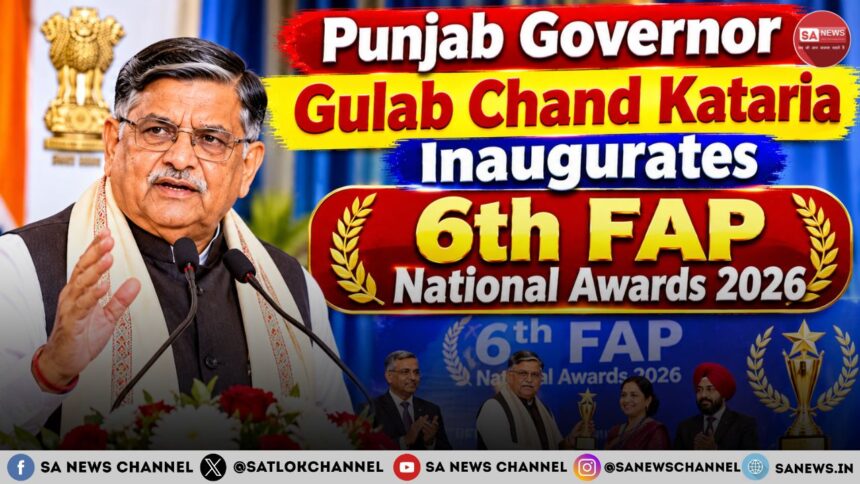
CHANDIGARH, November 27, 2026: Punjab Governor and UT Chandigarh Administrator Gulab Chand Kataria on Friday inaugurated the two-day 6th edition of the FAP National Awards 2026 at Chandigarh University. Organised by Chandigarh University in collaboration with the Federation of Private Schools and Associations of Punjab (FAP), the prestigious national-level event aims to recognise and celebrate the significant contributions of private schools, principals, teachers and students to the fields of education, sports and culture.
- Distinguished Dignitaries Grace the National-Level Ceremony
- 761 Awards Presented to Education and Sports Achievers on Day One
- Governor Kataria Calls for Mass Movement Against Drug Menace in Punjab
- Public and Private Schools Must Work Together, Says Kataria
- Sandhu and Dhuri Highlight Contribution of Private Schools to Nation-Building
- Day Two to Feature 764 Pride of School Awards for Principals
The ceremony witnessed the participation of prominent political figures, military leaders, academicians and personalities from the Punjabi entertainment industry. A total of 761 awards out of the 1,525 awards scheduled for the two-day event were presented on the inaugural day, honouring outstanding educational institutions, teaching professionals, students and non-teaching staff from across the country.
Distinguished Dignitaries Grace the National-Level Ceremony
The inauguration was attended by several eminent personalities, including Rajya Sabha Member of Parliament and Chandigarh University Chancellor Satnam Singh Sandhu, former Northern Army Commander Lieutenant General (Retd.) Deependra Singh Hooda, who attended as the Guest of Honour, and renowned Punjabi writer, singer and actor Happy Raikoti.
Other distinguished attendees included Chandigarh University Vice-Chancellor Prof. (Dr.) SS Sehgal and Federation of Private Schools and Associations of Punjab President Dr Jagjit Singh Dhuri.
The presence of these dignitaries underscored the importance of recognising the contribution of private educational institutions to India’s academic ecosystem and their role in nurturing future generations.
761 Awards Presented to Education and Sports Achievers on Day One
The first day of the FAP National Awards 2026 saw 761 awardees being recognised from more than 1,157 schools across 19 states and Union Territories.
The participating regions included Punjab, Haryana, Himachal Pradesh, Delhi, Chhattisgarh, Jammu and Kashmir, Madhya Pradesh, Kerala, Odisha, Rajasthan, Uttar Pradesh, Chandigarh, Assam, Bihar, Jharkhand, Sikkim, Uttarakhand, West Bengal and Nagaland.
The awards were distributed across multiple categories, acknowledging excellence in academic performance, sporting achievements, institutional leadership and dedicated service in the education sector.
Among the major recognitions, Lifetime Achievement Awards were conferred upon 15 school principals and 15 teachers in recognition of their long-standing contributions and dedicated service to education.
In the Best School Awards (Academics) category, 50 top-performing schools were recognised for having the highest proportion of students securing 97 per cent or above marks in the Class 10 and Class 12 board examinations.
Similarly, the Best School Awards (Sports) honoured 52 schools whose students had secured first positions at the state level or won medals at national-level sporting competitions.
622 Students Receive Pride of India Awards for Academic and Sporting Excellence
One of the major highlights of the inaugural day was the recognition of students under the Best Student (Pride of India) category.
A total of 254 students were honoured for academic excellence, having secured 97 per cent or above marks, while another 368 students received recognition for winning medals at national-level sporting competitions.
Together, 622 students were recognised for bringing distinction to their respective institutions through outstanding academic and sporting performances.
In addition, seven Appreciation Awards were presented to non-teaching staff members for their contributions and support in ensuring the effective functioning of educational institutions.
The awards highlighted the importance of recognising not only academic leadership and student achievements but also the collective efforts of the entire school ecosystem.
Governor Kataria Calls for Mass Movement Against Drug Menace in Punjab
Addressing the gathering, Governor Gulab Chand Kataria identified drug abuse as Punjab’s biggest challenge, particularly because of its adverse impact on the state’s youth.
Emphasising the crucial role of educators in shaping young minds, he said teachers were best positioned to guide students towards the right path and protect them from social evils, including drug addiction.
He called for the fight against drugs to evolve into a mass movement, stressing that collective participation and sustained efforts were essential to address the growing challenge.
His remarks placed the responsibility of social transformation alongside the conventional role of educational institutions, highlighting how teachers can contribute to building a healthier and more responsible society.
Public and Private Schools Must Work Together, Says Kataria
The Governor also highlighted the complementary roles played by government and private educational institutions in strengthening India’s education system.
Pointing out that approximately 52 per cent of students in Punjab are enrolled in private schools, he underlined the significant contribution of privately managed institutions to the state’s educational landscape.
He stressed that public and private schools must work in coordination to ensure quality education and expand opportunities for students.
Referring to the National Education Policy (NEP) 2020, Kataria emphasised its importance in transforming India’s education system and helping the country regain its position as a global education hub.
He also invoked India’s historic educational legacy, referring to renowned ancient centres of learning such as Nalanda and Takshashila, and highlighted the need to revive the country’s reputation as a centre of knowledge and academic excellence.
Connecting education with the country’s long-term development vision, he said quality education would remain a critical pillar in achieving the goal of Viksit Bharat by 2047.
Sandhu and Dhuri Highlight Contribution of Private Schools to Nation-Building
Chandigarh University Chancellor and Rajya Sabha MP Satnam Singh Sandhu and FAP President Dr Jagjit Singh Dhuri also emphasised the indispensable role of private schools and teachers in strengthening the country’s education sector.
Both highlighted how private educational institutions contribute to skill development, academic excellence and the overall progress of the nation.
They stressed that principals, teachers and educational institutions play a significant role in preparing students for future challenges and nurturing capable individuals who can contribute meaningfully to national development.
They also underlined the need to appropriately recognise the contributions of private schools and their educators, noting that such recognition provides encouragement to those working towards improving educational standards.
Day Two to Feature 764 Pride of School Awards for Principals
The second and concluding day of the FAP National Awards 2026, scheduled for November 28, will feature the presentation of the remaining 764 awards under the Pride of School category.
The awards will recognise school principals for their leadership and contributions to the development of educational institutions.
With 1,525 awards being presented across the two-day national event, the sixth edition of the FAP National Awards seeks to provide a prominent platform for acknowledging excellence across India’s private education sector.
The initiative also reflects the growing importance of recognising the collective contributions of school managements, teachers, students and support staff in strengthening the country’s educational framework.
By bringing together representatives from more than 1,157 schools across 19 states and Union Territories, the event has emerged as a significant national-level platform for celebrating academic distinction, sporting achievements and institutional leadership.
The ceremony’s broader message centred on the idea that quality education, empowered teachers and the recognition of institutional contributions are essential not only for individual achievement but also for social transformation and India’s journey towards becoming a developed nation by 2047.