


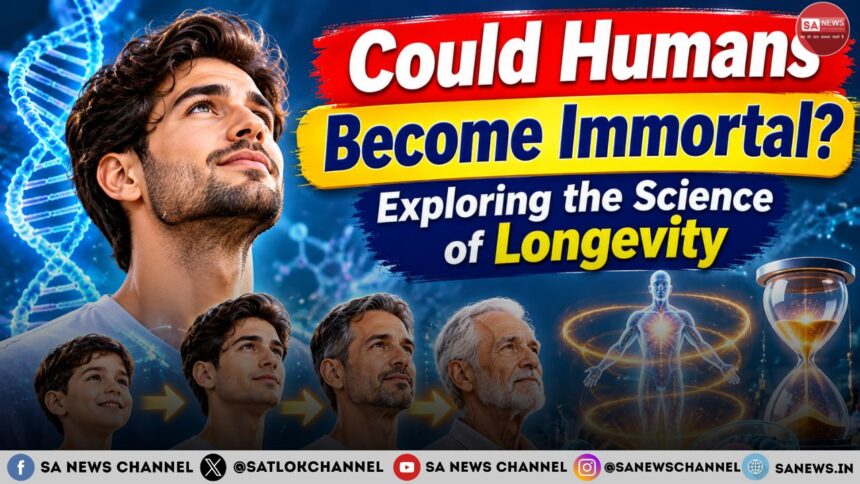
For centuries, humans have dreamed of overcoming aging and extending life indefinitely. Ancient stories, philosophical traditions and early medical practices often imagined a substance or method capable of granting eternal youth. Today, however, the search for longer life has moved from mythology into laboratories.
- News Highlights
- What Exactly Is Aging?
- Can Aging Be Slowed?
- The Role of Genetics
- Could Regenerative Medicine Change the Future?
- Could Artificial Organs Help Humans Live Longer?
- The Difference Between Longer Life and Immortality
- The Future of Longevity Science
- Could Humans Ever Become Immortal?
- Key Takeaways
- Immortality
Scientists are studying the biological mechanisms responsible for aging, including changes in DNA, cellular damage, inflammation, declining regenerative capacity and alterations in the immune system. The objective is not simply to make people live longer, but to understand whether the aging process itself can be slowed, modified or partially reversed.
This field of research is broadly associated with longevity science and geroscience. Although modern science has made remarkable progress in understanding aging, there is currently no scientifically established method that can make humans biologically immortal.
News Highlights
- Scientists are studying the biological mechanisms responsible for human aging.
- Aging is influenced by genetic, cellular and environmental factors.
- Research is examining DNA damage, cellular senescence, inflammation and regenerative capacity.
- Regenerative medicine and stem-cell research could influence future healthcare.
- Artificial organs and tissue engineering may help address age-related organ damage.
- Longevity research focuses increasingly on extending healthy lifespan rather than achieving immortality.
- There is currently no proven technology capable of making humans biologically immortal.
- Future advances in biotechnology and medicine could potentially increase human healthspan.
What Exactly Is Aging?
Aging is not caused by a single process. It involves numerous interconnected changes occurring throughout the body.
As cells function and, in some tissues, divide over many years, molecular damage can accumulate. DNA can accumulate damage, proteins may lose their proper structure, mitochondria may become dysfunctional, and the body’s ability to repair tissues may decline.
Another important aspect of aging is the accumulation of senescent cells in certain tissues. These are cells that have permanently stopped dividing but remain metabolically active and, in certain circumstances, release signals that contribute to inflammation and changes in surrounding tissues.
Although senescent cells can contribute to chronic inflammation and tissue dysfunction when they accumulate, they also perform beneficial functions in processes such as wound healing and tumour suppression.
Scientists therefore view aging as a complex biological process rather than simply the passage of time.
Can Aging Be Slowed?
One of the biggest questions in longevity research is whether biological aging can be modified.
Researchers are investigating several approaches, including interventions targeting metabolism, cellular pathways and genetic mechanisms, as well as regenerative medicine and methods of removing or modifying damaged cells.
Some preclinical studies have produced encouraging results in laboratory animals. However, an important distinction remains: a promising result in laboratory animals does not automatically mean the same intervention will safely extend human lifespan.
Human biology is extraordinarily complex, and treatments must also be evaluated for safety, effectiveness and long-term consequences.
The Role of Genetics
Genes play an important role in how organisms age and how long they live.
Researchers study genetic differences between individuals and species to understand why some organisms have unusually long lifespans. Certain genes and cellular pathways are involved in processes such as DNA repair, metabolism, stress responses and the maintenance of cellular function.
Scientists hope that understanding these mechanisms could eventually lead to therapies that help people remain healthier for longer.
However, longevity is not determined by genes alone. Nutrition, physical activity, sleep, environmental exposures, healthcare and many other factors also influence health and lifespan.
Could Regenerative Medicine Change the Future?
Another major area of research is regenerative medicine.
The human body already has a natural capacity to repair certain damaged tissues. Scientists are investigating stem cells, tissue engineering, organ replacement and other regenerative technologies to enhance or restore this natural repair capacity.
In the future, advances in regenerative medicine could potentially help replace or repair tissues damaged by disease or aging.
This does not necessarily mean creating an immortal human. Instead, it could help people maintain healthy bodily functions for a longer period.
Could Artificial Organs Help Humans Live Longer?
Organ failure is one of the major challenges associated with aging and disease. Advances in artificial organs, transplantation, biomedical engineering and tissue regeneration could potentially reduce the impact of organ deterioration.
Scientists are developing increasingly sophisticated medical technologies designed to support or replace specific biological functions.
If such technologies continue to advance, future medicine may be able to treat age-related organ damage more effectively than today.
The Difference Between Longer Life and Immortality
This distinction is crucial.
Longevity generally refers to extending lifespan or, more importantly, extending the period of life spent in good health.
Immortality, in contrast, would mean that biological aging and death from natural causes could essentially be eliminated.
Even if scientists eventually discover ways to significantly slow aging, humans would still be vulnerable to accidents, infections, severe injuries and other causes of death.
Therefore, extending human lifespan is a much more realistic scientific goal than achieving literal immortality.
The Future of Longevity Science
Future research may increasingly focus on healthspan rather than simply lifespan.
Healthspan refers to the period of life during which a person maintains good health and functional independence. A major goal of modern aging research is therefore to help people remain physically and mentally healthy for as long as possible.
Advances in artificial intelligence, genetics, biotechnology, regenerative medicine and drug discovery could accelerate research into aging and help scientists develop new approaches to preventing age-related diseases.
Scientists may eventually develop better methods to identify biological markers of aging and intervene before age-related diseases become severe.
Could Humans Ever Become Immortal?
At present, there is no scientific evidence that humans can become immortal.
Researchers are making progress in understanding the mechanisms of aging, but aging remains an extraordinarily complicated biological phenomenon. There is also no clinically proven therapy that can indefinitely stop or reverse human aging.
The future, however, could look very different from the present. Science may enable people to live substantially longer, healthier lives and delay many diseases associated with aging.
The question may therefore shift from “Can humans live forever?” to a more practical one:
“How can science help humans remain healthy for as long as possible?”
That question is already being explored in laboratories around the world—and its answer could transform the future of medicine and human health.
Key Takeaways
- Aging results from multiple biological processes rather than a single cause.
- Scientists are investigating genetics, cellular damage, senescent cells and regenerative mechanisms.
- Longevity research aims to extend healthy lifespan, not simply increase the number of years lived.
- Regenerative medicine and artificial organs could play important roles in future healthcare.
- There is currently no scientifically proven method to make humans immortal.
- The more realistic future goal is extending healthspan and delaying age-related diseases.
Immortality
Throughout history, humanity has pursued immortality through countless methods, from ancient rituals to modern science, yet none have succeeded. This failure has been met with endless explanations, both scientific and religious, and the Truth Supposedly Remained Unknown… UNTIL NOW.
The direct answer has finally been revealed, after centuries of searching and millennia of sacred texts. This truth was first brought forth by Saheb Kabir, famously known as Saint Kabir, and is now being propagated by his incarnation, Saint Rampalji Maharaj.
The revelation is that we are living in a world governed by the Devil, not metaphorically, but demonstrably, a fact Sant Rampalji Maharaj has proven using all holy scriptures. To achieve genuine immortality, we must return to our origin: Satlok. This is a realm superior to any heaven, where true immortality resides.
If you are looking to understand this profound truth, Sant Rampal Ji Maharaj is currently the only spiritual teacher providing the exact, scripturally-backed method of worship to achieve this state of consciousness. You can explore how the world’s scriptures align with this reality by tuning into his series, “शास्त्रार्थ का शंखनाद”. It broadcasts live on Sadhna TV and the Sant Rampal Ji Maharaj YouTube Channel every Saturday and Sunday, from 7:30 PM to 9:30 PM.
FAQs
1. Can humans become immortal?
There is currently no scientifically proven technology that can make humans biologically immortal.
2. What is longevity science?
Longevity science studies the biological processes of aging and explores ways to extend healthy human lifespan.
3. Can aging be reversed?
Some experimental studies have demonstrated changes in aging-related biological processes, particularly in laboratory animals. However, safe and sustained reversal of biological aging in humans has not been established.
4. What is the difference between lifespan and healthspan?
Lifespan is the total length of a person’s life, while healthspan refers to the period during which a person remains healthy and functionally independent.
5. What could future longevity research achieve?
It may help delay age-related diseases, improve tissue repair and extend the number of healthy years people can live, although the extent of future breakthroughs remains uncertain.