



The recent Learjet crash that burnt 9 people literally to ashes has sent chills down the spine of anyone who watched its video footage. Has flying always been this dangerous? The number of flying mishaps seems only to have increased over the last year, especially after the ghastly Air India crash in India brought focus back to such unbearable tragedies. In this article, we look back at 10 deadliest plane crashes that humanity has witnessed till date and what caused them.
- 10 Deadliest Plane Crashes Highlights
- A Recent Plane Crash Revives Questions About Aviation Safety
- The 10 Deadliest Plane Crashes in World History
- Tenerife Airport Disaster (1977): The Deadliest Collision in Aviation History
- Japan Airlines Flight 123 (1985)
- Charkhi Dadri Mid-Air Collision (1996)
- Turkish Airlines Flight 981 (1974)
- Saudia Flight 163 (1980)
- Kinshasa Antonov An-32 Crash (1996)
- American Airlines Flight 191 (1979)
- American Airlines Flight 587 (2001)
- China Airlines Flight 140 (1994)
- Nigeria Airways Flight 2120 (1991)
- What Are the Leading Causes of Plane Crashes?
- How Have Deadly Plane Crashes Changed Aviation Safety?
- Can Human Life Ever Be Completely Secure?
- FAQs: 10 Deadliest Plane Crashes in World History
10 Deadliest Plane Crashes Highlights
- The recent year brought along with it several air tragedies and loss of lives.
- There have also been minor accidents, whether it has been a plane skidding in the runaway or two planes colliding with each other during landing and take-off.
- The 1977 Tenerife Airport Disaster is believed to be the worst of aviation tragedies in human history. It killed 583 people straightaway.
- Among the others, are the Japan Airlines Flight 123 crash, the Charkhi Dadri collision in India and the Saudia Flight 163 disaster, to name a few.
- What turn of events, whether seen or unseen, could result in the death of so many people together?
A Recent Plane Crash Revives Questions About Aviation Safety
On 1st November 2026, a sudden blast shook the Greenacres area in Palm Beach County, Florida. Even the word ‘sudden’ seems too inferior to actually define the intensity of its suddenness. It happened so quickly that the onlookers and online speculators first thought it could be a missile. But it was the Learjet 60 that was carrying 9 people onboard, including the 2 pilots.
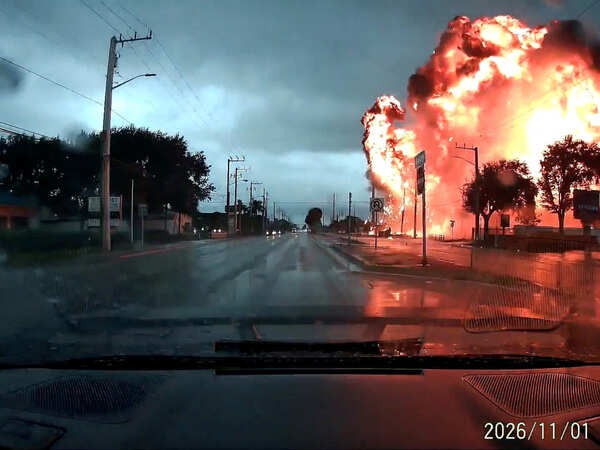
Humanity has barely seen such immensely tragic plane crashes in recent years, so horrific that the 9 people onboard were burnt into ashes instantaneously, with no bodies left. The Learjet 60 diving right into the face of the Earth left a deep greater at the spot it hit ground, just like an extraterrestrial object crashing onto the earth would.
With the investigation underway, investigators have also recovered aircraft components scattered away from the main crash site, indicating that parts of the plane had separated before actual impact.
On 9th November 2026, the US National Transportation Safety Board (NTSB) also confirmed that the cockpit voice recorder had been recovered and sent for laboratory examination. The cause of the crash remains under investigation until further details emerge.
Although this accident does not rank among history’s deadliest aviation disasters because of a lesser number of people onboard, but, did it fail at evoking the worst possible horrors? Not at all. The Learjet 60 crash has brought into focus several risks that exist despite decades of scientific progress in the aviation industry.
The 10 Deadliest Plane Crashes in World History
The following ranking takes into account accidental civilian aviation disasters involving passenger and cargo aircraft, i.e, plane crashes that did not involve any foul play like the Kanishka bombing incident, deliberate shootdowns, any hijacking attempts, etc.. It only includes deaths on the ground and combined fatalities from aircraft collisions.
| Rank | Plane crash | Year | Fatalities |
| 1 | Tenerife Airport Disaster | 1977 | 583 |
| 2 | Japan Airlines Flight 123 | 1985 | 520 |
| 3 | Charkhi Dadri Mid-Air Collision | 1996 | 349 |
| 4 | Turkish Airlines Flight 981 | 1974 | 346 |
| 5 | Saudia Flight 163 | 1980 | 301 |
| 6 | Kinshasa Antonov An-32 Crash | 1996 | 298 approximately |
| 7 | American Airlines Flight 191 | 1979 | 273 |
| 8 | American Airlines Flight 587 | 2001 | 265 |
| 9 | China Airlines Flight 140 | 1994 | 264 |
| 10 | Nigeria Airways Flight 2120 | 1991 | 261 |
Please note: The Kinshasa figure is an estimate rather than a confirmed total because even today, its final death toll figure is disputed.
Tenerife Airport Disaster (1977): The Deadliest Collision in Aviation History
Date: 27th March 1977
Place: Tenerife, Canary Islands, Spain
Loss of Life: 583 fatalities (two flights)
Survivors: 61 flyers only from the Pan Am Flight 1736
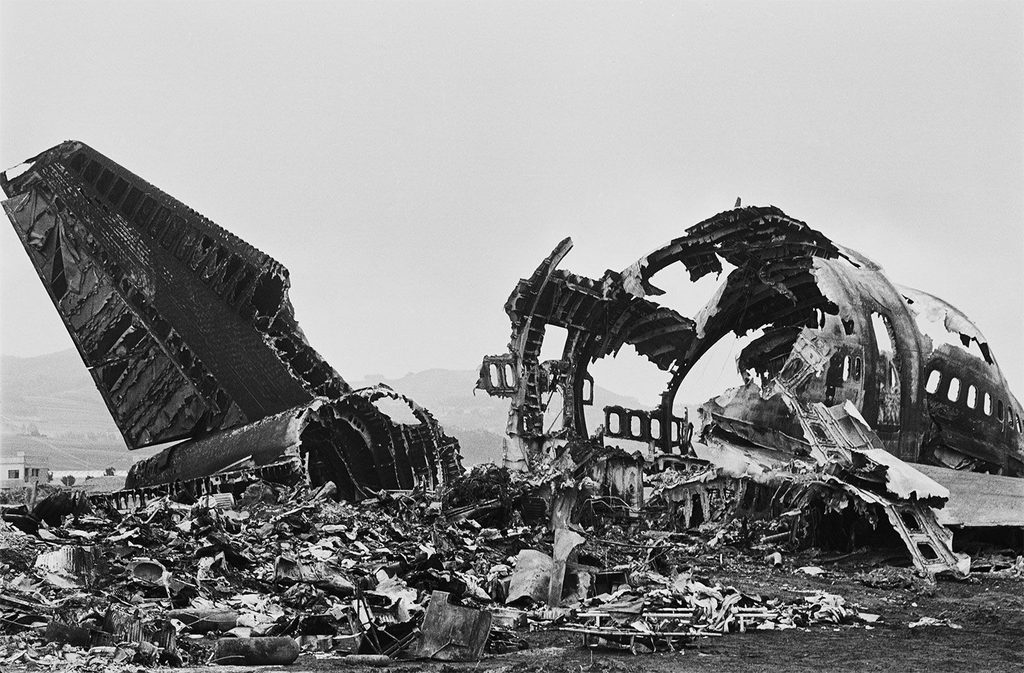
This brain-numbing tragedy occurred on the fateful 27th of March 1977 in Los Rodeos Airport in Tenerife, Spain. Two fully sold-out Boeing 747 passenger aircrafts collided on a runway taking 583 lives at once. This incident is remembered as the deadliest accidental aviation disaster in recorded history because of the highest death toll recorded in a plane crash.
Ironically, neither aircraft was originally scheduled to land at Tenerife. A bomb explosion at Gran Canaria Airport had forced several incoming flights to divert to the smaller Los Rodeos Airport. Among them were KLM Flight 4805 and Pan American Flight 1736 – the two planes involved in this deadly crash. This sudden influx created a severe congestion at the airport.
To add to this tense situation, the dense fog also reduced the visibility across the airfield. Such a situation made it difficult for pilots as well as air traffic controllers to monitor aircraft movements correctly.
The Pan Am Boeing 747 was taxiing along the runway. At that exact time, the KLM aircraft began its takeoff process. The KLM captain had not received authorisation to take off. But by the time the crews recognised the imminent collision, it was already too late.
The KLM aircraft struck the Pan Am jet. Both the planes were immediately destroyed. All 248 people aboard the KLM flight died. Out of the 396 people onboard the Pan Am flight, 335 died and only 61 people survived.
What Did the Investigation Reveal?
According to Spanish investigators, the main cause of this collision was the KLM flight captain’s wrong decision to begin a takeoff without clearance. Additionally, factors like poor visibility, miscommunication during tracking and operational pressures also contributed to the circumstances.
The tragedy thus became a defining case study in the history of aviation. It is also studied in aviation communication and crew resource management (CRM). It made everyone realise the importance of clear instructions, cockpit teamwork and the ability of crew members to question potential misjudgements.
The Tenerife disaster remains a reminder that catastrophic aviation accidents can occur before an aircraft can even take off.
Japan Airlines Flight 123 (1985)
Date: 12th August 1985
Place: Gunma Prefecture, Japan
Loss of Life: 520
Survivors: 4
This disaster involved a domestic flight in Japan. On 12 August 1985, Japan Airlines Flight 123 departed Tokyo’s Haneda Airport for Osaka with 524 passengers and crew aboard. What should have actually been just a short domestic journey turned into a real tragedy in just 12 minutes after takeoff. A loud explosion-like deafening sound was heard inside the Boeing 747.
To get into the technicalities, the aircraft’s rear pressure bulkhead had ruptured completely, causing an explosive decompression. It severely damaged its tail section. This destroyed the vertical stabiliser and all the four hydraulic systems. The pilots could no longer control the aircraft normally.
Despite this, the crew succeeded in keeping the aircraft airborne for approximately 30 minutes. They tried several combinations to change the engine thrust , thereby attempting to control the plane’s movement. The plane, however, struck a mountainous terrain near Mount Osutaka in Gunma Prefecture.
Only 4 passengers survived out of the 524 people aboard.
What Did the Investigation Reveal?
The investigation uncovered a disturbing connection to an incident that had occurred seven years earlier.
- In 1978, the same aircraft had experienced a ‘tail strike’ during landing – meaning the tail of this aircraft actually scraped the ground.
- This caused damage to its rear pressure bulkhead and it required structural repairs.
- However, the structural repair had not been performed well. Instead of using the required continuous reinforcement arrangement, the repair incorporated an improper splice configuration that reduced the structure’s fatigue resistance.
- The structures could not take the load of several thousand flights it took thereafter and cracks began to develop. This weakened the bulkhead that finally gave away in the August 1985 flight.
The safety lesson: The plane tragedy exposed how dangerous improper repairs can be. It also highlighted the importance of continuous checks and inspections of the repaired parts of aircraft to see how they are coping up.
Charkhi Dadri Mid-Air Collision (1996)
Date: 12th November 1996
Place: Haryana, India
Loss of Life: 349
Survivors: None
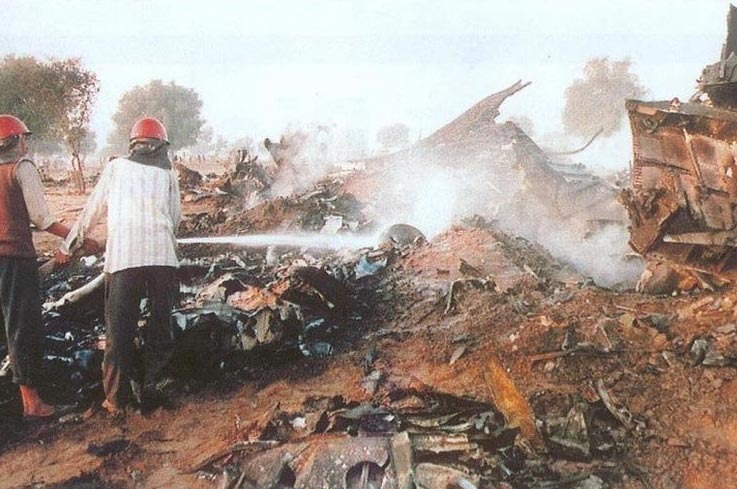
This accident again involved collision between two planes, but mid-air. On the fateful evening of 12th November 1996, two large aircraft were travelling in opposite directions near New Delhi. One aircraft was departing India and the other was preparing to land in India. Both had received instructions to maintain paths such that they stay clear of any mishaps and were safely separated.
Accordingly, the Indian air traffic control instructed the Saudi Arabian aircraft to maintain an altitude of 14,000 feet. The other aircraft, Kazakhstan Airlines Flight 1907, had been instructed to descend to 15,000 feet. The Saudi Arabian aircraft was Flight 763, a Boeing 747 carrying 312 passengers and crew, whereas the Kazakhstan Airlines Flight was an Ilyushin Il-76 carrying 37 people.
The assigned altitudes provided 1,000 feet of vertical separation between both the planes. However, the Kazakhstan aircraft continued descending below its authorised altitude, eventually entering the path of the Saudi Boeing 747. As a result, the two planes collided near Charkhi Dadri, Haryana, killing all people aboard both the flights.
It is indeed not only one of the deadliest mid-air collisions humanity has witnessed, but also India’s deadliest air tragedies.
What Did the Investigation Reveal?
The Indian Court of Inquiry found that the Kazakhstan crew had failed to maintain its assigned altitude of 15,000 feet.
- This finding was also supported by the investigation of the cockpit communication.
- It must be noted that the inquiry did not attribute the collision to incorrect instructions from the air traffic controller or faulty altimeters.
The safety lesson: The disaster showed how important strict altitude compliance is.
Turkish Airlines Flight 981 (1974)
Date: 3rd March 1974
Place: Ermenonville, France
Loss of Life: 346 fatalities
Survivors: None
This plane crash was a result of improper aft door closure in the cargo area, causing 346 passengers to die. The Turkish Airlines Flight 981 was flying from Istanbul to London on 3rd March 1974, with a brief layover at Orly in Paris. The first flight went without any trouble. Some passengers deboarded the flight at the Paris-Orly airport.
This McDonnell Douglas DC-10 aircraft took off from the Paris airport following all clearances. Approximately just ten minutes after takeoff, the aft door of the rear cargo area suddenly separated from the fuselage at an altitude of around 11,000 feet.
The pilots in the cockpit immediately noted that the aircraft had ‘burst’, as could be later heard in the cockpit recordings. What followed after the aft door separated was a rapid decompression within the aircraft cabin. This caused a part of the cabin floor at the rear side to separate from the aircraft.
There were two seats of three passengers each attached to this floor section and the passengers were expelled out too, still tied to their seats. Their bodies were later found near Saint-Pathus above which this part of the accident occurred.
By this time, the pilots could no longer control the aircraft. The cockpit conversations reveal that the pilots knew they would crash. They tried to reduce the nosedive, which they did succeed to a certain extent. But, just 77 seconds after the cargo door separated, the DC-10 plane crashed into the Ermenonville forest, northeast of Paris.
Everyone aboard was killed as this was a no-escape situation. The Ermenonville forest is full of extremely tall trees. The plane brushed across the tips of the trees before finally crashing.
An eerily similar cargo door failure had taken place with another DC-10 aircraft just two years prior to this fatal crash. However, the pilots there had managed to land the aircraft safely despite the serious damage to it.
What Did the Investigation Reveal?
The French investigation team determined that the cargo door’s locking mechanism had not been correctly engaged before departure.
- The design of the internal locking mechanism was such that the aft door appeared to be secured despite improper engagement of its locking components.
- Subsequently, when it opened, the rapid decompression damaged the aircraft’s floor and flight controls.
- The investigation further found that modifications introduced to this door were either incomplete or insufficient.
- The support bracket that is meant to hold the torque tube has not been installed at all during earlier repairs.
The safety lesson: A known aircraft design fault or vulnerability remained inadequately corrected and this cost precious human lives.
Saudia Flight 163 (1980)
Date: 19th August 1980
Place: Riyadh, Saudi Arabia
Loss of Life: 301 fatalities
Survivors: None
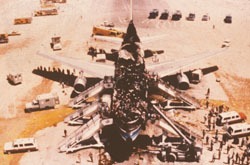
This airline tragedy is perhaps also the most perplexing because despite landing back safely, none of the 301 passengers and crew survived this tragedy.
On 19th August 1980, Saudia Flight 163 departed Riyadh for Jeddah. The flight had just arrived from Pakistan to Riyadh before taking off for Jeddah.
About seven minutes after takeoff, a smoke warning alerted the pilots. There was smoke arising from the aircraft’s rear cargo compartment due to a fire inside. Cabin crew members also reported smoke and fire spreading from the rear of the aircraft. Recognising this emergency, the captain decided to return to Riyadh immediately.
The pilots successfully brought the aircraft back to the airport approximately 20 minutes later. However, the emergency did not end here. It took more than 3 minutes for the plane to come to a halt. The pilots did not stop the plane for an immediate evacuation.
The engines also kept running for several minutes after it finally came to a stop. This delayed emergency responders’ team’s access to the flight cabin. By the time rescuers entered the aircraft, smoke and fire had killed everyone aboard.
All 301 people died, including the entire aircraft crew.
What Did the Investigation Reveal?
The investigation identified serious deficiencies in the crew’s management of this emergency.
- There were delays in stopping the aircraft, shutting down its engines and initiating an evacuation that should have been the priority.
- The exact source of the fire could not be established in the final investigation report.
- In this case, the passengers’ survival did not merely depend on bringing the aircraft safely back to the ground, but also on the timing of evacuating. It did not allow them to escape the deadly smoke.
The safety lesson: The need for rapid emergency evacuation and effective cockpit decision-making is important.
Also Read: World’s Most Dangerous and Deadliest Places You Should Never Visit
Kinshasa Antonov An-32 Crash (1996)
Date: 8th January 1996
Place: Kinshasa, Democratic Republic of the Congo (then Zaire)
Loss of Life: Approximately 298 fatalities, but this figure is still disputed
This Congo tragedy is particularly significant as it involved not just the people on board, but also normal people on the ground as the plane crashed into a crowded marketplace.
On 8th January 1996, an Antonov An-32 cargo aircraft attempted to take off from Ndolo Airport in Kinshasa, Congo, on its way to Kahemba. However, this cargo flight failed to gain sufficient height during its takeoff. When the rotation also failed, the crew decided to abort the flight and land back on the runway.
But the aircraft was travelling too fast to stop within the remaining runway. As a result, it overran the airport boundary and crashed into a densely populated marketplace of Simbazikita. The aircraft crashed right into stalls and people before bursting into flames.
Unlike most major plane crashes, the majority of the people who were killed were not passengers or crew members. Instead, they were traders, shoppers and other people going about their daily activities.
The scale of the devastation was tremendous, but the exact number of fatalities remains disputed till date. Most resources report figures ranging from approximately 227 to 350 deaths, but the Bureau of Aircraft Accident Archives states 298 as the death toll.
What Did the Investigation Reveal?
The investigation revealed that the aircraft was overloaded.
- This made it unstable and added to its inability to take off successfully.
- The decision to abort the takeoff also came too late to prevent the aircraft from overrunning the runway.
The safety lesson: The Kinshasa disaster shows why aircraft loading limits are important in aviation safety.
American Airlines Flight 191 (1979)
Date: 25th May 1979
Place: Chicago, United States
Loss of Life: 273 fatalities
Survivors: None aboard
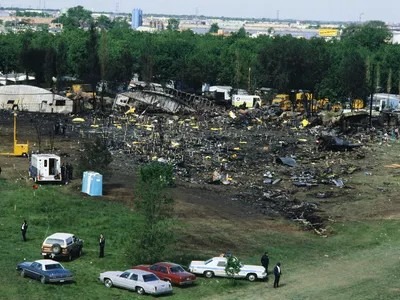
This tragedy was a result of poor maintenance of the American Airlines Flight 191. On 25th May 1979, this McDonnell Douglas DC-10 plane began its journey from Chicago O’Hare International Airport to Los Angeles. The aircraft was full with 271 passengers and crew when a catastrophic failure occurred just as it was taking off.
During the flight rotation, the aircraft’s left engine and the structure that attaches it to the wing suddenly broke away. The structure passed over the wing before falling onto the runway. Though the aircraft continued climbing, this damage had already compromised critical flight systems of the DC-10 plane. The pilots realised that something was wrong, but they were unaware of the damage to the left wing as the warning systems were also disabled following the engine separation.
Hydraulic lines were also severed. This made the leading-edge slats on the outer section of the left wing to retract. These devices help an aircraft generate sufficient lift at lower speeds, particularly during takeoff and landing. As a result, the pilots couldn’t get a sufficient lift.
Still, they responded as they would to a conventional engine failure, unaware of the extensive damage to the wing.
As the aircraft slowed, its left wing stalled, causing an uncontrollable roll. Ultimately, the plane crashed near a trailer park just shortly after takeoff, killing all 271 people aboard and two people on the ground. All the passengers were able to see their takeoff and crash as their seats were accompanied with live footage screens that displayed live take off and landing.
This disaster was the deadliest accidental single-aircraft crash in the history of the United States of America.
What Did the Investigation Reveal?
The National Transportation Safety Board (NTSB) discovered that the actual cause was engine separation that originated from damage caused during an earlier maintenance operation.
- An improper procedure had been used to remove and reinstall the engine and its supporting structure.
- This damaged a critical attachment point. It weakened it until the assembly separated during takeoff.
The safety lesson: The tragedy shows that aircraft maintenance procedures must be followed with the exact same precision as flight operations.
American Airlines Flight 587 (2001)
Date: 12th November 2001
Place: New York, United States
Loss of Life: 265 fatalities
Survivors: None
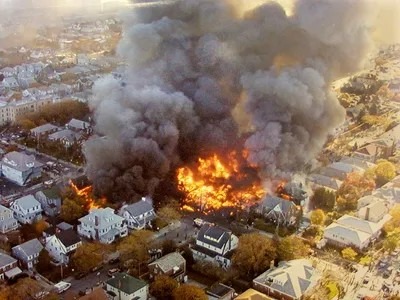
Another tragic plane crash in the United States of America took place on 12th November 2001 when the American Airlines Flight 587 departed New York’s John F. Kennedy International Airport for Santo Domingo (Dominican Republic).
The Airbus A300 plane had 260 passengers and crew onboard. Just shortly after takeoff, the plane encountered wake turbulence generated by a larger aircraft flying ahead. Wake turbulence is made up of powerful rotating air currents that trail behind an aircraft, particularly near its wingtips.
As the first officer attempted to respond to the disturbance, he made a series of rapid, alternating movements of the aircraft’s rudder pedals. The rudder is a movable control surface on the vertical tail that helps control an aircraft’s movement from side to side. But, these repeated inputs generated a force greater than what the vertical stabiliser was designed to withstand.
Within a few seconds, the aircraft’s vertical stabiliser and rudder separated from the fuselage. The plane was now beyond the pilot’s control.
The aircraft crashed into Belle Harbor in Queens – a residential area. The crash killed everyone aboard and five people on the ground.
What Did the Investigation Reveal?
The NTSB concluded that the vertical stabiliser separated.
- The excessive aerodynamic loads generated by the first officer’s ‘unnecessary’ and ‘extreme’ rudder inputs were believed to have caused this separation.
- However, the investigation did not attribute the disaster solely to pilot actions.
- It also identified characteristics of the Airbus A300-600 rudder-control system and some elements of American Airlines’ pilot training programme as contributing factors.
The safety lesson: The accident proves the dangers of excessive rudder movements at higher airspeeds and the importance of training pilots to respond correctly to wake turbulence.
Also Read: 10 of the Deadliest Cyclones in World History: When Nature Claimed Hundreds of Thousands of Lives
China Airlines Flight 140 (1994)
Date: 26th April 1994
Place: Nagoya, Japan
Loss of Life: 264 fatalities
Survivors: 07
The Chinese Airlines Flight 140 crash shows how technology can sometimes work against us too. On 26th April 1994, China Airlines Flight 140 was approaching Nagoya Airport in Japan after departing Taipei, Taiwan. The flight was an Airbus A300 plane and it was carrying 271 passengers and crew at the time of crash.
So far the journey had proceeded normally until its final approach to the ground. As the aircraft descended toward the runway, the first officer inadvertently activated the go-around mode, a system intended to help pilots discontinue a landing and climb away safely.
This accidental activation caused the aircraft’s automated systems to increase engine thrust and command a climb. However, the crew attempted to continue the landing rather than complete the go-around. The first officer pushed the control column forward to bring the aircraft back toward its intended descent path. Meanwhile, the autopilot, operating in go-around mode, adjusted the horizontal stabiliser toward an increasingly nose-up position.
The opposing inputs created a dangerous situation. Now, the aircraft’s automation and the pilots were actually working against each other. Eventually, the aircraft climbed too steeply, lost airspeed and stalled completely.
It crashed near the runway, killing 264 people. Only seven passengers survived.
What Did the Investigation Reveal?
The Japanese investigation team identified a combination of factors.
- Crew errors, inadequate understanding of the aircraft’s automated flight-control systems and design flaws that enabled this dangerous situation.
- The accident demonstrated how an incorrectly selected automation mode could create confusion when the crew attempted to control the aircraft manually.
The safety lesson: The disaster reinforced the importance of automation awareness and intensive pilot training to understand it.
Nigeria Airways Flight 2120 (1991)
Date: 11th July 1991
Place: Jeddah, Saudi Arabia
Loss of Life: 261 fatalities
Survivors: None
This Douglas DC-8 plane’s tragic crash was again due to lapses in flight procedures. On 11th July 1991, the Nigeria Airways Flight 2120 departed King Abdulaziz International Airport in Jeddah for Sokoto, Nigeria. It has 247 passengers and 14 crew members. The plane was being operated by the Canadian charter company Nationair and it was transporting pilgrims returning from Saudi Arabia.
Two tyres on the aircraft’s main landing gear were dangerously underinflated. The flight crew was unaware of this. During taxiing and takeoff, the underinflated tyres caught fire due to excessive stress on the wheel assemblies resulting in overheating. There was structural damage too.
As the aircraft accelerated along the runway, tyres failed and friction generated enough heat to ignite the remaining rubber. Though the crew was unaware of the training tyres, they still had an indication of a possible tyre problem. Despite this, they continued with the takeoff.
Once the plane was airborne, the crew retracted the landing gear, bringing inside the burning tyre material into the wheel wells. The fire spread rapidly, damaging hydraulic lines, electrical systems and eventually the aircraft’s structure. The smoke not only affected the passenger cabin area, but also entered the cabin as the pilots attempted to return to Jeddah.
However, the fire continued to intensify and kept destroying the aircraft’s systems. It is also said that the fire spread so much that some people also spotted burning bodies falling from the plane before it crashed.
The plane crashed approximately just 2.9 kilometres short of the runway. All 261 passengers and crew aboard were killed.
What Did the Investigation Reveal?
The investigation revealed that maintenance personnel had identified the underinflated tyres before departure.
- However, the aircraft was allowed to operate without the necessary corrective action.
- There was also a communication gap between ground personnel and the flight crew.
- The pilots had not been informed of the dangerously low tyre pressures before departure.
The safety lesson: The disaster showed how a relatively simple maintenance deficiency could develop into a catastrophic in-flight emergency.
What Are the Leading Causes of Plane Crashes?
An aircraft accident most often does not result just from a single mistake. In many cases, investigators discover that several failures occurred in succession, with each one reducing the crew’s ability to prevent disaster. These shortcomings may involve human judgment, mechanical components, maintenance practices, weather conditions or communication between pilots and air traffic controllers.
How Have Deadly Plane Crashes Changed Aviation Safety?
Every major aviation accident has led to an examination of what went wrong and whether the same circumstances could endanger another flight. Investigators examine flight recorders, aircraft wreckage, maintenance records, weather information and communication transcripts, etc., to reconstruct the sequence of events.
Some of the findings led to several developments in flying procedures and safety protocols:
- A strong emphasis on standardised radio communication, clearances and crew resource management (CRM).
- Modern Traffic Collision Avoidance Systems (TCAS) have now been introduced.
- Today, aircraft maintenance is believed to be followed with due diligence and is accompanied by detailed inspection schedules, approved repair procedures, documentation requirements and regulatory oversight.
- Structural fatigue monitoring and compliance with manufacturer instructions are particularly important for ageing aircraft.
- Modern pilot training increasingly focuses on automation awareness. Because recognition of unexpected system behaviour and the ability to transition between automated and manual control when necessary, is an extremely important attribute to inculcate.
- Technology can reduce workload and improve precision, but pilots must also understand what the aircraft’s systems are doing and why.
Despite the massive developments in aviation technology, the number of plane crashes recently do not seem to go down.
Can Human Life Ever Be Completely Secure?
Human beings can develop extraordinary technologies, take on complex risks and create multiple layers of protection, and yet they can never eliminate every uncertainty from life.
Passengers board an aircraft expecting to reach their destinations. Their families wait for their return. Even pilots and engineers who rely on years of training, try their best to adopt procedures that could make each journey safe. Yet history proves that even an unexpected, tragic turn can occur any moment.
While humanity continues to pride itself on the ‘frequent flyer’ tag, how much thought do we give to the ultimate destination of human life? How often do we ignore death?
Despite the massive scientific advancement, something or the other always falls short, causing deaths in plane crashes and accidents. The Saudia Flight tragedy is a classic example here. Despite the successful return to ground, none of the people aboard survived. It is because when death is destined to arrive, it will. For no one can stop it.
None other than a Tatvdarshi Sant (Complete Saint). A Tatvdarshi Sant is the chosen messenger of Supreme God Kabir and He alone can authorise karmic changes in our life by the power of God Kabir, the True Creator of all souls. The Tatvdarshi Sant wields the ultimate power to change the course of a disciple’s life.
God Kabir says in His divine Kabir Vani:
Masa ghate na til badhe, Vidhina likhe to lekh |
Sachha Satguru met Ke, Upar mare Mekh ||
It means that only a Satguru (Tatvdarshi Sant) can alter the course of His disciple’s life by destroying his grave sins and rewriting a new course of life for him.
But, in a sea of spiritual gurus, how can we ordinary humans spot the actual Tatvdarshi Sant?
Identification of the Sole Tatvdarshi Sant
The real Tatvdarshi Sant is one who is well-versed with the true spiritual knowledge of all scriptures across all faiths. The Holy Bhagwad Gita illustrates the prerequisites of a Tatvdarshi Sant:
Jagatguru Tatvdarshi Sant Rampal Ji Maharaj is that Tatvdarshi Sant of our times. He is not just the true representative of God Kabir, but He is also an Avtar of the Supreme God.
Sant Rampal Ji Maharaj alone dispenses the deep hidden spiritual knowledge of all scriptures, revealing the identity of our Real Creator, God Kabir. The true worship imparted by Sant Rampal Ji Maharaj is so powerful, that it has not only cured innumerable devotees, but also brought many of them back from death.
Genuine and lasting security lies not merely in protecting our physical existence but also in understanding the path that leads the soul beyond repeated birth and death. And Sant Rampal Ji Maharaj alone reveals the true importance of human life and its role in achieving complete liberation from this cycle of life and death.
Recognise the real Tatvdarshi Sant and seek His refuge before it is too late. Understand the true value of your human life by listening to the enlightening spiritual discourses of Jagatguru Tatvdarshi Sant Rampal Ji Maharaj Ji on:
- Website: www.jagatgururampalji.org
- YouTube: Sant Rampal Ji Maharaj
- Facebook: Spiritual Leader Saint Rampal Ji
- ‘X’ handle: @SaintRampalJiM
FAQs: 10 Deadliest Plane Crashes in World History
Q1) What is the deadliest plane crash in world history?
Answer: The 1977 Tenerife Airport Disaster. It killed 583 people when two planes collided on a runway in Spain.
Q2) What is the deadliest single-aircraft crash ever recorded?
Answer: It is the Japan Airlines Flight 123 incident. It killed 520 people.