

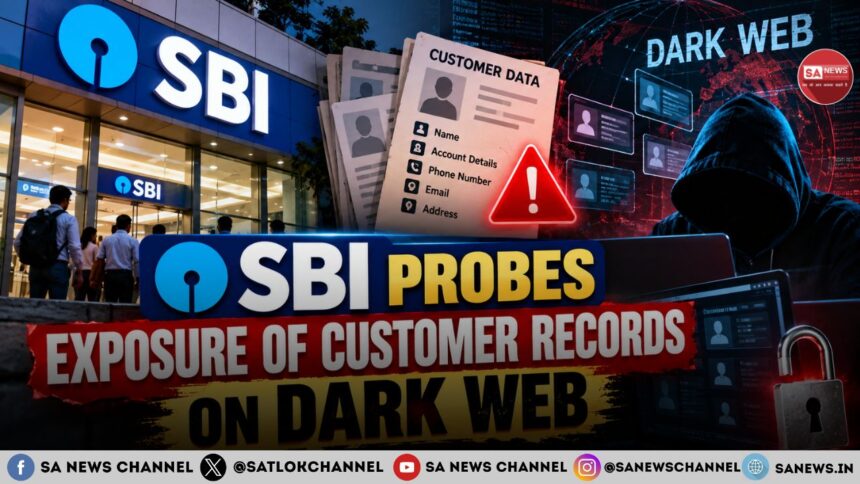
SBI Data Leak Details: State Bank of India (SBI), India’s largest public sector commercial bank, is investigating why customer records were found on the dark web. In a disclosure to stock exchanges on October 21, 2026, the bank said that a preliminary analysis of files circulating online revealed data on 3,897 individual customer records which contain personally identifying information. The bank confirmed that its daily operations, financial stability, and customer services remain unaffected while independent cybersecurity experts investigate how the data was exposed online.
How was the Data Exposure Discovered?
The problem was first noticed on October 16, 2026, after threat monitoring systems detected the posting of a user identified as Siriusim on BreachForums, a known cybercrime forum. The anonymous threat actor claimed to have leaked about 3.75 lakh (375,000) records in CSV format and 2,722 PDF files allegedly belonging to SBI.
Soon after the claim was made, India’s top national cyber security agencies – Defence Cyber Agency (DCyA) and Indian Computer Emergency Response Team (CERT-In) – and SBI’s threat intelligence partners contacted the bank. SBI has started an internal screening process of the 3.75 lakh records currently being shared on the dark web to cross-verify if any of the data shared actually belongs to its customers.
What Customer Data Was Compromised?
After its initial screening process, SBI has found that 3,897 records matched with true customer data that supposedly contained Personally Identifiable Information (PII). As per the bank’s regulatory filing, the PII information compromised contained:
- Customer name, birth date and gender
- Registered mobile number and email id
- Residential address
- Branch information and the customer’s CIF (Customer Information File) number
- Internal lead IDs and other metadata pertaining to the customer’s loan applications
The bank clarified that the compromised data did not contain any financial credentials such as bank account details, passwords or Pin, One Time Password (OTP), account balance, Debit/Credit Card numbers or Government issued ID (Aadhaar, PAN) etc. However, experts feel that personal information like the CIF number and other metadata pertaining to the customer’s loan applications may be misused by malicious actors to target the customer with impersonation frauds.
Containment and Independent Cyber Forensics Audit by Empaneled Agency
After confirming the security breach, SBI’s standard cyber incident response and containment procedures were triggered in order to ascertain the vector of breach. An independent cybersecurity auditing firm empaneled with CERT-In has been commissioned by the bank to conduct a detailed forensic audit of the circumstances surrounding the data breach.
Investigators were looking at the possibility that the compromised data may have come from either internal systems at SBI or one of its associate or subsidiary entities that handles lead generation and loan processing documentation. SBI clarified that its broader network infrastructure was not compromised and it has taken appropriate measures to ensure that no such future security breaches occur while simultaneously informing the relevant regulatory agencies of the situation.
Customer Communication Concerns Raised by Digital Rights Groups and Legislators
The disclosure has sparked calls for better customer communication, particularly by digital rights advocacy group Internet Freedom Foundation (IFF). IFF raised concerns with why the bank decided to inform market regulators first before alerting the 3,897 affected customers directly. The group requested that SBI provides multi-lingual customer support and a hotline for customers to enquire as to what action they should take, whether they would be covered under any customer liability guidelines in case of impersonation frauds etc. Political leaders also questioned the bank’s decision to file a stock exchange disclosure on October 21 following threat monitoring agency alerts on October 16, asking institutions to improve transparency with customers on such issues.
Can Modern Firewalls Ever Protect What Truly Matters?
The probe by the State Bank of India into leaked customer records on the Dark Web highlights an inescapable reality of our digital age: no matter how fortified an institution’s cyber perimeter appears, data breaches and human exploitation continue to surface. We place immense trust in firewalls, encrypted servers, and financial safeguards, believing they can shield our identity and livelihood.
But have we ever paused to ask—why does every technological advancement inevitably bring a new avenue of vulnerability, greed, and crime? If systems engineered by the sharpest minds remain susceptible to compromise, can any worldly creation offer absolute security?
Jagatguru Tatvdarshi Sant Rampal Ji Maharaj reveals that humanity’s relentless pursuit of physical protection overlooks the root cause of danger. In this mortal realm governed by Kaal Brahm, the human mind itself is driven by lust, greed, and deception. Digital firewalls cannot curb internal vices; only the true worship of Supreme God Kabir, imparted by a Tatvdarshi Sant, can purify the consciousness and grant eternal protection from life’s vulnerabilities.
Discover the path to lasting peace beyond temporary material systems:
- Website: www.jagatgururampalji.org
- YouTube: Sant Rampal Ji Maharaj
- Facebook: Spiritual Leader Saint Rampal Ji
- ‘X’ handle: @SaintRampalJiM