


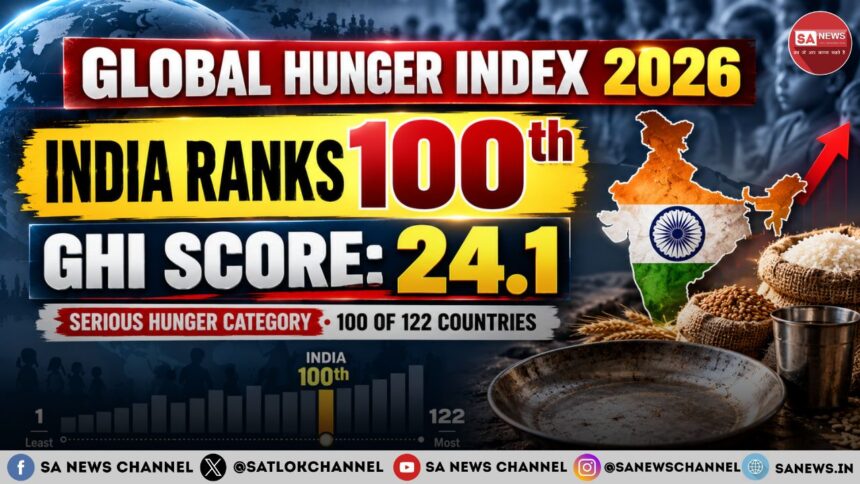
India ranks 100th among 122 countries with sufficient data in the Global Hunger Index (GHI) 2026, with a score of 24.1. The report classifies India’s hunger level as “serious.”
- Global Hunger Index 2026: India’s Position
- What Is the Global Hunger Index?
- India’s Four Hunger Indicators
- 1. Undernourishment: 9.8%
- 2. Child Stunting: 29.3%
- 3. Child Wasting: 19.0%
- 4. Under-Five Mortality: 2.7%
- India’s Progress in Reducing Hunger
- India Compared With Other South Asian Countries
- Global Hunger Situation in 2026
- Why Is the Global Hunger Index Important for India?
- India’s Road Ahead: Moving Towards Zero Hunger
- Sant Rampal Ji Maharaj’s Annapurna Campaign Supports Needy Families Amid Hunger Challenges in India
- Conclusion
- FAQs
The findings highlight continuing challenges related to undernourishment and child malnutrition. Although some of India’s nutritional indicators have improved, further progress is needed.
The report also examines the global hunger situation. South Asia has a GHI score of 23.5, compared with the global score of 18.1. India’s child stunting rate has declined over the long term, but child wasting remains a significant concern.
News Highlights
- India’s rank: 100th among 122 countries with sufficient data
- GHI score: 24.1
- Hunger category: Serious
- Undernourishment: 9.8%
- Child stunting: 29.3% of children under five
- Child wasting: 19.0% of children under five
- Under-five mortality indicator: approximately 2.7%
- Long-term progress: Child stunting declined from 50.0% in 2000 to 29.3% in the latest data used in the 2026 index
- South Asia GHI score: 23.5
- Global GHI score: 18.1
- Pakistan’s GHI score: 25.5
- 2030 goal: Continued progress towards Zero Hunger
Global Hunger Index 2026: India’s Position
The Global Hunger Index 2026 ranks India 100th among 122 countries with sufficient data to calculate their scores. India has received a score of 24.1. The report classifies India’s hunger level as “serious.” It highlights the continuing challenges of undernourishment, child stunting and child wasting.
The Global Hunger Index is an annual report that measures hunger at global, regional and national levels. It helps identify nutritional challenges and encourages action to improve food security. India’s ranking highlights the need for further progress. Although some indicators have improved over the years, hunger and malnutrition remain significant public health concerns.
What Is the Global Hunger Index?
The Global Hunger Index (GHI) measures hunger using a 100-point scale. A lower score indicates a better hunger situation, while a higher score indicates more severe hunger. The 2026 report was prepared by Welthungerhilfe, the Institute for International Law of Peace and Armed Conflict at Ruhr University Bochum, and Helvetas.
The index combines four indicators: undernourishment, child stunting, child wasting and under-five mortality. Together, these indicators provide a broader picture of hunger and its effects on health. According to the GHI classification, scores below 10 indicate low hunger, while scores from 10.0 to 19.9 indicate moderate hunger. Scores from 20.0 to 34.9 indicate serious hunger.
Scores between 35.0 and 49.9 indicate alarming hunger, while scores of 50 or above indicate extremely alarming hunger. India’s score of 24.1 places it in the serious category.
India’s Four Hunger Indicators
The Global Hunger Index uses four indicators to assess hunger. India’s 2026 figures highlight different aspects of the country’s nutritional situation.
1. Undernourishment: 9.8%
Undernourishment refers to the percentage of people whose food intake does not provide enough dietary energy for a healthy and active life.
According to the data used in the report, approximately 9.8% of India’s population is undernourished. This highlights the importance of ensuring consistent access to sufficient food.
2. Child Stunting: 29.3%
Child stunting occurs when children are too short for their age because of chronic undernutrition and related factors. It can affect their physical growth and development.
In India, 29.3% of children under five are affected by stunting. However, long-term data show improvement.
The rate declined from 50.0% in 2000 to 29.3% in the latest data used in the 2026 index. Despite this progress, stunting remains a concern.
3. Child Wasting: 19.0%
Child wasting refers to a low weight relative to height. It is generally associated with acute undernutrition and can increase the risk of serious health complications.
The report estimates that 19.0% of children under five in India experience wasting. This remains one of the major concerns in the country’s hunger assessment.
The findings highlight the importance of adequate nutrition, timely healthcare and support for children experiencing malnutrition.
4. Under-Five Mortality: 2.7%
The under-five mortality indicator measures the proportion of children who die before their fifth birthday.
India’s reported under-five mortality indicator is approximately 2.7%. This indicator reflects several factors, including healthcare access, living conditions and nutrition.
Poor nutrition can increase children’s vulnerability to illness. Therefore, under-five mortality is included in the index alongside the other three indicators.
Together, these indicators contribute to India’s overall GHI score of 24.1.
India’s Progress in Reducing Hunger
India’s current ranking should also be viewed in the context of its long-term progress. The country’s GHI score has declined over the years.
The historical series published in the 2026 Global Hunger Index shows that India’s score declined from 37.0 in 2006 to 28.8 in 2012, 25.8 in 2018 and 24.1 in 2026.This overall decline indicates an improvement in the indicators used to calculate the index. The reduction in child stunting is another important development. The rate fell from 50.0% in 2000 to 29.3% in 2026.
However, progress has not been equal across all indicators. Child wasting remains high, while the overall score continues to place India in the serious hunger category. These findings show that further efforts are needed to improve child nutrition, food access and public health.
India Compared With Other South Asian Countries
South Asia continues to face considerable hunger and nutrition challenges. The region’s GHI score is 23.5, higher than the global score of 18.1.
The report provides the following GHI scores for selected South Asian countries:
- India: 24.1
- Pakistan: 25.5
- Afghanistan: 28.6
- Bangladesh: 19.2
- Nepal: 14.5
- Sri Lanka: 10.2
These figures show differences in the severity of hunger across the region. India and Pakistan fall within the serious hunger category, while Bangladesh, Nepal and Sri Lanka fall within the moderate category. Afghanistan also falls within the serious hunger category. Among these six countries, Sri Lanka has the lowest score at 10.2.
Pakistan’s GHI score of 25.5 is higher than India’s score of 24.1, indicating a more severe hunger situation in Pakistan according to the index. These comparisons consider several nutritional and health indicators rather than food production alone.
Global Hunger Situation in 2026
The Global Hunger Index 2026 highlights that hunger remains a global concern. The global GHI score stands at 18.1, although the situation varies considerably between countries and regions. The report highlights uneven progress in reducing hunger. Some countries continue to experience serious or alarming hunger levels, while others have achieved lower scores.
Conflict, climate-related shocks and rising food costs can make it difficult for people to access adequate food. These challenges may disrupt food production and distribution while weakening households’ purchasing power. The findings underline the importance of strengthening food security and improving access to nutritious food.
Why Is the Global Hunger Index Important for India?
The Global Hunger Index provides a broader picture of hunger by combining nutrition-related and health-related indicators. It helps identify areas where further attention may be needed.
For India, the findings highlight the importance of reducing undernourishment and improving child nutrition. The decline in child stunting shows progress, but the high child wasting rate remains a concern. Improving nutrition requires more than ensuring the availability of food. The nutritional quality of diets, access to healthcare and families’ ability to afford adequate food also matter.
The report can help inform discussions about nutrition programmes, food distribution, public health and child welfare. However, the ranking should be interpreted in context. The index measures hunger through four specific indicators and does not capture every aspect of a country’s food system.
India’s Road Ahead: Moving Towards Zero Hunger
India’s ranking in the Global Hunger Index 2026 highlights the need for continued efforts to improve nutrition and food security.
Reducing child wasting, addressing undernourishment and supporting healthy childhood development remain important priorities. Continued progress in these areas can help improve the country’s nutritional outcomes. The United Nations’ Sustainable Development Goal 2, known as Zero Hunger, aims to end hunger, achieve food security, improve nutrition and promote sustainable agriculture by 2030.
Achieving this goal requires sustained efforts by governments, communities and organisations to improve access to food and nutrition. India’s progress in reducing child stunting is encouraging. However, the latest available figures show that further improvements are needed to address the remaining challenges.
Sant Rampal Ji Maharaj’s Annapurna Campaign Supports Needy Families Amid Hunger Challenges in India
Sant Rampal Ji Maharaj launched the Annapurna Campaign in March 2025 to help families in need address food insecurity. Under this campaign, thousands of needy families have received free ration supplies, bringing relief to their lives and smiles back to their faces. Moreover, Sant Rampal Ji Maharaj has taken responsibility for supporting these vulnerable families until a member of the family secures employment or becomes capable of earning a livelihood.
This initiative provides families not only with food but also with new hope for living a life of dignity. Inspired by the social welfare activities of Sant Rampal Ji Maharaj, many people are seeking His guidance and giving up social evils such as drug addiction and dowry practices to move towards a better life. Such welfare initiatives and social reforms are helping pave the way for greater happiness, equality, and prosperity in India, while contributing towards the vision of restoring the country’s former glory as the Golden Bird.
Conclusion
The Global Hunger Index 2026 ranks India 100th among 122 countries with sufficient data, with a score of 24.1. The report classifies India’s hunger level as serious. Child stunting declined from 50.0% in 2000 to 29.3% in the latest data used in the 2026 index. However, the reported child wasting rate of 19.0% and undernourishment rate of 9.8% highlight persistent nutritional challenges.
The findings underline the importance of improving food access, strengthening nutrition support and protecting children’s health. Sustained progress in these areas will be essential to reducing hunger and advancing towards the global goal of Zero Hunger by 2030.
FAQs
Q1. What is India’s rank in the Global Hunger Index 2026?
India ranks 100th among 122 countries with sufficient data in the Global Hunger Index 2026.
Q2. What is India’s GHI score in 2026?
India has a GHI score of 24.1, placing it in the serious hunger category.
Q3. Who prepared the Global Hunger Index 2026?
The report was prepared by Welthungerhilfe, the Institute for International Law of Peace and Armed Conflict at Ruhr University Bochum, and Helvetas.
Q4. What are the four indicators of the Global Hunger Index?
The four indicators are undernourishment, child stunting, child wasting and under-five mortality.
Q5. What is India’s child stunting rate?
According to the data used in the Global Hunger Index 2026, 29.3% of children under five in India are affected by stunting.