

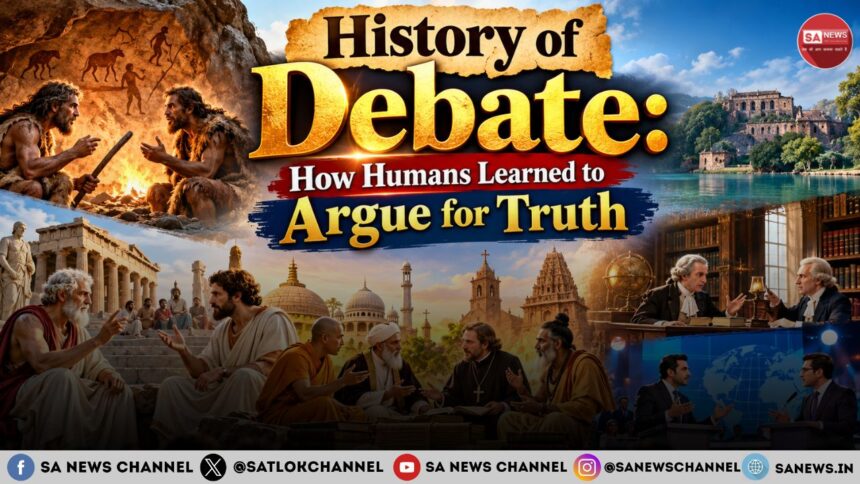
When did disagreement become a structured intellectual exercise? Long before instant communication or easy travel, scholars crossed great distances to challenge ideas, defend their beliefs and search for truth. Over centuries, societies developed rules for presenting arguments, examining evidence and determining when a claim had failed. The history of debate is not merely the history of people arguing. It is the story of humanity’s search for better ways to distinguish a convincing claim from a truthful one.
- The First Debate in History? We Simply Do Not Know
- India Turns Debate Into an Intellectual Discipline
- But How Did Anyone Challenge Anyone Without Phones?
- ‘Shastrarth’ Was More Than an Argument
- Are You Seeking Truth or Simply Trying to Win?
- Greece and the Power of Public Argument
- Debate Enters the University
- Debate Escapes the Physical Room
- When Debate Entered the Stage: Shakespeare and the Battle of Arguments
- Every Communication Revolution Changed Debate
- The Audience Can Now Audit the Debate
- From the King’s Court to a Global Sabha
- The Questions Humanity Has Never Stopped Asking
- FAQs: History of Debate
The First Debate in History? We Simply Do Not Know
There can be no definitive answer to the question, ‘Who conducted the world’s first debate?’
While it is very difficult to pinpoint the exact instance of the birth of debates, it is most likely that debates could be older than written history. Human beings might have argued about decisions, beliefs and explanations for thousands of years before anyone recorded such conversations.
However, what historians can identify is the earliest surviving evidence of organised disputation. Some of it takes us approximately 4,000 years into the past.
- Ancient Sumer produced a remarkable literary genre in which opposing entities were personified and made to argue their superiority. Surviving examples include disputes between Bird and Fish, Winter and Summer, Tree and Reed, Silver and Copper and perhaps most famously, Sheep and Grain.
- In ‘The Debate Between Sheep and Grain’, the two contestants argue over which contributes more to human civilisation until Grain is ultimately declared superior.
- The composition is generally dated to around 2000 BCE, while evidence suggests formal disputation performances were already popular at the courts of the Third Dynasty of Ur, where records even mention payments to performers.
- These were literary performances rather than proof of the first real debate between two historical individuals. The identity of humanity’s first debaters is lost forever.
But one thing is clear – four millennia ago, people were already familiar with the idea of opposing arguments being presented, compared and judged.
India Turns Debate Into an Intellectual Discipline
Ancient India developed one of history’s richest traditions of philosophical disputation.
The questions being debated could hardly have been more fundamental, as they revolved around our existence:
- What is the Self?
- What constitutes valid knowledge?
- What happens after death?
- What is ultimate reality?
- What is liberation?
- How can a proposition be established as true?
One extraordinary example survives in the Brihadaranyaka Upanishad. It describes a remarkable intellectual assembly at a sacrifice performed by King Janaka of Videha. Scholars from Kuru and Panchala had gathered there, and Janaka, wishing to discover who among them was the most learned, offered a thousand cows with gold attached to their horns. When Yajnavalkya had his pupil drive the cows away, the other scholars began challenging him with questions, setting in motion one of the Upanishad’s most celebrated sequences of philosophical disputation.
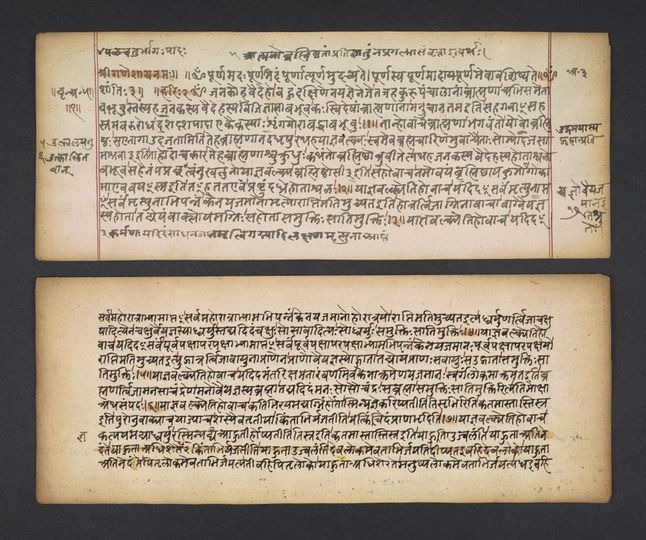
Image Title: Brihadaranyakopanishad (Chapter 2), section that speaks of King Janak’s intellectual assembly
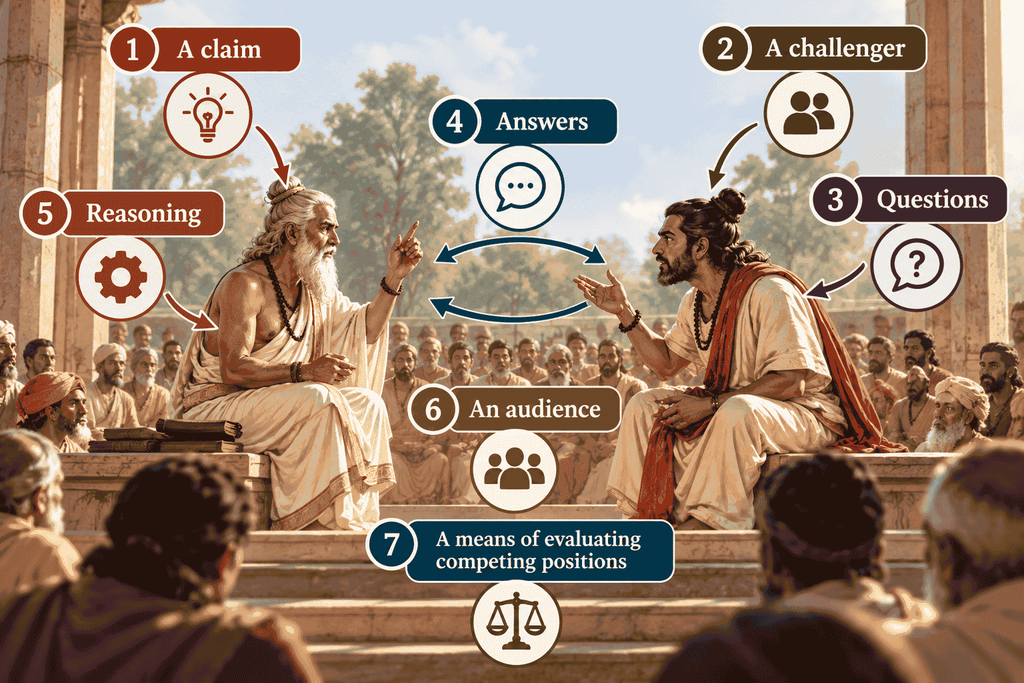
Already we can recognise much of the architecture of debate we are familiar with:
But How Did Anyone Challenge Anyone Without Phones?
This is where the ancient world becomes particularly fascinating. Long before information could cross distances in seconds, ideas travelled through human journeys.
- Scholars, monks, ascetics, students, pilgrims and merchants travelled and moved between regions. Royal messengers connected kingdoms.
- A famous teacher arriving somewhere could itself become news.
- Royal courts, monasteries, educational centres, pilgrimage sites, religious gatherings and scholarly assemblies consequently became intellectual meeting points.
- A challenger did not necessarily need to summon an opponent to his own home. The assembly itself could provide the forum.
- Kings could offer what individual scholars could not – a recognised venue, an audience, patronage and sometimes a framework within which competing claims could be examined.
- Historical sources preserve repeated references to important teachers defending their doctrines in public discussion, sometimes under royal patronage.
- And how did the arguments spread beyond those physically present? Through the people who heard them.
- Students carried teachings elsewhere. Travellers retold important encounters and scholars responded to rival schools. Arguments entered texts and intellectual traditions.
Before mass media, human networks were the media. A debate did not require millions of simultaneous spectators to influence millions of future minds.
‘Shastrarth’ Was More Than an Argument
As Indian traditions of debate developed, thinkers began asking a second-order question, ‘How should people disagree?’
- This is crucial because a proper intellectual contest could not simply consist of two people repeatedly declaring one is right and the other is wrong. Rules were required here.
- Early Indian sources such as the Charaka Samhita, a foundational medical work and the Nyaya Sutra preserve material concerning methods of debate, valid reasoning and circumstances in which a participant could be considered defeated.
- Scholars studying these sources believe earlier manuals or traditions of professional debating probably existed even though they have not survived intact.
- The Nyaya tradition eventually identified 22 nigrahasthanas, or grounds of defeat – different kinds of argumentative failure.
- It meant that losing a debate was not supposed to depend merely upon who appeared more confident or who attracted louder applause. A participant could fail intellectually by abandoning a thesis, contradicting it, failing to answer appropriately or committing other recognised defects in argumentation.
In other words, ancient thinkers were already attempting to distinguish reasoned debate from argumentative chaos.
Are You Seeking Truth or Simply Trying to Win?
Indian philosophy made another distinction that remains startlingly relevant. The Nyaya tradition differentiated among vada, jalpa and vitanda.
- Vada was directed toward determining truth or establishing a sound position through proper reasoning.
- Jalpa was a competitive debate in which victory over an opponent became an important objective.
- Vitanda concentrated upon refuting the opponent’s position without properly establishing an alternative thesis of one’s own.
This distinction transforms the way we think about debate. Two conversations can look almost identical from outside with two people questioning and contradicting one another, yet have completely different purposes.
One seeks the truth and the other seeks victory. Perhaps this is one of the most enduring questions in the entire history of debate: Is the purpose of debate to defeat a person or to defeat an error?
Greece and the Power of Public Argument
Meanwhile, another influential culture of argument was developing in ancient Greece. Some historical facts to mull over:
- In Athens, argument was a civic skill. Citizens debated policy in the Assembly and litigants argued their own cases before large juries, with speeches timed by water clocks.
- The stakes could be extreme. In 427 BCE, as Thucydides records, the Assembly voted to execute the adult men of the rebellious city of Mytilene.
- The next day it reopened the question. Cleon argued for severity and Diodotus for mercy and Diodotus’s proposal narrowly won.
- A ship carrying the revised order reached Mytilene just in time. Few debates in history have been so literally a matter of life and death.
- Teachers called Sophists, such as Protagoras, trained people to argue both sides of a question.
- Rather than simply countering an argument, Socrates examined it through a chain of questions, testing whether its underlying reasoning could hold together.
- Plato, his student, drew a distinction that Indian readers will recognise – dialectic, the cooperative search for truth, versus eristic, argument aimed only at winning.
- Aristotle later catalogued common fallacies in his Sophistical Refutations, much as the Nyaya tradition catalogued grounds of defeat.
Indian and Greek traditions developed in different intellectual environments, but both recognised a transformative principle that a claim need not be accepted merely because an important person makes it. It can be questioned, examined and defended.
That principle would eventually become fundamental to philosophy, education, law and intellectual inquiry. Two cultures with little direct contact reached the same conclusion – some arguments are better than others and the difference can be named.
Debate Enters the University
Centuries later, medieval European universities institutionalised debates through the disputatio. It became an instrument of teaching, examination and even the dissemination of scholarly ideas.
A question could be proposed. One participant defended a position, an opponent raised objections, responses followed, and a master could ultimately provide a resolution. Formal debates became so central to university life that it served as an important form of academic examination. These were not necessarily obscure classroom exercises either. Some public debates became major occasions attended not only by members of the university but also by important visitors from the church, city and court.
The audience had therefore changed. The royal court and philosophical assembly had gradually been joined by the university hall. The next stage would reshape the very format of debate.
Also Read: History of Protests: From Ancient Resistance to the Digital Age
Debate Escapes the Physical Room
One of the most important developments in the history of debate occurred long before radio, television or the internet. Debaters stopped needing to occupy the same physical space.
- Once arguments could be recorded in writing, the argument could travel without its author.
- Historical scholarship uses ‘debate’ not only for face-to-face encounters but also for controversies conducted through written exchanges, or even long-running exchanges involving multiple groups across different places.
- Around the year 800, for example, accounts of debates circulated in written form and could be read aloud elsewhere.
- Scholar Alcuin reportedly learned about one debate not by witnessing it, but by hearing its written account read publicly in Pavia. He also sought a copy of another written religious debate, apparently to understand the arguments and methods employed by one of its participants.
- This was an enormously important development. The intellectual structure of debate had begun separating from the physical meeting of the debaters.
When Debate Entered the Stage: Shakespeare and the Battle of Arguments
Debate did not remain confined to royal courts, philosophical assemblies or universities. It also became a powerful literary device, allowing audiences to hear competing versions of truth and judge the arguments for themselves.
A memorable example from Shakespeare’s Julius Caesar:
- After Caesar’s assassination, Brutus addresses the Roman citizens and justifies the killing by arguing that Caesar’s ambition threatened Rome. The crowd is persuaded. But after Brutus leaves, Mark Antony addresses the same public and responds to the case that has just been made. Through carefully constructed rhetoric, repetition and emotional appeal, he gradually transforms the mood of the crowd.
- The two men never conduct a conventional face-to-face debate in this scene. Yet their arguments confront one another before the same audience.
- Shakespeare’s scene demonstrates something enduring about public argument – competing positions do not necessarily have to be presented simultaneously for an audience to compare them. The audience hears one case, then another, and is left to reconsider what it has previously accepted.
- In this sense, the intellectual contest takes place not simply between two speakers, but also within the minds of those listening.
Shakespeare explored similar contests of interpretation elsewhere. In The Merchant of Venice, the famous courtroom scene revolves around competing interpretations of law, justice, contractual obligation and mercy. Once again, words and texts become the battleground.
By Shakespeare’s time, debate had therefore travelled far beyond the formal disputation. It had also become a dramatic way of making audiences listen to opposing claims and entrust them with deciding what is right.
Every Communication Revolution Changed Debate
From that point, evolution becomes easier to recognise. Tracking it here:
- Writing allowed an argument to survive its speaker.
- Manuscripts allowed it to travel beyond geography.
- Printing multiplied its audience base.
- Newspapers enabled public controversies across cities and countries.
- Radio carried voices beyond physical halls.
- Television transformed debates into mass events.
- And the internet introduced something historically extraordinary. Two people no longer need to occupy the same place or even speak at exactly the same time, to conduct a publicly verifiable intellectual exchange.
One side can present a proposition with evidence. The other can examine it carefully and publish a response. Thereafter, first can answer the objections. The exchange can continue until the disputed questions have been addressed.
But the internet changes something else as well.
The Audience Can Now Audit the Debate
An ancient spectator heard an argument and had to remember much of it.
A modern viewer is no longer limited to simply listening. They can pause the debate, open the cited scripture, examine the chapter and verse in context, compare translations and revisit both the original claim and the counterargument before reaching a conclusion.
The audience no longer has to merely witness the debate. It can independently audit the debate too. And that makes the role of the public very different.
From the King’s Court to a Global Sabha
This brings us to an intriguing development in contemporary spiritual discourse currently in the world.
Sant Rampal Ji Maharaj has proposed a phased online scriptural debate in which He places His position and scriptural evidence before what he calls the ‘Janta Ki Adaalat’ – the court of the people, and invites religious authorities who consider His teachings incorrect to establish their objections from their scriptures. In His announcement, Sant Rampal Ji Maharaj specifically distinguishes this from the necessity of a face-to-face confrontation.
Seen against this long evolution, an online scriptural debate is less a departure from the history of debate than another change in its medium.
Communication technology has gradually removed all walls that can limit participation of a larger audience. It may have changed the setting, but not the essential test. Scriptural references can now be examined in their original context, arguments revisited and counterarguments preserved for anyone who wishes to scrutinise them. The audience is no longer bound by the limits of a physical gathering, it can participate in the examination of evidence from anywhere in the world.
And where religious disagreement risks turning into personal hostility or physical confrontation, digital distance offers another important possibility – people need not confront one another physically for their arguments to confront one another intellectually.
The internet has not displaced the ancient tradition of shastrarth after all. It has simply expanded the sabha beyond its physical walls.
The Questions Humanity Has Never Stopped Asking
Since the earliest civilisations, human beings have wrestled with questions that reach to the very heart of our existence. Who created this universe? Why are we here? What happens after death? Is there a Supreme God, and if so, can that God be known?
Civilisations changed, philosophies emerged and religious traditions developed, yet these questions remained. Scholars, philosophers and spiritual teachers offered different explanations, often interpreting sacred texts in very different ways. For an ordinary person, this inevitably leaves one fundamental question – which interpretation is actually correct?
For much of history, answering that question independently was difficult. Education was limited, manuscripts were scarce, literacy was far from universal and access to sacred texts often depended upon geography, language and scholarly institutions.
Today, that situation has changed dramatically. Scriptures, translations and commentaries that once required access to specialised libraries can increasingly be consulted by ordinary readers. A reference quoted in a debate need not simply be accepted because a religious authority has cited it. It can be opened, read in context and examined independently. Never before have so many people had the means to investigate these timeless questions for themselves and no generation before ours has had such immediate access to these very texts from which these answers are claimed to come.
Sant Rampal Ji Maharaj has placed his spiritual teachings and their scriptural basis before the public and invited those who disagree with his interpretation to challenge them through their own sacred texts. The resulting exchange offers something more valuable than simply watching two opposing sides argue – an opportunity for the audience to investigate the questions alongside them.
A phased out version of this online spiritual debate, also gives us enough time to verify. Scriptural claims cannot be properly tested in a few minutes of live exchange. Locating the correct edition, reading the surrounding verses and comparing translations takes time. A phased format gives each side the chance to do that work and respond with evidence instead of speed.
Ask the questions that have remained unanswered. Examine the references presented in response. Listen to the objections. Study the counterarguments. And above all, open the scriptures and verify the evidence for yourself. Our ability to investigate them has never been greater.
To watch this historic online debate, tune into Sant Rampal Ji Maharaj YouTube Channel every Saturday and Sunday, 7:30 to 9:30 PM IST. Watch the previous segments of this debate here:
FAQs: History of Debate
Q1) What is the earliest known debate in history?
Answer: The earliest recorded debate traditions date back around 4,000 years to ancient Sumer, where structured disputations were preserved in writing.
Q2) What is Shastrarth in ancient Indian debate tradition?
Answer: Shastrarth is a traditional Indian method of examining spiritual or philosophical claims through scriptures, evidence and reasoned argument.
Q3) Can a debate or Shastrarth be conducted online?
Answer: Yes, debate does not inherently require physical proximity and online platforms allow claims, counterarguments and supporting evidence to be publicly examined and verified.