


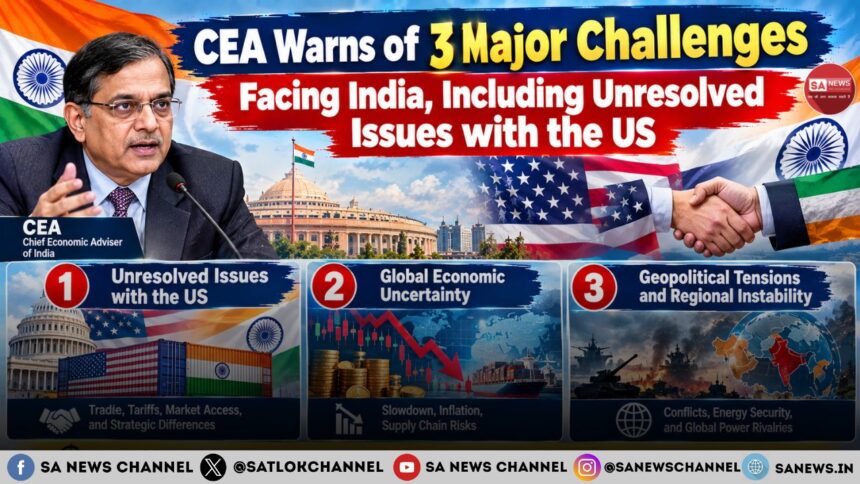
CEA Warning: Chief Economic Advisor (CEA) V. Anantha Nageswaran has warned about three challenges for India’s growth story in the near future with unresolved nature of relations with the United States. The CEA believes these challenges could have an adverse impact on India’s rapid economic momentum.
- CEA’s Big Warning on India’s Economy: Key Highlights
- India’s Economic Growth Under Pressure? CEA Highlights US Disputes, Energy Volatility and AI Challenge
- India’s Economic Growth Remains Robust
- Building Manufacturing Capabilities is Essential
- Advice on Formulating a Strategy for Foreign Investment
- Highlighted the impact of AI on employment
CEA’s Big Warning on India’s Economy: Key Highlights
1. CEA Lists 3 Challenges That Could Impact India’s Growth
2. India’s Economic Growth Resilient Amid Global Uncertainty, Says Nageswaran
3. India’s Road to Developed Nation by 2047
4. India’s Trade Deficit Signals Urgent Need to Boost Domestic Manufacturing
5. Nageswaran Highlights Key Reforms to Attract Global Capital
6. CEA V. Anantha Nageswaran Urges India to Balance AI Innovation with Employment Growth
India’s Economic Growth Under Pressure? CEA Highlights US Disputes, Energy Volatility and AI Challenge
Chief Economic Advisor (CEA) V. Anantha Nageswaran has listed three challenges facing India’s growth story in the near term namely, unresolved issues with the US, volatile energy prices, and absence of Artificial Intelligence (AI) adoption in the country. These factors are limitingIndia’s economic pace, according to a Reuters report. On Thursday, Nageswaran addressed the State Bank of India (SBI) Banking and Economics Conclave in Mumbai, characterizing India-US relations as being in “uneasy equilibrium” due to persistent trade-related disagreements between the two nations.
India’s Economic Growth Remains Robust
Speaking at the 13th SBI Banking and Economics Conclave, Nageswaran stated that India’s economic growth remains robust despite the challenges with geopolitical tensions, weaponized supply chains, climate change, and competition from China’s manufacturing capabilities.
He said, “We need to rethink many of our ways of working and be prepared to adopt new approaches- whether we are in the private sector or the public sector.”
Requirements for Becoming a Developed Nation
Nageswaran stated that as India moves towards becoming a developed nation by 2047, it needs to enhance its manufacturing capabilities, attract foreign investment, and create jobs that are suitable for an AI-driven economy.
He stressed that the role of manufacturing goes beyond just diversifying economic growth but it is also vital for building resilience and strengthening economic security. Thus, India cannot be picking between manufacturing and service sectors, it needs to progress both.
Building Manufacturing Capabilities is Essential
India’s merchandise trade deficit is one of the factors pointing on the need to strengthen domestic manufacturing. Nageswaran pointed out that even with exclusions of oil and gold, the deficit is at around 3.5-4% of the GDP.
Additionally, the CEA emphasized that ‘indigenization’ can not be restricted to just replacing imports with domestic production, building manufacturing capabilities needs to go in tandem with export competitiveness.
Advice on Formulating a Strategy for Foreign Investment
Foreign investment is another area where Nageswaran believes India needs to beef up its strategy. With developed economies vying to attract capital, India needs robust state and national level policies. He identified tax certainty and simplicity, investor protection, and availability of skilled workforce as areas for attracting foreign investment.
Nageswaran also emphasized on the need to be prepared for disruptions or risks in global supply chains. He suggested that India should create buffers for essential goods and build capabilities for small but strategically important components that could cause bottlenecks in global supply chains.
Highlighted the impact of AI on employment
The CEA also highlighted the impact of AI on employment as a key area that needs to be focused on. He stated that India’s perspective should go beyond pioneering AI, but focus on how this technology might affect jobs.
Nageswaran remarked that India should aim to create both AI-enabled jobs as well as jobs insulated from AI’s impact. Labor intensive manufacturing can create employment, while service sector activities like hospitality, tourism, and elderly care can play an important role.
Despite the challenges, Nageswaran noted that India’s growth momentum remains robust. The economy has registered a growth rate of 7.8 percent. Meanwhile, reforms in digital public infrastructure, inclusion, capital expenditure, and formalization have enabled the economy to register sustained growth of 7 percent or higher.