

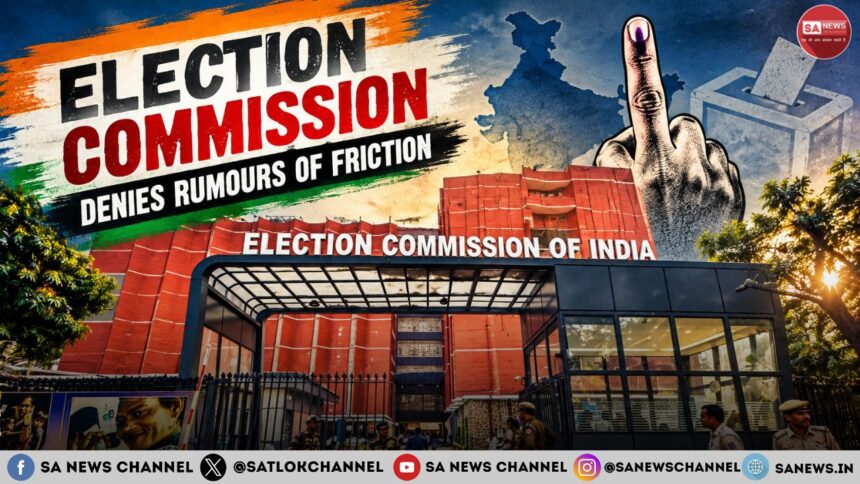
The Election Commission of India (ECI) has denied reports of friction and dissent inside the poll body, saying all of its actions are in accordance with statutory procedures, and that every decision taken by it over the past year has been taken unanimously by the full Commission.
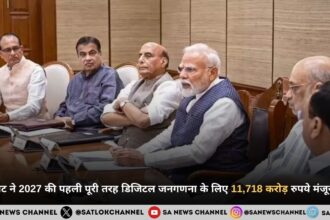
This comes after a report which revealed that two of the three Election Commissioners – Sukhbir Singh Sandhu and Vivek Joshi – had formally recorded written objections to at least 14 instances in the span of a 10-month timeframe from October 2025 to August 2026. The Commissioners accused that key administrative and electoral steps were taken in the name of the Commission without their knowledge, with several moves being described by them as “unauthorised and illegal” and the most serious notes copied to Chief Election Commissioner (CEC) Gyanesh Kumar.
ECI’s Stand: Notes Part of Deliberative Checks and Balances
Speaking to the allegations, the poll body argued that focusing on certain specific internal notes over the span of a 10-month period while ignoring the much larger body of approvals, decisions, instructions and initiatives gives only one part of the story.
“Highlighting certain specific internal notes or observations spread over the period of 10 months while overlooking the much larger body of approvals, decisions, instructions, and initiatives gives only one part of the picture,” the Commission stated in a formal release.
The poll body also pointed out that differing viewpoints are integral to governance:
- Multi-Member Framework: As a multi-member constitutional body, written notes, technical observations, checks and balances, and so forth are all part and parcel of standard administrative practices intended to ensure operational rigor and legal compliance.
- Open Input System: Not only the three Commissioners, but every officer in the Commission is fully authorised to submit suggestions to improve the electoral framework.
- Unanimous Decisions: The Election Commission reiterated that all of its decisions (e.g., ongoing Special Intensive Revision (SIR) of electoral rolls, approx 40 new initiatives and various electoral reforms) were taken unanimously by the full Commission.
- Statutory Compliance: The poll panel clarified that all directions are given in accordance with The Chief Election Commissioner and Other Election Commissioners (Appointment, Conditions of Service and Term of Office) Act, 2023.
Key Concerns Raised in Internal Objections
The investigative report outlined specific procedural and technical issues flagged by Election Commissioners Sandhu and Joshi:
- Form 6 Modifications: On May 16, Vivek Joshi noted on file that Form 6 (used for fresh voter registration) cannot be modified without amending the Registration of Electors Rules, 1960, and suggested that the matter should be referred to the Union government. Sandhu concurred on May 19. Despite the objections, an SIR declaration appeared on the online form in July. Sandhu wrote on August 13 that the addition had been made despite the clear objections, calling it “unauthorised/illegal” and requesting its immediate removal.
- Centralisation of Electoral Software: The Commissioners mentioned problems with ERONet and ECINet platforms. Sandhu noted on August 14 that ground-level officials have reported that they do not have full access to the ERONet portal, and stated that the Director General of IT does not have legal authority to restrict statutory officers. The Commissioners warned that centrally-controlled software could override the decisions of ground-level Electoral Registration Officers (EROs).
- Work Allocation and Administrative Orders: An order modifying internal work allocations (specifically relating to IT and ICT) was issued on July 28, following a Senior Deputy Election Commissioner’s temporary charge of Administration. Joshi noted that the order was issued without informing or discussing it with the Commission. Both Commissioners wrote separately to the Cabinet Secretary citing violations of Section 18(1) and 18(2) of the 2023 Act, and then proceeded to act jointly on July 30 to set aside the allocation.
- Appeals and Full Commission Meetings: Objections also related to pending questions of who authorised lakhs of appeals filed on behalf of the ECI against restored voters in West Bengal, an unanswered proposal for an audit of ECINet, and why no full Commission meetings were held between May and August.
Response on Digital Security and Statutory Powers
Addressing questions of digital roll management, the ECI maintained that ECINet platforms are safeguarded by cybersecurity measures and audit controls to prevent unauthorised access or tampering. It added that field authorities (EROs, DEOs) have been working strictly within their statutory mandates for voter additions and deletions.
Opposition Demands on CEC Gyanesh Kumar
After the news broke out about two Election Commissioners going against the decisions of Chief Election Commissioner Gyanesh Kumar, the opposition leaders immediately launched a scathing attack on him, demanding his resignation and the termination of the SIR exercise. The DMK president, M.K. Stalin demanded immediate resignation from office by Kumar besides calling off SIR. West Bengal chief minister Mamata Banerjee even went as far as demanding his arrest. Congress leaders Rahul Gandhi and Priyanka Gandhi, on their part, called his alleged violation of rules and tampering with voters as treason against the Constitution.