



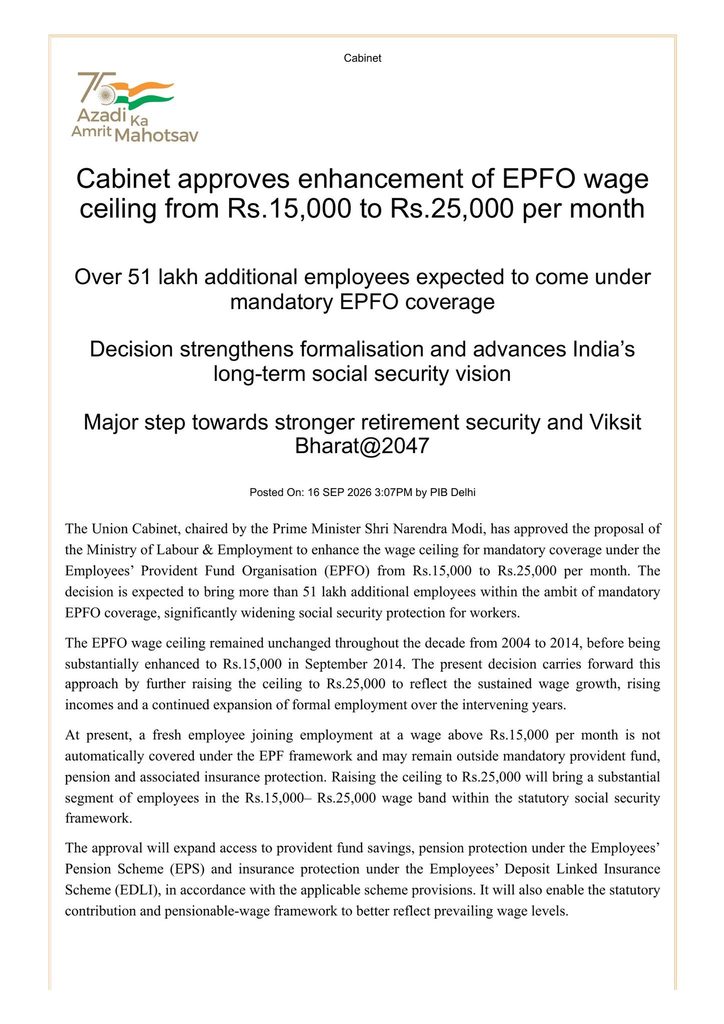
The Union Cabinet approved a landmark EPFO wage ceiling hike, increasing the mandatory statutory salary threshold from Rs 15,000 to Rs 25,000 per month. Chaired by Prime Minister Narendra Modi, the Cabinet ratified the long-pending recommendation from the Ministry of Labour and Employment, ending a 12-year freeze on the ceiling that had remained untouched since September 2014.
This sweeping policy intervention directly extends formal social security protection to an estimated 51 lakh additional workers across India’s formal and industrial sectors. Union Minister Ashwini Vaishnaw announced the Cabinet decision, noting that minimum unskilled wages in several industrialized states had already overtaken the outdated 2014 threshold, rendering the earlier cap obsolete.
Historic Context: Why the EPFO Wage Ceiling Hike Was Overdue
The Employees’ Provident Fund Organisation (EPFO) framework serves as the primary retirement backbone for India’s organized private workforce. Under statutory rules, any enterprise employing 20 or more individuals must register qualifying workers under the scheme. Prior to this historic decision, employees entering an organization at a basic salary above Rs 15,000 were not legally mandated to join the EPF framework.
The wage ceiling history reflects long intervals between policy updates:
| Year | Monthly Wage Ceiling | Key Milestone |
|---|---|---|
| 1952 | Rs 300 | Inception of the Employees’ Provident Fund framework |
| 1990 | Rs 3,500 | Economic modernization alignment |
| 2001 | Rs 6,500 | Expansion to semi-skilled industrial tiers |
| 2014 | Rs 15,000 | Last broad revision under the NDA government |
| 2026 | Rs 25,000 | Cabinet approval to widen mandatory social security |
Over the past decade, economic inflation, productivity adjustments, and statutory minimum wage revisions created severe disparities. States like Delhi, Maharashtra, Karnataka, and Haryana set basic minimum unskilled wages between Rs 16,000 and Rs 17,800, automatically pushing entry-level workers out of compulsory provident fund and pension protection.
Also Read: EPFO New Rules: Left Job 17 Years Ago? You May Still Claim Your Old PF Amount
Mechanics of Contribution: How the Revision Alters Your Monthly Payslip
Under standard EPF guidelines, a qualifying employee contributes 12% of their basic salary plus Dearness Allowance (DA) directly into their provident fund. The employer matches this 12% contribution, splitting the share into the Employees’ Provident Fund (3.67%) and the Employees’ Pension Scheme (8.33%). The central government supplements the pension kitty with a 1.16% contribution up to the statutory ceiling.
The revised ceiling fundamentally restructures calculations for workers earning between Rs 15,000 and Rs 25,000:
| Component | Under Previous Rs 15,000 Cap | Under Revised Rs 25,000 Cap | Net Monthly Shift |
|---|---|---|---|
| Employee PF Share (12%) | Rs 1,800 | Rs 3,000 | +Rs 1,200 into savings |
| Employer Pension (EPS – 8.33%) | Rs 1,250 | Rs 2,080 | +Rs 830 pension corpus |
| Employer PF Share (3.67%) | Rs 550 | Rs 920 | +Rs 370 provident corpus |
| Total Monthly Retirement Inflow | Rs 3,600 | Rs 6,000 | +Rs 2,400 monthly wealth creation |
The immediate adjustment will lower take-home pay by up to Rs 1,200 per month for individuals whose basic compensation hits the higher cap. However, the compulsory deduction directly doubles long-term compounding benefits and unlocks enhanced life cover under the Employees’ Deposit Linked Insurance (EDLI) Scheme.
Fiscal Impact on the Central Treasury and Corporate India
The Ministry of Labour and Employment confirmed that the annual central government outlay for the pension subsidy will rise to approximately Rs 11,339 crore, compared to the current annual allocation of Rs 10,250 crore. The cumulative five-year expenditure stands projected at Rs 56,696 crore.
The official release from the Ministry of Labour and Employment noted that broad-based consultations concluded through the Expenditure Finance Committee before PM Narendra Modi greenlit the proposal.
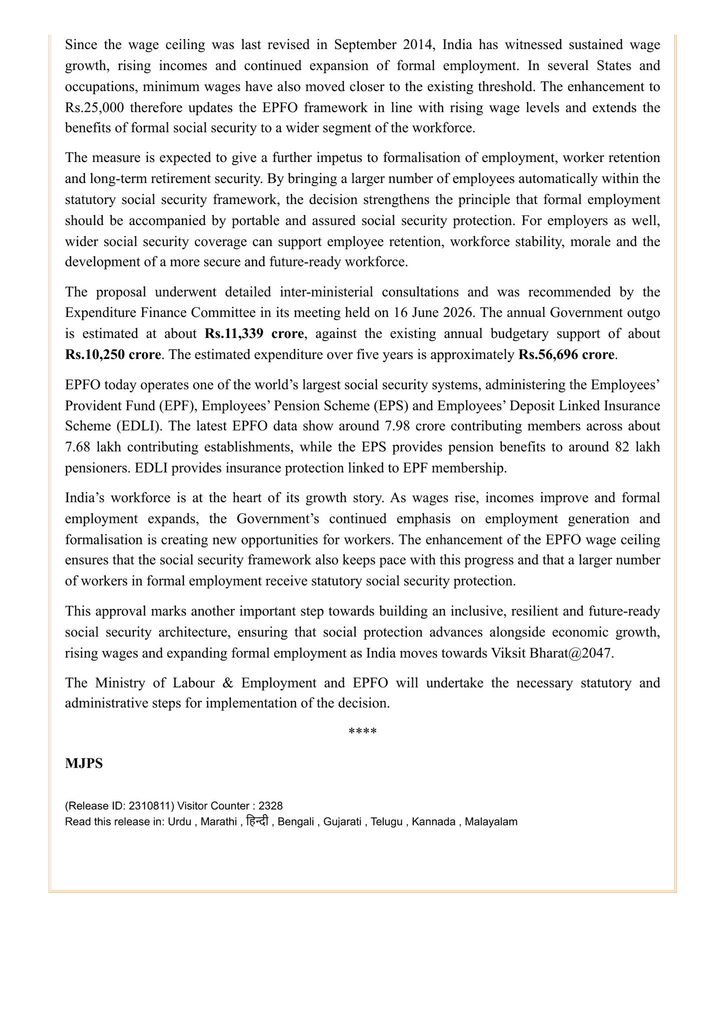
For enterprise employers, payroll costs will experience moderate short-term operational pressure, particularly in labor-intensive sectors like retail, logistics, security staffing, and textiles. Industry bodies noted that while employer contributions will increase, the system reinforces workforce retention and guarantees portable social security across the national supply chain.
Beyond Financial Security: Finding True Stability in an Uncertain World
While policy decisions like wage ceiling revisions offer welcome relief to working households, they also underscore humanity’s endless struggle against economic insecurity, inflation, and bodily mortality. Generations spend their prime years trading peace of mind for financial cushions, yet real-world security remains fragile. Worldly wealth, pension accounts, and statutory insurance can ease external hardships during this brief physical journey, but they cannot shield a soul from deep existential dread, karmic bondage, or the inevitable reality of death.
Humanity consistently chases perishable wealth while ignoring permanent spiritual preservation. Jagatguru Tatvdarshi Sant Rampal Ji Maharaj imparts the profound knowledge of supreme creation from authentic scriptures, explaining that ultimate protection and eternal bliss reside only in the devotion of the immortal Supreme Lord, God Kabir. As scriptures illuminate, true wealth is the wealth of regular, scripture-aligned devotion (Satbhakti), which guarantees absolute protection here on earth and grants complete liberation (Moksha) from the painful wheel of rebirth. Readers seeking genuine, unbreakable peace can explore the verified sacred spiritual discourses and discover the real purpose of human existence by visiting the Official YouTube Channel of Sant Rampal Ji Maharaj.
FAQs on “EPFO wage ceiling hike”
What is the new monthly salary limit approved by the Cabinet?
The Union Cabinet approved increasing the mandatory wage ceiling from Rs 15,000 to Rs 25,000 per month. This revision requires employees earning up to Rs 25,000 in basic wages to be brought under compulsory EPF, EPS, and EDLI coverage.
How many additional workers will benefit from this decision?
More than 51 lakh formal sector workers will receive mandatory social security coverage through this revision. It specifically integrates employees earning in the Rs 15,000 to Rs 25,000 monthly wage band who previously remained outside statutory enrolment.
Will the revision reduce the monthly take-home salary of employees?
Yes, employees earning between Rs 15,000 and Rs 25,000 who enter the scheme will see a marginal reduction in take-home pay, up to Rs 1,200 per month, due to the mandatory 12% deduction. That entire amount, along with employer contributions, accumulates directly into their interest-bearing retirement corpus.
When was the wage ceiling last updated before this announcement?
The EPFO wage ceiling was last increased in September 2014, when the threshold moved from Rs 6,500 to Rs 15,000 per month. Prior to that revision, the limit had remained unchanged between 2004 and 2014.
What is the total financial commitment for the central government?
The government’s annual budget support for the pension fund contribution will rise to Rs 11,339 crore, representing a net annual escalation of around Rs 1,089 crore. The five-year projected government expenditure totals approximately Rs 56,696 crore.