


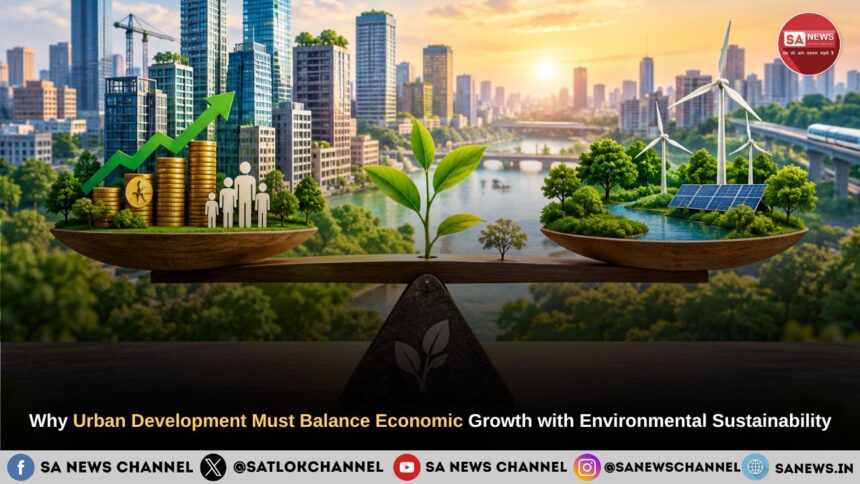
Modern cities are the engines of economic growth in today’s era. They create a lot of employment opportunities, connect people to the market, and support innovation. As they are growing at a fast pace, they play a crucial role in national as well as global development.
- Importance of Balancing Economic Growth with Environmental Sustainability
- Key Features of Sustainable Urban Development
- Major Challenges to Sustainable Urban Development
- Opportunities for sustainable cities
- Way Forward
- The Role of Citizens in Sustainable Urban Development
- The Future of Sustainable Urban Development
- A Spiritual Perspective: Sustainable Development and the Knowledge of Sant Rampal Ji Maharaj
However, this development didn’t come like a bouquet of roses; there are certain issues and concerns inclined to it, like air pollution, rising temperature, water scarcity, flooding, and loss of green space.
This made us take this matter seriously and work towards a sustainable development which focuses on environmental protection and quality of life.
Importance of Balancing Economic Growth with Environmental Sustainability
Urban development and environmental sustainability are related to each other. A city requires all the resources to function properly. If these resources are used inappropriately, it will lead to huge long-term social and environmental costs.
A polluted environment can lead to severe health problems and can reduce workers’ productivity. Traffic congestion can waste valuable time and fuel. The scarcity of water can affect households as well as businesses. Climate-related disasters can damage the infrastructure.
Therefore, environmental sustainability must be seen as an investment for our future generations.
Key Features of Sustainable Urban Development
Some common features of sustainable urban development include:
- Effective and efficient use of resources
- Integrated Urban Planning
- Climate-resilient infrastructure
- Social Inclusion
- Sustainable urban infrastructure
Major Challenges to Sustainable Urban Development
Some concerns often associated with sustainable urban development:
- Rapid and unplanned infrastructure development
- Rising demand for resources
- Huge competition for buying urban land
- Pollution and waste generation
- Climate change and global warming
These concerns suggest that urban development offers benefits, but they require mindful, sustainable usage of resources.
Opportunities for sustainable cities
There are various opportunities for economic growth and transformation.
- Use of low-carbon technologies
- Digitalisation and smart urban management
- Circular economy (use of triple R, i.e., reuse, recycle and reduce)
- Nature-based urban solutions
- Investment in sustainable finance
Way Forward
In order to achieve sustainable urban development, there is a requirement of a shift from fragmented planning towards long-term decision-making.
- Every major project or investment should consider its long-term environmental costs.
- Investment should primarily focus on resilient infrastructure.
- Cities should prioritise connected and accessible development.
- The government should encourage resource-efficient practices and public awareness.
- Citizens must be included in decision-making.
The Role of Citizens in Sustainable Urban Development
Urban sustainability cannot be achieved through government policies alone. Every single day whatever choices are made by millions of citizens collectively influence the environment. The government prepares policies to save water, save electricity and take care of sanitation, but the actual implementation will be seen at ground level only when citizens take the responsibility of the environment.
Citizen participation creates a stronger impact in maintaining and following the goals of sustainability. The young generation should be made sensitive towards the environment so that better implementation is done.
The Future of Sustainable Urban Development
The future of urban development completely depends on knowing and understanding that economic prosperity and environmental sustainability are complementary to each other rather than substitutes.
The biggest challenge is to create an urban model in which development improves along with the standard of living of the individuals. The successful city in the future will not be one which is full of tall buildings but a city where people live in dignity and consider the environment as a part of life and family.
A Spiritual Perspective: Sustainable Development and the Knowledge of Sant Rampal Ji Maharaj
A sustainable approach requires every citizen to recognise that resources are limited and human actions affect the natural world. The teachings which are associated with Sant Rampal Ji Maharaj emphasise spiritual knowledge, disciplined and simple living and responsible human behaviour.
Traditional Indian thinking encourages people to distinguish between needs and wants. The aim is not to avoid modern services but to use them wisely and responsibly.
Sant Rampal Ji Maharaj also emphasises doing the bhagti as per our scriptures to achieve salvation. There is a need for involving the concepts of going back to our scriptures to live a more peaceful life in this mortal world.
“A balanced life is not built on having more, but on understanding what is truly necessary.”