

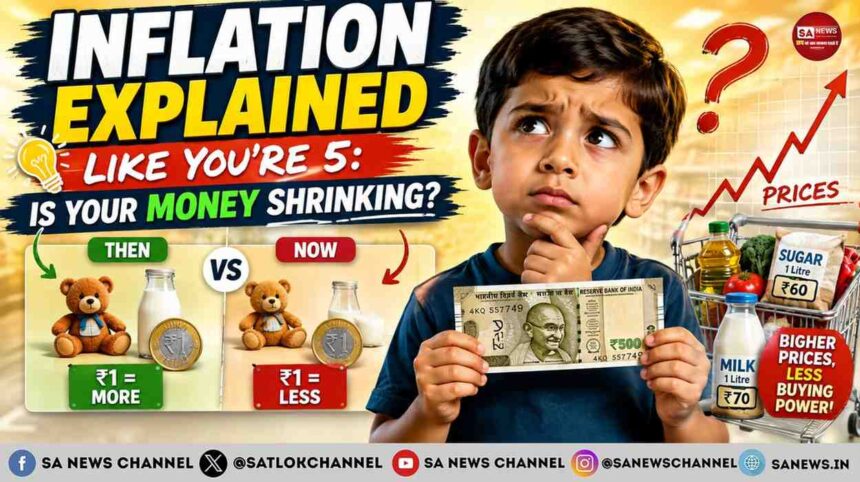
Inflation Explained: Ever wondered why earning the same amount of money can suddenly feel like having less? That is inflation quietly changing what your money can do. But why do prices rise, who decides whether inflation is too high and what does the RBI have to do with it? This guide explains it all without the economic jargon – simply enough for a five-year-old, but useful enough for every adult.
- Highlights
- What Is Inflation in Simple Words?
- Why Does Inflation Matter in Everyday Life?
- Why Can Inflation Feel Worse Than the Headline Number Suggests?
- What Causes Inflation in an Economy?
- What Is Cost-Push Inflation?
- How Can Supply Disruptions Push Prices Higher?
- Can More Than One Cause of Inflation Happen at the Same Time?
- What Are the Main Types of Inflation?
- What Happens If Inflation Becomes Extremely High?
- How Do We Calculate Inflation Using CPI?
- But Why Not Just Check the Price of Tomatoes or Milk?
- Does Everything in the CPI Basket Count Equally?
- CPI vs WPI: What Is the Difference?
- How High Is Inflation in India Right Now?
- Is Inflation Always Bad for the Economy?
- Why Is Zero Inflation Not Always the Goal?
- Inflation or Deflation: What Happens When Prices Move in Opposite Directions?
- Who Benefits From Inflation and Who Feels the Pinch?
- How Does Inflation Affect Your Savings and Salary?
- How Do Central Banks Control Inflation?
- What Role Does the RBI Play in Managing Inflation?
- A Simple Rule for Understanding Whether Inflation Is Hurting You
- When Inflation Is a Percentage for Some, but a Crisis for Others
- When Everything Costs More, Giving Costs More Too
- Annapurna Muhim
- FAQs
Highlights
- Inflation means prices across an economy are generally moving upward over time, reducing what money can purchase.
- India’s retail inflation hit 4.45% in July 2026 (provisional), according to MoSPI data on the new 2024-base series.(Source: MoSPI)
- But what does that 4.45% actually mean when you’re paying for groceries, rent, fuel or everyday essentials?
- The Reserve Bank of India targets 4% CPI inflation, with a tolerance band of 2-6%. This framework was retained by the government in March 2026 for another five years.(Source: RBI Bulletin)
- But why doesn’t the RBI simply aim for zero inflation?
- The inflation you read about may not be the inflation you personally feel. Your spending habits determine why rising prices can hurt your budget much more or less than the headline CPI number suggests.
- Prices rarely rise for just one reason. Demand surges, higher production costs and supply disruptions can push inflation upward and sometimes all three strike together.
- Interest rates work like a brake on an overheating economy. Understand how the RBI can make borrowing costlier to cool demand, and why fighting inflation can bring its own financial pain.
- Three simple questions can reveal whether inflation is making you poorer in real terms. Compare what is happening to your expenses, income and savings returns.
- You can’t control inflation, but you can change how exposed your finances are to it. Learn practical ways to protect your budget, emergency savings and long-term purchasing power as prices rise.
What Is Inflation in Simple Words?
Inflation is a continuing rise in the overall price level of goods and services that causes money to lose some of its buying power over time.
- An easy example: Imagine you have INR 100 and your favourite chocolate costs INR 20. You can happily buy five.
- A year later, you return with the same INR 100, but each chocolate now costs INR 25. This time, you can take home only four.
- Nothing happened to the INR 100 note. What changed was how much that INR 100 could purchase.
- That shrinking ability of money to buy things is called a decline in purchasing power.
- However, one expensive chocolate does not automatically mean inflation.
- Suppose chocolate prices rise because cocoa becomes scarce while most other prices remain unchanged. That is a price increase in one product, not necessarily inflation across the economy.
Inflation describes a broader movement in prices, rather than an isolated increase in the cost of a single item.
Why Does Inflation Matter in Everyday Life?
Inflation matters because it determines how much your income and savings can actually buy as everyday expenses change.
A case scenario to understand much better:
Imagine your family has INR 50,000 to spend every month.
- Last year, that money was enough to pay for the house, groceries, electricity, school, petrol and other everyday needs. At the end of the month, everything was paid for.
- Now imagine the family still gets the same INR 50,000, but things have become more expensive.
- The grocery shop wants a little more. The school wants a little more. Petrol costs more. The electricity bill is higher.
- Suddenly, paying for all the same things would need INR 54,000.
- But your family still has only INR 50,000.
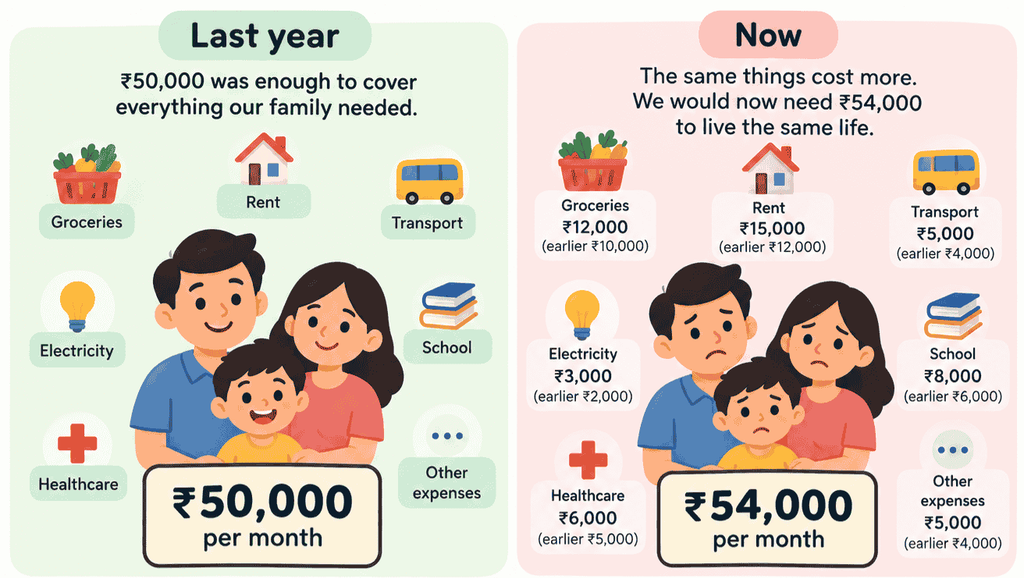
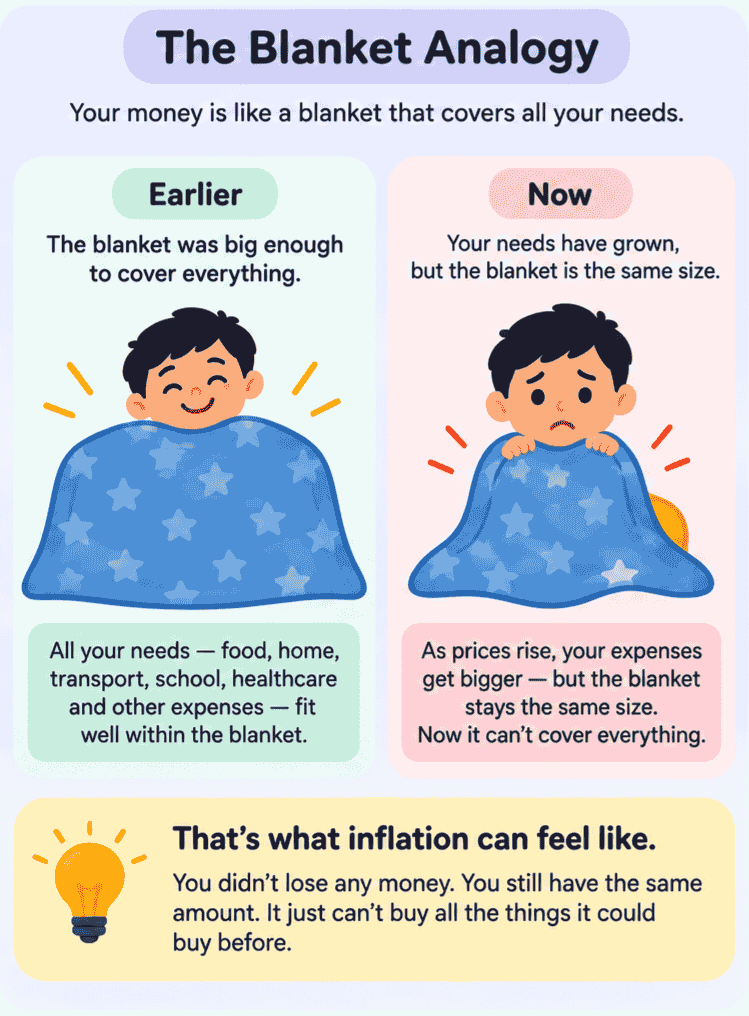
That is what inflation can feel like. You still have the same amount, but it no longer covers the same purchases.
This infographic explainer nails the blanket analogy for you:
Inflation can show up in familiar places:
- A grocery basket costs more.
- Your landlord increases the rent.
- School or college fees rise.
- Petrol and transportation become costlier.
- Restaurant bills creep upward.
- Medical expenses consume more of the household budget.
This is also where inflation and cost of living differ slightly. Inflation is an economic measure based on changes in a broad set of prices, whereas your cost of living reflects the expenses that matter specifically to you.
Someone who drives long distances every day may feel a sharp rise in fuel prices much more strongly than someone who works from home. Your personal experience of rising costs can therefore differ from the headline inflation figure.
Why Can Inflation Feel Worse Than the Headline Number Suggests?
Inflation can feel worse than the official rate because every household spends money differently and individual prices do not rise at the same speed. Here is an easier way to understand this dynamics:
- Imagine national inflation is 4%, but the food your family buys regularly becomes 9% more expensive.
- If groceries take up a large portion of your monthly budget, your personal experience may feel much harsher than the 4% headline number suggests.
- The same applies to rent, fuel, school fees or healthcare.
- A person who rarely drives may barely notice a sharp increase in petrol prices, while someone commuting 50 kilometres every day will feel it immediately.
- This gives us an important idea that headline inflation measures the economy broadly, but personal inflation reflects the prices that matter most to your own household.
- There is another reason inflation feels so noticeable.
- Higher prices confront you repeatedly. You see them when buying groceries, filling your fuel tank, paying rent or ordering food.
- Even when your salary also rises, the higher prices remain highly visible and felt each day
- For example, receiving a 7% salary increase may feel good once, but paying more for dozens of everyday purchases throughout the year can feel painful again and again.
Also read: Global Inflation 2026: How Rising Prices and Job Markets Will Affect Everyday People
What Causes Inflation in an Economy?
Though this sub-topic is vast in itself, we will briefly explore it at the surface level. Inflation can develop when spending grows faster than supply, businesses face rising costs, shortages disrupt production or monetary and economic conditions encourage prices to move higher.
Importantly, inflation rarely has one neat explanation. In reality, inflation often develops when different economic forces collide. Let us look at the two most common types of inflations:
What Is Demand-Pull Inflation?
Demand-pull inflation happens when people want to buy goods and services faster than businesses can provide them.
- Example: a toy shop receives 50 new toys, but 200 children want one. The shop cannot instantly manufacture another 150 toys.
- With plenty of buyers competing for limited stock, prices may rise.
In other words, demand is pulling prices upward because supply cannot keep pace.
What Is Cost-Push Inflation?
Cost-push inflation occurs when businesses face higher expenses and pass at least some of those additional costs on to customers through higher prices.
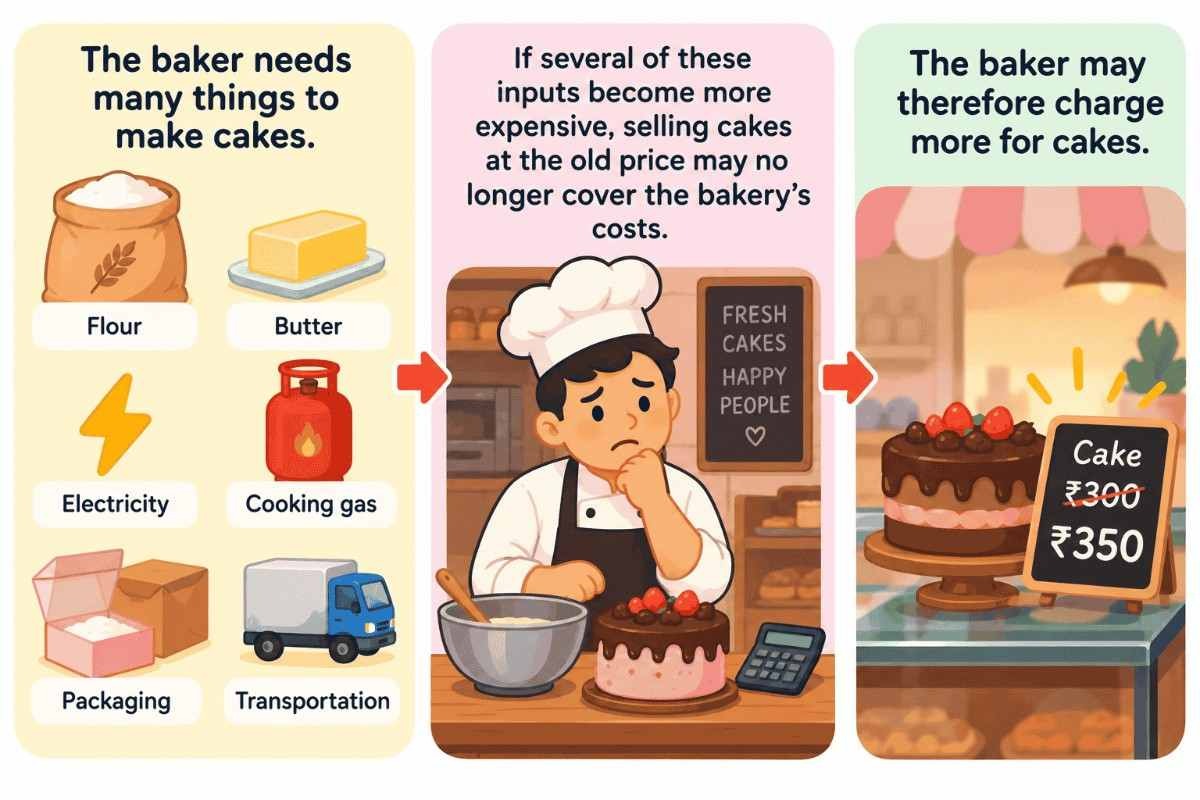
- Example: In a bakery, the baker needs flour, butter, electricity, cooking gas, packaging and transportation.
- If several of those inputs become significantly more expensive, selling cakes at the old price may no longer cover the bakery’s costs. The baker may therefore charge more.
This effect can travel through an economy. For instance, expensive fuel can raise transportation costs, which may increase the cost of moving food, clothing and other products.
How Can Supply Disruptions Push Prices Higher?
Supply disruptions can create inflationary pressure when essential goods or production inputs suddenly become harder to obtain. This is important to decode.
- Some real cases: Poor weather can damage crops and reduce food supplies. A geopolitical conflict may interrupt energy supplies, while shipping disruptions can make imported components scarce.
- When supply falls but people still need those products, prices can move upward.
- It is therefore misleading to reduce every inflation episode to the phrase ‘the government printed too much money’.
Money and credit conditions can influence inflation, but demand, productive capacity, supply constraints, expectations and monetary conditions interact in different ways depending on the circumstances.
Can More Than One Cause of Inflation Happen at the Same Time?
Several causes of inflation can operate at the same time, which is why real-world inflation rarely has one single explanation.
It can be best understood with examples:
- Suppose a restaurant that suddenly has twice as many customers.
- At the same time, cooking oil, vegetables, electricity and transportation all become more expensive.
- The restaurant is now facing pressure from both sides – higher demand from customers and higher costs of serving them.
- This is exactly why inflation cannot always be neatly labelled as only demand-pull or only cost-push.
- A larger version of this happened during and after the COVID-19 pandemic.
- Supply chains were disrupted, factories and businesses faced production problems, and shipping became difficult.
- Later, consumer demand recovered quickly while many supply problems had not yet disappeared.
- In other words, people wanted to buy more at a time when the economy was still struggling to supply everything they wanted.
- That combination helped create unusually strong inflationary pressure.
- Real-world inflation is often created by several forces like demand, supply, production costs and expectations etc., working together.
Also read: The Invisible Tax: How Corruption Fuels Inflation and Public Suffering
What Are the Main Types of Inflation?
Inflation can range from mild and manageable price growth to extremely rapid increases that seriously disrupt an economy.
A few basic categories make these differences easier to understand:
| Price Environment | What Happens | Effect Possible |
| Low or moderate inflation | Prices increase gradually | INR 100 slowly buys a little less |
| High inflation | Prices climb quickly | Household planning becomes harder |
| Hyperinflation | Prices increase at an extraordinary pace | Money can rapidly lose usefulness |
| Deflation | Overall prices decline for a sustained period | Money buys more, but the economy may face other problems |
What Happens If Inflation Becomes Extremely High?
Hyperinflation is an exceptionally severe form of inflation in which prices rise so rapidly that money can lose purchasing power at an extraordinary rate.
A real life case would be receiving your salary and discovering that essential products become noticeably more expensive before you have even finished spending it. Saving, pricing products and signing long-term contracts become extremely difficult. Hyperinflation should therefore not be confused with the relatively modest annual price increases seen in ordinary economic conditions.
How Do We Calculate Inflation Using CPI?
The Consumer Price Index, or CPI, helps measure inflation by checking how the overall cost of things households commonly buy changes over time. Think of CPI as one giant imaginary shopping basket. But unlike your grocery basket, this one does not contain only food.
It represents many of the things households regularly spend money on, such as:
- Food and drinks,
- Clothes and footwear,
- Housing-related expenses,
- Petrol, bus fares and other transport costs,
- Medicines and healthcare,
- School and education expenses,
- Other commonly purchased goods and services.
Suppose this giant basket costs INR 10,000 today. After some time, statisticians check the prices of those things again. Buying the same basket would now cost INR 10,500.
The basket has become 5% more expensive. That increase helps show how much consumer prices, taken together, have changed.
But Why Not Just Check the Price of Tomatoes or Milk?
CPI looks at many different prices because one product becoming expensive does not necessarily mean prices everywhere are rising.
- A case to consider: Tomatoes might suddenly become much more expensive because heavy rain damaged the crop. Meanwhile, the prices of clothes, medicines, school supplies and many other things may barely change.
- If we looked only at tomatoes, we might conclude that everything had suddenly become much more expensive. This would not be true.
- So, what does CPI look at instead? It checks the prices of many different things households commonly spend money on.
- Imagine that during the same period tomatoes become 20% more expensive, clothes remain at the same price, transport becomes 3% more expensive, medicines become 2% more expensive, while some other prices rise, fall or remain unchanged.
- CPI brings these different price movements together to see what happened to the cost of the household basket as a whole.
- So CPI isn’t simply asking ‘Did tomatoes become more expensive?’
- It is asking ‘Has the overall basket of things households buy become more expensive, and if so, by how much?’
That is the basic idea behind using CPI to measure inflation.
Does Everything in the CPI Basket Count Equally?
No. CPI gives greater importance to categories on which households typically spend a larger share of their money.
Again we need to understand with an example here:
- Imagine your family spends INR 5,000 on food but only INR 500 on footwear during a particular period.
- Now suppose both food and footwear prices rise by 10%.
- Would those two increases affect your household equally? No.
- A 10% increase in something you spend INR 5,000 on matters much more to your budget than a 10% increase in something you spend only INR 500 on.
- CPI takes this difference into account. Economists call this weighting.
- But there’s an easier way to remember it: The things households spend more of their money on get a bigger say in the final CPI number.
- The International Monetary Fund similarly explains CPI as a measure based on changes in the prices of goods and services consumed by households, with different items weighted according to their share in household expenditure. (Source: International Monetary Fund, 2025)
So, if the Consumer Price Index ever sounds complicated, just remember one picture. A giant household shopping basket. Check its price today. Check the same basket again later. If the overall cost has risen, CPI helps show us by how much.
CPI vs WPI: What Is the Difference?
CPI measures price changes faced by consumers, while WPI tracks price movements largely at the wholesale level.
Example: The wholesale price of wheat rises before that increase fully reaches the packet of flour you buy from a supermarket. WPI can capture changes earlier in the supply chain, while CPI focuses more directly on what consumers are paying.
This is why CPI is especially relevant when asking questions such as:
- Are groceries becoming more expensive?
- Is everyday living costing households more?
- How much purchasing power is consumers’ money losing?
- How is inflation affecting ordinary people?
For an individual trying to understand the effect of inflation on everyday spending, CPI is generally the more directly relatable measure.
How High Is Inflation in India Right Now?
India’s headline CPI inflation stood at 4.45% year-on-year in July 2026, according to official data available when this article was prepared. (Source: Ministry of Statistics and Programme Implementation, 2026)
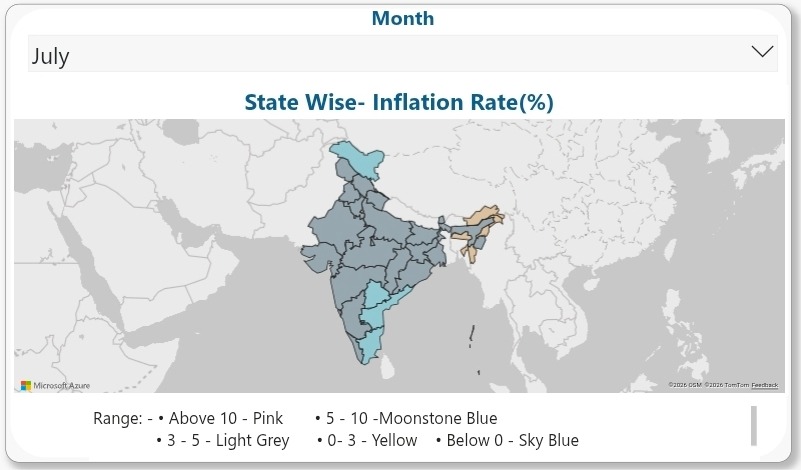
India’s updated CPI series uses 2024 as its base year. The revised system also expanded price collection and incorporated newer consumption patterns to better represent household expenditure.
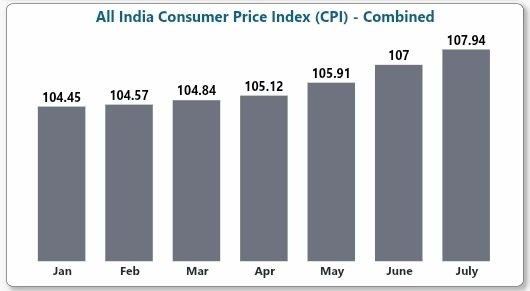
Because inflation changes every month, readers should always check the latest official MoSPI release rather than treating any figure in an older article as today’s inflation rate.
Is Inflation Always Bad for the Economy?
Inflation is not automatically harmful because low and predictable price growth can exist alongside a healthy economy, while rapid or erratic inflation is far more disruptive.
- Predictability makes a huge difference.
- If businesses, workers and households can reasonably anticipate changes in prices, they can plan salaries, budgets, contracts and investments more effectively.
- India’s flexible inflation-targeting framework centres on 4% CPI inflation, with a tolerance range of 2% to 6%, as mentioned earlier in the article. This structure has been retained for the next 5 years.
The objective is therefore not necessarily to make inflation permanently zero. Price stability is about keeping inflation sufficiently controlled and predictable for households and businesses to make sensible decisions.
Why Is Zero Inflation Not Always the Goal?
Zero inflation is not automatically ideal because continuously falling or stagnant prices can create problems of their own.
- If you want to buy a refrigerator for INR 30,000, but you strongly believe it will cost INR 27,000 next year. You may decide to wait.
- Now imagine millions of people begin delaying purchases for the same reason.
- Businesses sell fewer products, earn less revenue and may reduce investment or hiring.
- That is one reason persistent deflation (a broad decline in prices) can become troublesome.
- Japan provides a useful real-world lesson. The country experienced long periods of very weak inflation and episodes of deflation following the collapse of its asset bubble in the early 1990s. Weak demand, slow wage growth and cautious spending became persistent economic challenges.
- This also does not mean rising prices are always desirable.
- It means the goal is generally stable prices rather than prices that endlessly rise or endlessly fall.
Inflation that is far too high hurts purchasing power. Persistent deflation, on the other hand, can discourage spending and investment.
What policymakers generally want is inflation that remains low, stable and predictable.
Inflation or Deflation: What Happens When Prices Move in Opposite Directions?
Inflation describes a sustained increase in the general price level, while deflation describes a sustained decline in the general price level.
Falling prices may initially sound fantastic. Why wouldn’t everyone want cheaper products?
Persistent economy-wide deflation, however, can create problems. If consumers expect products to become cheaper later, they may postpone spending. Businesses can then receive less revenue, reduce investment or cut employment, potentially weakening economic activity further.
Cheaper prices are not automatically evidence of a healthier economy.
Who Benefits From Inflation and Who Feels the Pinch?
Inflation affects people differently because its impact depends on wages, debt, savings, assets, interest rates and individual spending patterns.
- A person on a fixed income can struggle if essential expenses increase while earnings remain unchanged.
- Similarly, someone keeping substantial long-term savings entirely in cash can gradually lose purchasing power.
- Borrowers can experience inflation differently. Someone with long-term fixed-rate debt may sometimes benefit if income rises while the real value of the debt falls, although the outcome depends heavily on wages, interest rates and personal circumstances.
- Workers can also fare differently. If someone’s salary rises 8% while their expenses rise 4%, their purchasing power may improve. If salary increases by 3% while expenses jump 7%, the opposite occurs.
How Does Inflation Affect Your Savings and Salary?
A higher salary does not necessarily increase your purchasing power if prices are rising even faster.
Suppose a person’s salary increases from INR 50,000 to INR 52,500 per month. It is a 5% rise and may seem fine to begin with. But suppose the cost of maintaining your usual lifestyle rises by 7% during the same period.
You now earn more rupees, but those rupees do not stretch as far. The difference lies between earning more in numbers and actually being able to buy more.
Nominal simply describes the number you see. Real asks what that number can actually buy after inflation is considered. A salary can rise on paper while your real purchasing power falls.
Inflation weakens the real value of savings and income whenever they grow more slowly than the prices of the things you need to buy.
If you have an investment earning 6% annually while inflation is 4%. Your statement may show a 6% gain, but that does not mean your purchasing power improved by the full 6%.
A useful beginner approximation is:
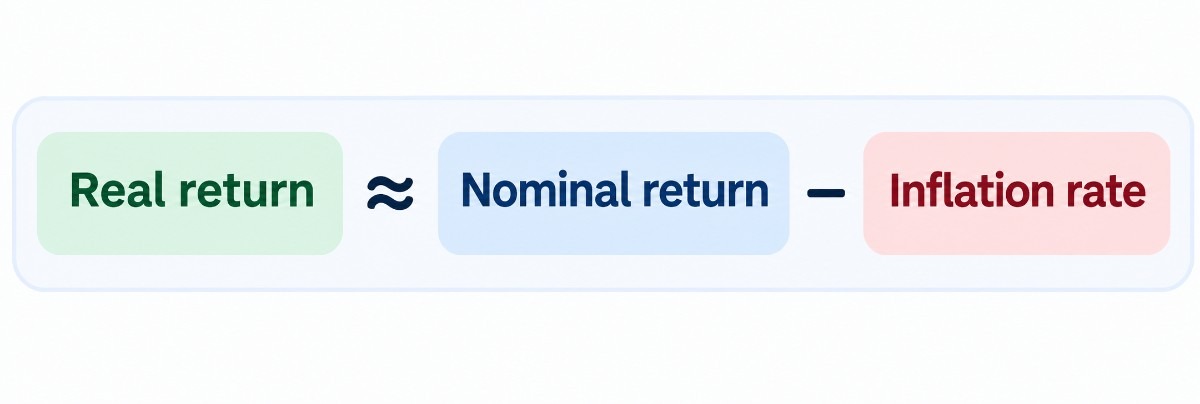
Using that shortcut, a 6% nominal return with 4% inflation produces a real return of roughly 2%, before considering taxes, charges and the more precise compounding calculation.
The same principle applies to salaries. A 5% pay rise may sound good, but if your living expenses rise 7%, your real spending power has fallen despite earning more rupees.
Also read: Best Tax-Saving Investment Options in India: A Complete Guide for 2026
How Do Central Banks Control Inflation?
Central banks try to influence inflation by adjusting monetary conditions, particularly interest rates, which affect borrowing, saving, spending and demand.
Let us understand how:
- Interest rates are one of the economy’s brakes and accelerators.
- When borrowing becomes more expensive, people may postpone certain purchases and businesses may reconsider some investments.
- A family wanting to buy a car might delay taking a car loan if monthly repayments become substantially more expensive.
- If millions of households and businesses reduce borrowing and spending, overall demand can cool.
- However, interest rates cannot immediately repair every cause of inflation. A higher policy rate cannot produce a failed wheat crop or reopen a disrupted shipping route.
This distinction matters because inflation caused mainly by excessive demand behaves differently from inflation driven by a sudden shortage.
Why Does Higher Interest Make Inflation Fall?
Higher interest rates can reduce inflation by making borrowing more expensive and encouraging people and businesses to spend less.
- Continuing with the car example: If 100 people are thinking about borrowing money to buy cars and interest rates are lower, most of them could decide to borrow.
- Now if interest rates rise considerably. Some buyers may think about it and want to wait as the EMI would turn out more expensive at that moment.
- Perhaps only 70 people now borrow instead of 100.
- When this pattern happens across millions of households and businesses, fewer borrowed rupees chase goods and services. That can reduce demand and ease some pressure on prices.
- However, controlling inflation this way comes with a trade-off.
- Higher interest rates can help cool inflation, but they can also make home loans, vehicle loans and business borrowing more expensive.
- Someone planning to buy a house may face a higher monthly loan repayment after interest rates rise. A business may postpone opening another factory because borrowing for the project has become costlier.
- Central banks therefore cannot simply keep raising rates without considering the wider economy.
Inflation control is a balancing act. Policymakers want to cool excessive demand without unnecessarily damaging jobs, investment or economic growth.
What Role Does the RBI Play in Managing Inflation?
The Reserve Bank of India uses monetary policy to maintain price stability while taking the economy’s growth requirements into account. One of the RBI’s most visible tools is its policy interest rate. Changes in monetary policy can influence borrowing costs across the financial system and, over time, affect spending and demand.
When demand-driven inflation remains persistently high, tighter monetary conditions can discourage some borrowing and spending. Lower demand can then reduce some pressure on prices. However, these measures take time to work and may not always produce the expected outcome. RBI policy works through the wider financial system, which means changes can take time to influence households, businesses and prices.
A Simple Rule for Understanding Whether Inflation Is Hurting You
Inflation hurts your finances most when your essential expenses rise faster than your income and long-term savings.
You can therefore ask yourself three simple questions and use it as your checklist:
- Are my everyday expenses rising? Then compare groceries, rent, transport, utilities, education and healthcare with what you paid a year ago.
- Is my income keeping up? For the answer, compare your percentage salary or income increase with the increase in your regular expenses.
- Are my savings growing faster than inflation? Comparing your investment or savings return with the inflation rate rather than looking only at the headline return, will answer this question.
- Example: If your salary rises 6%, your essential expenses rise 4%, and your long-term savings earn 7%, inflation may be manageable for you.
- But if your salary rises 3%, essential expenses rise 8%, and your savings earn 4%, inflation is steadily squeezing your purchasing power from both sides.
The more important question to analyse yourself is whether your income and savings keep pace with the prices that matter to you.
When Inflation Is a Percentage for Some, but a Crisis for Others
Inflation may appear as a percentage on an economic report, but for a family already struggling to survive, even a small rise in everyday expenses can become a serious crisis.
For someone with financial security, a higher grocery bill may mean cutting back on eating out, postponing a purchase or saving a little less that month. But what happens when there is already nothing left to cut?
For a family struggling to afford food, more expensive flour, cooking oil, vegetables, medicines or school supplies can force impossible choices. When every rupee is already accounted for, inflation does not simply reduce purchasing power. It can push basic necessities further out of reach.
And perhaps that is where the subject of inflation stops being only about economics.
When Everything Costs More, Giving Costs More Too
Rising prices do not increase the cost of living only for the person receiving help. They also increase the cost of providing that help. Feeding a family, buying clothes, purchasing medicines, building a house costs, seeds, fertilizers, other agricultural essentials, everything costs more too.
And yet, at a time when almost every act of giving has itself become more expensive, something extraordinary is unfolding across India, largely away from the attention it deserves.
Under the guidance of Jagatguru Tatvdarshi Sant Rampal Ji Maharaj, a one-of-a-kind humanitarian movement is steadily reaching people at the very edges of society – families without enough food, children whose education is at risk, patients unable to afford treatment, people without safe homes, disaster-hit communities and now even small-scale farmers struggling to sustain their livelihoods.
But its scale alone is not what makes this movement remarkable. It is the way help is being given. Poverty is not being treated as a reason to lower the standard of what a human being deserves.
This is not assistance offered merely to tick a box, distribute a token package or create a photograph. The help provided across the different sections is of top notch quality, exactly the same as we would do for our families. And this principle changes everything.
What is taking shape, therefore, is far bigger than a conventional charity drive. It is an expanding system of humanitarian support built around a simple idea – find the need, verify it and address it with the same dignity and quality you would expect for your own family.
And this movement has a name: Annapurna Muhim
Annapurna Muhim
In an age when blood relations are killing each other for money, Jagatguru Tatvdarshi Sant Rampal Ji Maharaj is spearheading the most historic movement ever. A movement that defies all the changing dynamics of the current world we live in. A movement that teaches us to embrace each and every soul with compassion, share all resources and care for others just as we would for our own family.
Sant Rampal Ji Maharaj’s Annapurna Muhim promises a simple yet profound reality – ‘Koi Bhookha Na Soye’ (no one should sleep hungry). But the mission does not stop at hunger.
Families in extreme poverty are provided a complete monthly ration; children receive school fees, books and uniforms; the sick receive medicines; and those surviving in dilapidated huts are given safe, permanent homes. The support is extended without discrimination, political motive or monetary exchange.
What makes Annapurna Muhim even more remarkable is that the helpless are not always expected to find help; help goes looking for them. Dedicated volunteers survey areas to identify families living in severe poverty, their circumstances are respectfully verified on the ground, and assistance is delivered directly to their doorstep, without forcing them through lengthy paperwork.
As awareness spreads, people with genuine needs are also coming forward themselves. Their circumstances are assessed and, where the criteria are fulfilled, assistance is extended under the instructions of Sant Rampal Ji Maharaj.
And yet, Annapurna Muhim is far more than a humanitarian movement. It is part of Sant Rampal Ji Maharaj’s vision to make India ‘Sone Ki Chidiya’ (the Golden Bird) once again. At a time when people and authorities remain caught in an endless cycle of blaming one another for society’s problems, Sant Rampal Ji Maharaj is working at the roots and systematically eradicating addiction, dowry, corruption, discrimination and other social evils while nurturing compassion, equality, brotherhood and moral integrity.
This is not merely a vision of a better India. It is a blueprint for rebuilding society from within, where every soul matters. Watch this eye-opening video to see how that transformation is already taking shape:
To know more, visit:
- Website: www.jagatgururampalji.org
- YouTube: Sant Rampal Ji Maharaj
- Facebook: Spiritual Leader Saint Rampal Ji
- ‘X’ handle: @SaintRampalJiM
FAQs
Q1) What does inflation mean in simple terms?
Answer: Inflation means everyday prices broadly increase, so your money gradually pays for less than before.
Q2) How does inflation affect the value of money?
Answer: As prices climb, each rupee covers fewer purchases, effectively weakening its buying power.
Q3) How does the RBI manage inflation in India?
Answer: The RBI adjusts monetary conditions, including interest rates, to influence borrowing and spending and help keep inflation under control.