


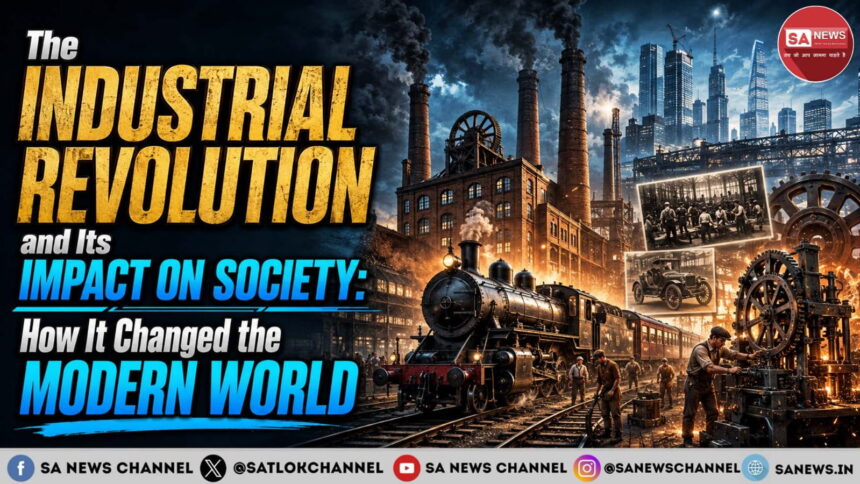
We can never imagine a world without factories, railways, or mass production. These are basic to modern civilization. The Industrial Revolution is considered as one of the most transformative phases of human history which redefined economies, technology, and everyday life on a substantial scale.
- Causes of the Industrial Revolution
- Social Impact of the Industrial Revolution
- Impact on Workers and Labor Conditions
- Technological Advancements and Their Long-Term Influence
- Environmental Impact of the Industrial Revolution
- Positive and Negative Effects of the Industrial Revolution
- The Industrial Revolution’s Legacy in Today’s World
- Technology is a Gift of God: Saint Rampal Ji Maharaj
The Industrial Revolution led to the replacement of handcraft production with tech-powered manufacturing. This phase is believed to be the period of drastic increase in productivity and laid the foundation for the present day global economy. The Industrial Revolution also had its challenges; it introduced child labour, packed cities, and environmental pollution.
Continue with the article to understand the insights of the industrial revolution. Also know the reason why the industrial revolution became a turning point in history and how its innovations continue to influence modern industries, artificial intelligence, automation, and the future of society.
Causes of the Industrial Revolution
The Industrial Revolution was driven by multiple economic, technological, and social changes that reshaped the world. The Agricultural Revolution led to the increases in the overall food production, which ultimately led to population growth, which created a huge workforce for the emerging industries.
Additionally, revolutionary technological advancements, such as the steam engine as well as mechanised textile machines, transformed manufacturing and elevated productivity. The plentiful availability of natural resources including coal and iron produced the raw materials required for the industrial expansion.
Not only this, the extension of global trade as well as capital investment allowed entrepreneurs to finance the emerging factories, infrastructure as well as the unfolding inventions. All these factors supported industrialization, which ultimately turned Britain into the birthplace of the Industrial Revolution and transformed the global economy in many ways that continue to influence modern society.
Economic Impact of the Industrial Revolution
The Industrial Revolution caused a major impact on the global economy. The Industrial Revolution redefined the global economy by transforming traditional agriculture-based societies into robust industrial economies. The rise of factories and mass production enabled manufacturers to produce goods faster, at lower costs, and on a phenomenal scale, making products more accessible to the common people.
At the same time, the emerging global trade and markets supported by the transportation systems, also allowed the raw materials and finished goods to move efficiently across continents. The Industrial Revolution witnessed an unfolding of capitalism and an industrial economy, where private investment, entrepreneurship, and competition drove innovation and economic expansion.
At the dawn of the 19th century, the industrialized nations witnessed astonishing economic growth. But industrialisation also widened the gap between rich and poor, which highlighted the major challenges and opportunities of the modern economic development.
Social Impact of the Industrial Revolution
The period of the Industrial Revolution transformed the ways in which the people lived, worked or interacted. Urbanization and emergence led to the migration of millions of workers from rural villages into industrial zones in search of jobs in the factories.
Simultaneously, family life and living conditions underwent great changes as old jobs of family workers were replaced by wage jobs, which resulted in overpopulation and poor living conditions for a number of families.
The Industrial Revolution also triggered the growth of education and literacy, as the industries required workers with a high level of qualifications and the states made steps towards improving accessibility of education.
Also read: The Black Death: The Plague That Changed the World
Impact on Workers and Labor Conditions
The Industrial Revolution brought both challenges and opportunities to the living conditions of workers and labourers. While the industrial revolution created millions of new employment opportunities, the factory working conditions were often inhumane, with employees enduring long hours, unprotected environments, and less wages.
Among all these negative aspects, the darkest aspect of this era was child labor during the Industrial Revolution. Children as young as five or six worked in factories and mines under dangerous conditions to support their families.
These global injustices eventually led to the rise of labor unions and workers’ rights movements, which fought for fair wages, shorter working hours, safer workplaces, and legal protections for employees. Their efforts resulted in major labor reforms which continued to shape modern employment laws and workplace standards around the world.
Technological Advancements and Their Long-Term Influence
Many technological advancements transformed communication, transportation and industrial production during the Industrial Revolution. Innovations in communication including the telegraph, which allowed the speedier information exchange across long ranges, transforming business and governance.
Additionally, advances in the field of transportation, including steam-powered railways and ships, reduced travel time, expanded trade, and connected regions, which were difficult previously. These groundbreaking transformations established the foundation of modern industrial technology, inspiring continuous innovation in engineering, manufacturing, and automation.
The technological progress achieved during the Industrial Revolution continues to influence today’s digital economy, artificial intelligence, smart factories, and advanced manufacturing systems, proving that this historic era remains relevant in shaping the future of global development.
Environmental Impact of the Industrial Revolution
The Industrial Revolution had a major environmental impact, leading to rapid industrial growth which came with a significant ecological cost. The massive number of coal-burning plants caused severe air and water pollution, making life difficult and unhealthy in industrializing cities.
Factories that were dependent on timber and coal for construction and heat, caused large scale destructive impact on forests. This was similar to the erosion of natural resources. While environmental concerns were not acknowledged in the 18th and 19th centuries, the process of industrialization had long-term effects.
Positive and Negative Effects of the Industrial Revolution
The positive and negative effects of the Industrial Revolution continue to shape societies around the world. Among its key benefits to society were:
- Increased Productivity
- Technological Innovation
- Higher Economic Output
- Improved Transportation
- Mass Production Of Affordable Goods
All these factors raised living standards for many people during the Industrial Revolution. However, the Industrial Revolution also brought major challenges and drawbacks.
- Poor Factory Conditions
- Child Labor
- Income Inequality
- Overcrowded Cities
- Severe Environmental Pollution.
While industrialization accelerated global progress and created countless opportunities for economic growth, it also exposed the need for labor laws, social reforms, and environmental regulations. Its mixed legacy demonstrates that technological advancement must be accompanied by ethical responsibility and sustainable development.
The Industrial Revolution’s Legacy in Today’s World
The legacy of the Industrial Revolution is still apparent in today’s world in everything from production, logistics, modern means of communication, and commerce.
The automated factories, supply chains, the use of modern engineering, and large-scale production techniques of the modern industries are all among the advancements of the Industrial Revolution. Today, many researchers believe the Digital Revolution and the development of AI, robotics, and smart technologies can be regarded as the next phase of changes in the industry, known as the Fourth Industrial Revolution.
Similar to the steam engines that changed the 18th century, digitization affects businesses, working environments, and life in all its aspects confirming that the effect of the Industrial Revolution still appears in modern history and can play a great role in shaping the future of humanity.
Technology is a Gift of God: Saint Rampal Ji Maharaj
In the spiritual discourses of Saint Rampal Ji Maharaj, it is taught that technology is a precious gift from the Supreme God Kabir Saheb, which is intended to benefit humanity and support spiritual progress. Saint Rampal Ji Maharaj teaches that this technology should be used to gain true spiritual knowledge, listen to God’s teachings, and spread the message of salvation rather than wasting time on worldly distractions such as gossip, politics, excessive entertainment, or gaming.
When used wisely, technology is a powerful tool for knowing about the true worship of the Supreme God, connecting people with God and attaining salvation, which is the ultimate goal of human life. For more information, visit Sant Rampal Ji Maharaj Ji Maharaj YouTube Channel or visit www.jagatgururampalji.org.