

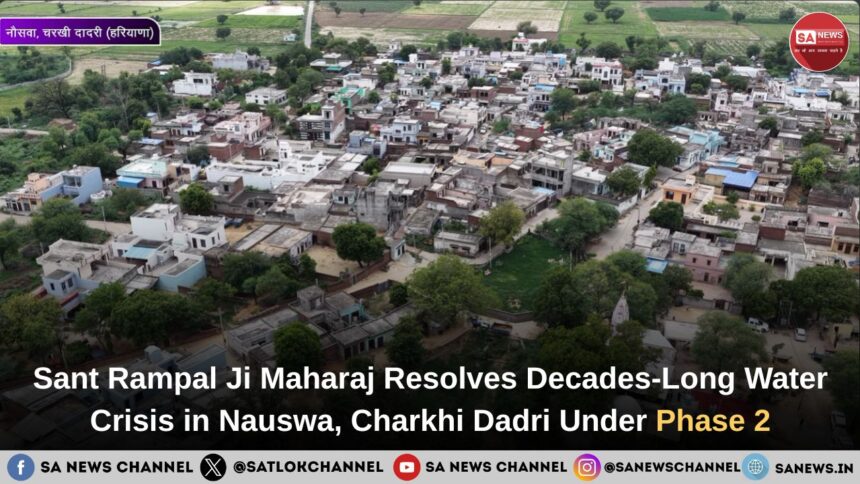
In Nauswa village, situated within the Charkhi Dadri Tehsil of Charkhi Dadri district, Haryana, residents faced two severe water-related challenges that persisted for years without state resolution:
- On-Site Survey Conducted by the Technical Team of Sant Rampal Ji Maharaj
- Material Dispatch and Complete Relief Provided by Sant Rampal Ji Maharaj
- Equipment and Technical Summary Table
- Arrival of Relief Fleet and Village Reception
- Nationwide Scope of Humanitarian Campaigns Initiated by Sant Rampal Ji Maharaj
- Agricultural Waterlogging:
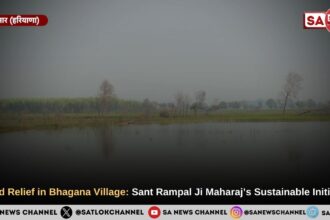
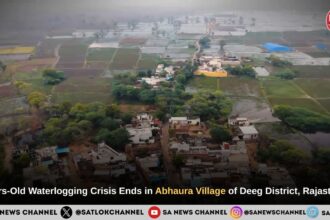
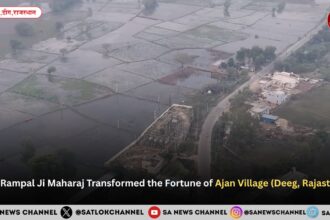
- For the past three to four years, standing rainwater affected approximately 200 acres of agricultural land out of the total 700 acres belonging to the village.
- The construction of six link roads connecting adjacent villages disrupted natural drainage pathways, trapping run-off water near the village boundaries and inundating farm fields instead of directing it into the local dry pond (johar).
- Standing water ruined cash crops, particularly cotton (kapas). Historically, farmers in Nauswa harvested up to 14 quintals of cotton per acre, earning the village a strong reputation in the Charkhi Dadri grain market (mandi). Recent standing water reduced yields to zero, forcing farmers to halt crop cultivation entirely.
- Livestock feed and health were severely affected due to submerged fields and ruined fodder.
- Brackish Underground Drinking Water:
- Underground water in Nauswa had been non-potable and highly saline for 40 to 80 years, dating back to the establishment of the village.
- Total Dissolved Solids (TDS) levels ranged from 550 PPM to 850 PPM.
- Consuming the water led to widespread health complications, including jaundice (peeliya) and skin conditions (charm rog), resulting in three to four recorded deaths two to three years prior.
- The saline water destroyed domestic Reverse Osmosis (RO) water purifiers within months. An RO unit requiring three service visits per year incurred annual maintenance costs of ₹12,000—exceeding the purchase price of a new ₹10,000 unit.
- Water stored in the village storage tank (diggi), supplied by two local borewells, turned green and unusable for humans and cattle.
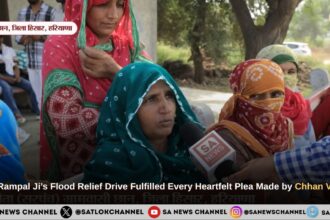
- Women and villagers gathered at two public handpumps connected to an 11 km supply pipeline running from Bhala village to Makrana village, queuing with earthen pots (matkas) to collect drinking water.
- Government Inaction:
- Village representatives submitted multiple petitions over a period of 3 to 3.5 years to local administrators, Members of the Legislative Assembly (MLAs), state ministers, and the Chief Minister, requesting a drainage canal and canal water arrangements.
- Sarpanch Representative Naseeb Kumar made over 500 unsuccessful attempts to secure government intervention.
On-Site Survey Conducted by the Technical Team of Sant Rampal Ji Maharaj
Following an official request submitted by the Gram Panchayat of Nauswa at 4:00 PM, Sant Rampal Ji Maharaj dispatched a specialized technical survey team within 24 hours under the Kisan Mazdoor Bachao Abhiyan Phase 2 and the Shuddh Peyjal Seva Abhiyan.
- Survey Methodology:
- The survey team analyzed geographic contours using Google Maps alongside on-ground physical inspections of farm fields, village boundaries, drainage paths, water storage tanks, and neighboring terrain.
- Survey Findings and Equipment Determination:
- Drainage Requirements: To redirect accumulated rainwater from 200 acres of farmland into the dry village pond, the team calculated a requirement of 6,000 feet of 8-inch PVC pipeline and three 10 HP electric motor sets.
- Drinking Water Pipeline Requirements: To convey potable water from a high-quality water source near the Sarnali Feeder canal in Bhala village (Rewari district, located 4 km from Nauswa), the survey determined a requirement of 11,000 feet of 6-inch PVC pipeline.
- Tube Well Requirements: A borewell site was identified near Bhala village where sweet water was accessible at a depth of 140 to 150 feet. Equipment needs included 150 feet of 10-inch casing pipe, a 10 HP submersible motor, and an automatic starter.
Material Dispatch and Complete Relief Provided by Sant Rampal Ji Maharaj
Within 48 hours of receiving the Gram Panchayat’s request, Sant Rampal Ji Maharaj approved the relief package and delivered all required equipment directly to Nauswa village through a fleet of 8 to 10 loaded trucks.
- Pipes and Equipment Provided Directly by Sant Rampal Ji Maharaj:
- 8-Inch Pipeline: 6,000 feet of heavy-duty Kasta brand 8-inch PVC pipes for agricultural water drainage.
- 6-Inch Pipeline: 11,000 feet of heavy-duty Kasta brand 6-inch PVC pipes for drinking water transport.
- Total Pipeline Delivered: 17,000 feet of pipeline.
- Tube Well Casing Pipes: 160 feet of 10-inch borewell casing pipes (comprising 8 pipes of 20 feet each, exceeding the required 150 feet).
- Motors: Three 10 HP electric surface motors for field drainage and one 10 HP Texmo brand submersible motor set with an automatic starter for the tube well (total of 4 heavy-duty motors).
- Comprehensive Installation Accessories: Kasta PVC bends, air release valves, PVC solvent cement (Favicol), rubber gaskets, heavy-duty iron joining plates, stainless steel nuts and bolts, electrical insulation tape, steel wire, and heavy-duty motor installation rope.
- Guidelines Issued for Installation:
- Sant Rampal Ji Maharaj instructed the Gram Panchayat to bury the pipelines underground, test all joints for leakages by flushing water prior to covering them with soil, and systematically install air release valves to ensure long-term durability.
Equipment and Technical Summary Table
| Category | Specification / Item | Quantity / Volume Provided | Purpose / Objective |
| Drainage Pipeline | 8-Inch Kasta PVC Pipes | 6,000 Feet | Draining 200 acres of standing water into dry pond |
| Drinking Water Line | 6-Inch Kasta PVC Pipes | 11,000 Feet | Transporting sweet water 4 km from Bhala village |
| Borewell Casing | 10-Inch PVC Pipes | 160 Feet (8 x 20 ft) | Tube well casing at Sarnali Feeder canal site |
| Pumping Motors | 10 HP Texmo Submersible Set | 1 Unit | Extracting sweet drinking water from borewell |
| Drainage Motors | 10 HP Surface Electric Motors | 3 Units | Pumping rainwater from farm fields to pipeline |
| Hardware Accessories | Air Valves, Bends, Plates, Fasteners | Complete Kit | Joint sealing, air venting, and pipeline maintenance |
Arrival of Relief Fleet and Village Reception
The arrival of the material convoy led to celebrations across Nauswa village.
- Welcoming Ceremony:
- Between 100 and 200 villagers, including Sarpanch Representative Naseeb Kumar, Gram Panchayat members, women, elders, and children, assembled at the village entrance with flower garlands and blossoms.
- Volunteers conducted a traditional sacred chanting (Mangalacharan), while villagers performed flower showers and shouted slogans of gratitude.
- Sarpanch Representative Naseeb Kumar carried the portrait of Sant Rampal Ji Maharaj on his head at the front of the procession.
- Villagers distributed sweets (laddus) throughout the community to mark the resolution of their 70- to 80-year-old water crisis.
- Statements from Local Representatives and Residents:
- Naseeb Kumar (Sarpanch Representative): Stated that while government authorities failed to act after three years of continuous appeals, Sant Rampal Ji Maharaj dispatched a survey team within 24 hours and delivered complete high-grade material within 48 hours.
- Deepak (Government Employee & Resident): Highlighted that the relief benefits all 36 communities (chhattis biradari) of the village, restoring agricultural viability and relieving women of daily water hauling duties.
- Elderly Female Resident (Tai): Expressed that generations had suffered from saline water, and the provision of fresh drinking water restored health and well-being to the village.
- Pappu and Sanjay (Villagers): Confirmed that political leaders made empty promises during elections, whereas Sant Rampal Ji Maharaj delivered immediate physical solutions without charging any fees or freight costs.
Nationwide Scope of Humanitarian Campaigns Initiated by Sant Rampal Ji Maharaj
The project in Nauswa village forms part of a broader nationwide welfare effort directed by Sant Rampal Ji Maharaj across multiple states, including Haryana, Punjab, Rajasthan, Uttarakhand, and Himachal Pradesh.
- Active Campaigns:
- Kisan Mazdoor Bachao Abhiyan Phase 2: Provides pipeline infrastructure, motor pumps, and drainage tools to flood-affected and waterlogged agricultural areas.
- Shuddh Peyjal Seva Abhiyan: Installs borewells and long-distance conveyance pipelines to bring clean drinking water to drought-affected or saline areas.
- Pashudhan Bachao Shuddh Jal Pilao Abhiyan: Ensures clean drinking water supplies for cattle and livestock to prevent diseases.
- Agricultural Input Relief Scheme: Sant Rampal Ji Maharaj provides free fertilizers, seeds, and crop protection medicines for up to 2.5 acres of land per farmer upon submitting registration forms at Dhanana Dham.
To date, Sant Rampal Ji Maharaj has extended full infrastructure relief and completed water management projects in over 100 villages across India.