

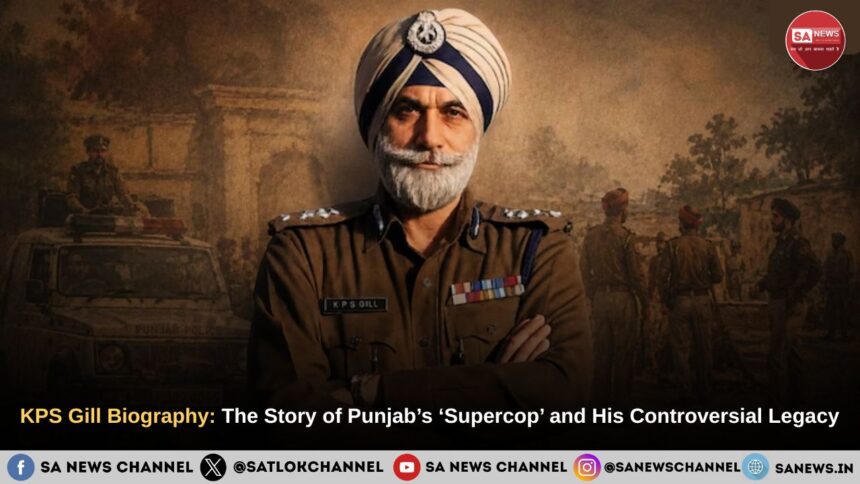
KPS Gill, the former Punjab Director General of Police (DGP), has once again become a topic of national discussion after renewed debates around the film Satluj (earlier titled Panjab ’95), involving Jaswant Singh Khalra’s life (a human rights activist). Known as the “Supercop of India” and the “Lion of Punjab”, Gill remains one of the most debated figures in India’s security history.
- Who Was KPS Gill?
- KPS Gill and Punjab Militancy: How Did He Fight Insurgency?
- Operation Black Thunder II: A Major Turning Point
- Why Is KPS Gill’s Legacy Controversial?
- KPS Gill’s Awards and Later Career
- Why Is KPS Gill Trending Again?
- The Limitation of Human Power and the Law of True Peace
- FAQs on KPS Gill
While supporters credit KPS Gill with ending the Khalistani insurgency in Punjab during the 1990s, critics continue to question the methods used during the counter-insurgency period.
Who Was KPS Gill?
Kanwar Pal Singh Gill was an Indian Police Service (IPS) officer from the 1958 batch who served in the Assam-Meghalaya cadre before returning to Punjab during a period of severe unrest.
Born on December 29, 1934, in Ludhiana, Punjab, Gill gained national attention for his tough policing approach. He served as Punjab DGP twice — from 1988 to 1990 and again from 1991 to 1995 — during the peak years of militancy in the state.
KPS Gill and Punjab Militancy: How Did He Fight Insurgency?
During the late 1980s and early 1990s, Punjab faced widespread violence linked to separatist militancy. As DGP, KPS Gill introduced an intelligence-driven counter-insurgency strategy focused on:
- Strengthening police intelligence networks
- Targeting militant leadership
- Improving coordination between security agencies
- Increasing operational capabilities of Punjab Police
His approach played a major role in reducing militant activities by the mid-1990s, helping restore democratic functioning and normal civilian life in Punjab.
Operation Black Thunder II: A Major Turning Point
One of Gill’s most significant operations was Operation Black Thunder II in May 1988 at the Golden Temple complex in Amritsar.
Unlike Operation Blue Star in 1984, which involved heavy military action and caused major damage to the complex, Operation Black Thunder II relied on a controlled security operation involving negotiations, intelligence gathering, and targeted action.
According to official accounts, the operation ended with dozens of militants killed and several others surrendering. The event was also notable because media access was permitted, making it one of the most publicly observed counter-insurgency operations in India.
Why Is KPS Gill’s Legacy Controversial?
Despite his success against militancy, KPS Gill’s career remains surrounded by criticism related to alleged human rights violations during the Punjab insurgency period.
Human rights organizations and activists documented allegations of:
- Illegal detentions
- Fake encounters
- Disappearances
- Unidentified cremations
One of the most prominent cases connected to this period was the disappearance and murder of human rights activist Jaswant Singh Khalra in 1995. Khalra had investigated allegations related to unidentified bodies and secret cremations in Punjab.
A Central Bureau of Investigation (CBI) investigation later resulted in convictions of Punjab Police personnel involved in the case. However, KPS Gill was never convicted in relation to Khalra’s murder.
KPS Gill’s Awards and Later Career
For his contribution to national security, KPS Gill received the Padma Shri award in 1989.
After retiring from the police service in 1995, he continued working in security-related fields. He founded the Institute for Conflict Management and later advised governments on security issues, including anti-insurgency strategies.
He passed away on May 26, 2017, in New Delhi at the age of 82.
Why Is KPS Gill Trending Again?
The renewed discussion around KPS Gill is linked to the upcoming release debates surrounding Satluj (Panjab ’95), a film based on Jaswant Singh Khalra’s life.
The controversy has reopened conversations about how India remembers its conflict years — whether through the lens of national security achievements or questions of accountability and human rights.
The Limitation of Human Power and the Law of True Peace
The biography of KPS Gill, Punjab’s ‘Supercop’, highlights a life of immense power, iron-fisted authority, and a controversial legacy. While history credits him with restoring law and order through force, the vital question remains: Can true peace ever be established through weapons? Can human authority wipe out the root cause of unrest? This makes us wonder—if suppressing crime externally leaves a trail of controversy, are we truly transforming human consciousness?
Jagatguru Tatvdarshi Sant Rampal Ji Maharaj reveals that no worldly strategy can bring permanent peace. This mortal realm is ruled by Kaal Brahm, who traps souls in vices and karmic debt. True transformation happens not by the sword, but through the spiritual purification of the soul. Only scripture-based worship granted by a Complete Saint can dissolve karmic bonds and eliminate hatred from its root, establishing real harmony. To understand how true peace and a crime-free society are being established today, watch this eye-opening video:
Website: www.jagatgururampalji.org
YouTube: Sant Rampal Ji Maharaj
Facebook: Spiritual Leader Saint Rampal Ji
‘X’ handle: @SaintRampalJiM
FAQs on KPS Gill
What was KPS Gill famous for?
KPS Gill was famous for leading Punjab Police during the 1990s counter-insurgency campaign against Khalistani militancy.
Did KPS Gill end Punjab militancy?
KPS Gill was one of the key security officials involved in reducing militant activities in Punjab during the 1990s, although multiple agencies contributed to the outcome.
Was KPS Gill convicted in the Jaswant Singh Khalra case?
No. KPS Gill was never convicted in the Jaswant Singh Khalra murder case. Several Punjab Police personnel were convicted after a CBI investigation.