

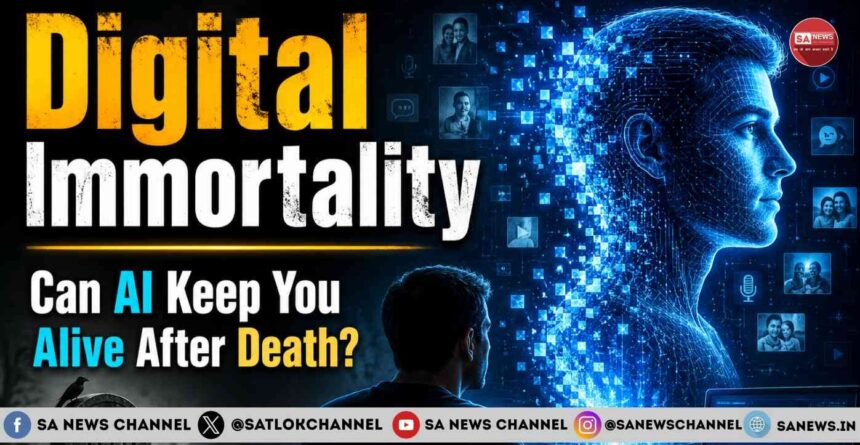
For centuries, humanity has dreamed of conquering death. From ancient myths to modern science, the desire to live forever remains one of our deepest aspirations. Today, Artificial Intelligence (AI) has introduced a fascinating new concept known as Digital Immortality. Through AI-powered avatars, digital twins, voice cloning, and memory-based chatbots, technology companies claim that a person’s digital presence can continue even after physical death. But does this mean humans can truly become immortal? Can consciousness be preserved through algorithms and data? Or is digital immortality simply an advanced simulation? Let’s explore the science, ethics, opportunities, and spiritual dimensions behind this revolutionary idea.
- What Is Digital Immortality?
- How AI Creates a Digital Version of You
- The Rise of AI Afterlife Technology
- AI Startups Creating Digital Humans
- Can AI Actually Preserve Consciousness?
- Benefits of Digital Immortality
- The Psychology Behind the Desire for Immortality
- How Digital Immortality Could Transform Family Relationships
- The Business of Digital Afterlife Services
- Digital Immortality and the Future Workplace
- The Role of AI in Preserving Cultural Heritage
- Could Digital Immortality Change How Society Views Death?
- Legal Challenges in the Age of Digital Humans
- The Difference Between Legacy and Immortality
- Preparing for Your Digital Legacy
- Risks and Ethical Concerns
- Understanding the True Immortality Through Spirituality
- FAQs on Digital Immortality
What Is Digital Immortality?
Digital immortality refers to the preservation of a person’s identity, memories, behavior, voice, and personality using advanced technologies such as:
- Artificial Intelligence (AI)
- Machine Learning
- Voice Cloning
- Digital Twins
- Generative AI
- Virtual Reality
- Deep Learning
- Neural Networks
- Chatbots
- Digital Legacy Platforms
The goal is to create an AI model capable of interacting like the original person, even after death. Imagine your grandchildren having conversations with a digital version of you decades after you’re gone. This is the vision driving the rapidly growing digital afterlife industry.
How AI Creates a Digital Version of You
Data Collection
AI systems gather information from:
- Social media posts
- Emails
- Videos
- Voice recordings
- Text messages
- Personal journals
- Online interactions
Personality Modeling
Machine learning algorithms analyze patterns such as:
- Writing style
- Speech habits
- Emotional responses
- Personal preferences
- Decision-making tendencies
AI Avatar Generation
The collected information is used to create:
- Interactive chatbots
- Voice replicas
- 3D digital avatars
- Virtual companions
These systems can simulate conversations that closely resemble interactions with the original person.
Also read : National Technology Day 2026: Is Science & Technology greater than Spirituality?
The Rise of AI Afterlife Technology
Several startups and technology companies are investing heavily in digital resurrection technologies. Recent developments show growing interest in preserving human identity digitally after death. Companies are building AI systems capable of recreating voices, memories, and personalities for future interactions. Researchers describe these systems as “interactive representations of deceased individuals” that use personal data to simulate conversations.
The emerging industry is often called:
- Digital Afterlife Industry
- AI Afterlife
- Digital Resurrection
- Virtual Legacy Technology
Researchers warn that while the technology is advancing rapidly, important ethical and legal questions remain unresolved.
AI Startups Creating Digital Humans
Startups are developing services that preserve a person’s stories, voice, and personality so future generations can interact with a digital version of them. One company gained attention for creating detailed AI replicas using extensive interviews and personal life histories.
These innovations demonstrate that digital immortality is moving from science fiction toward commercial reality.
Can AI Actually Preserve Consciousness?
This is where science draws an important distinction.
What AI Can Preserve
AI can preserve:
- Voice patterns
- Speech style
- Memories
- Photos
- Behavioral tendencies
- Knowledge
What AI Cannot Preserve
There is currently no scientific evidence that AI can preserve:
- Human consciousness
- Self-awareness
- Soul
- Emotions as genuinely experienced
- Spiritual identity
The AI avatar does not “become” the person.
Instead, it predicts responses based on data.
Think of it as an incredibly advanced imitation rather than actual survival.
Experts continue to emphasize that digital replicas represent patterns of information, not the continuation of human consciousness.
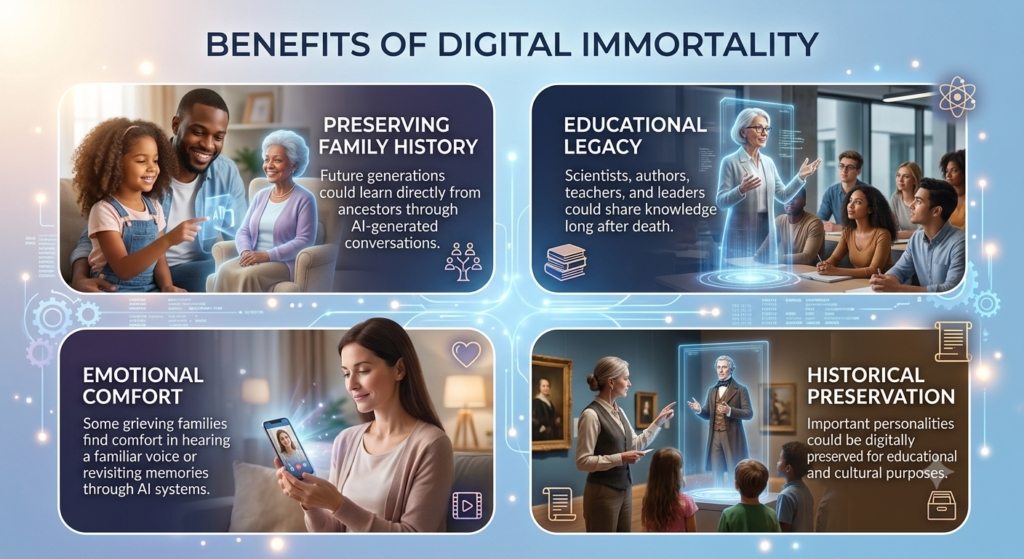
Benefits of Digital Immortality
Preserving Family History
Future generations could learn directly from ancestors through AI-generated conversations.
Educational Legacy
Scientists, authors, teachers, and leaders could share knowledge long after death.
Emotional Comfort
Some grieving families find comfort in hearing a familiar voice or revisiting memories through AI systems.
Historical Preservation
Important personalities could be digitally preserved for educational and cultural purposes.
The Psychology Behind the Desire for Immortality
The idea of living forever is not new. Ancient civilizations built monuments, wrote scriptures, and created family lineages to ensure they would be remembered long after death. Today, AI-powered digital immortality is the modern expression of the same desire.
Psychologists believe that humans naturally seek meaning, legacy, and continuity. Knowing that our memories, experiences, and wisdom may survive through technology provides a sense of comfort. For many people, digital immortality is less about avoiding death and more about ensuring that future generations remember who they were.
This emotional connection is one reason why AI memorial platforms are attracting attention worldwide. They offer individuals an opportunity to preserve stories, life lessons, and personal experiences that might otherwise be lost over time.
How Digital Immortality Could Transform Family Relationships
Future generations may interact with digital archives of their ancestors in ways never before possible.
Imagine a teenager learning about family history not from old photo albums but through an AI-powered conversation with a digital version of a great-grandparent. Instead of reading written records, descendants could ask questions and receive personalized responses based on preserved memories and historical information.
This could revolutionize genealogy, family storytelling, and cultural preservation. Families may build extensive digital heritage libraries that allow future generations to remain connected to their roots.
However, experts also caution that AI-generated responses may not always accurately reflect the original person’s thoughts, creating challenges in preserving authentic family history.
The Business of Digital Afterlife Services
Digital immortality is becoming a rapidly growing industry.
Technology companies are exploring subscription-based services that help individuals create digital legacies during their lifetime. These services often include:
- Voice preservation
- AI chatbot creation
- Digital memory archives
- Virtual memorial spaces
- Interactive family history platforms
Market analysts predict that as AI becomes more advanced, demand for digital legacy solutions will continue to grow. Many people now consider their digital presence as valuable as physical assets, leading to discussions about “digital inheritance” and online estate planning.
This emerging sector could become a significant part of the future digital economy.
Digital Immortality and the Future Workplace
One of the most surprising applications of digital immortality may appear in professional environments.
Organizations are exploring ways to preserve the expertise of retiring employees, scientists, engineers, and business leaders. AI systems could capture decades of knowledge and create interactive digital mentors capable of answering questions for future employees.
For example, a company could maintain access to the expertise of a highly experienced professional long after their retirement. Instead of losing institutional knowledge, organizations could use AI-powered knowledge archives to train future generations.
This concept raises important questions about intellectual property, ownership of professional knowledge, and ethical use of personal data.
Also Read- Digital Immortality
The Role of AI in Preserving Cultural Heritage
Beyond individual preservation, AI is increasingly being used to safeguard collective human history.
Languages, traditions, folklore, and indigenous knowledge systems are at risk of disappearing as communities change over time. Digital immortality technologies could help preserve cultural identities by recording stories, customs, and historical experiences in interactive formats.
Future generations may one day learn directly from AI-generated cultural ambassadors trained on authentic historical records and community knowledge.
Such applications could play a vital role in protecting humanity’s diverse cultural heritage for centuries to come.
Could Digital Immortality Change How Society Views Death?
Throughout history, death has been considered a final and unavoidable part of life. However, AI technologies are beginning to challenge traditional perceptions.
If digital versions of people continue to communicate after death, society may gradually develop new rituals, customs, and expectations surrounding grief and remembrance.
Memorial services could evolve into interactive experiences where attendees engage with digital representations of loved ones. Future generations might view death less as a complete disappearance and more as a transition from physical presence to digital legacy.
Whether this shift will be beneficial or harmful remains one of the most important social questions of the AI era.
Legal Challenges in the Age of Digital Humans
As digital immortality becomes more common, lawmakers around the world face complex questions.
Key legal concerns include:
Ownership of Digital Identity
Who controls an AI replica after a person dies?
Should ownership belong to family members, technology companies, or designated beneficiaries?
Posthumous Rights
Can a digital version of a person sign contracts, endorse products, or participate in business activities?
Data Protection
How long should personal information be stored after death?
Governments and legal experts are working to establish frameworks that balance innovation with privacy and human dignity.
The Difference Between Legacy and Immortality
One of the biggest misconceptions surrounding digital immortality is the belief that preserving information is equivalent to preserving life.
Legacy and immortality are not the same.
A legacy represents the impact, memories, achievements, and influence a person leaves behind. Immortality suggests continued existence itself.
AI can help preserve legacy by storing stories, knowledge, and personal experiences. However, preserving data does not necessarily mean preserving the individual.
Understanding this distinction is essential as society navigates the promises and limitations of emerging technologies.
Preparing for Your Digital Legacy
Whether or not digital immortality becomes mainstream, people are increasingly thinking about how they want to be remembered.
Practical steps include:
- Organizing digital assets
- Preserving family stories
- Recording personal experiences
- Creating ethical guidelines for future AI use
- Documenting wishes regarding digital identity
Just as people create wills for physical possessions, future generations may create “digital legacy plans” to manage their online presence and personal data after death.
This growing trend highlights how technology is reshaping not only how we live but also how we think about remembrance, identity, and legacy.
Risks and Ethical Concerns
Privacy Issues
Who owns your data after death?
Researchers highlight growing concerns regarding privacy, consent, and control of digital remains.
Emotional Dependency
Psychologists question whether prolonged interaction with AI versions of deceased loved ones could interfere with healthy grieving.
Identity Manipulation
AI replicas might say things the original person never intended, potentially damaging reputations.
Consent Challenges
Can someone truly consent today to how an AI version of them will behave decades in the future?
This remains a major legal and ethical challenge.
What Does Society Think?
Public opinion remains divided.
- Some view digital immortality as a revolutionary way to preserve legacy.
- Others see it as a disturbing imitation of life.
- Online discussions frequently compare AI resurrection technology to science-fiction scenarios, with reactions ranging from excitement to deep discomfort.
The debate reflects a broader question:
Should technology attempt to blur the boundary between life and death?
Understanding the True Immortality Through Spirituality
The growing interest in digital immortality reveals a universal human desire-to overcome death and achieve eternal existence. According to the spiritual teachings of Sant Rampal Ji Maharaj, true immortality cannot be achieved through technology, artificial intelligence, or digital preservation. Human life consists not only of the physical body and memories but also of the eternal soul.
While AI may preserve photographs, voices, writings, and behavioral patterns, it cannot preserve the soul. The soul is described in sacred scriptures as an imperishable divine entity that continues its journey after death. Sant Rampal Ji Maharaj explains that real freedom from birth, death, old age, and suffering is attained through true devotion to the Supreme God and by following scriptural spiritual knowledge.
As AI companies attempt to create digital versions of human beings, this development indirectly reminds humanity of an important truth: people desire immortality because the soul naturally longs for eternal existence.
Technology may create digital memories.
Spiritual realization leads to eternal life.
Therefore, while digital legacy can preserve information, only true spiritual knowledge can guide a soul toward permanent liberation and everlasting peace.
FAQs on Digital Immortality
1. What is digital immortality?
Digital immortality is the use of AI and digital technologies to preserve a person’s voice, memories, personality, and behavior after death.
2. Can AI bring dead people back to life?
No. AI can simulate conversations and behaviors but cannot restore consciousness or biological life.
3. What are AI grief bots?
AI grief bots are chatbots designed to imitate deceased individuals using their digital data, voice recordings, and communication history.
4. Is digital immortality ethical?
The ethics remain debated due to concerns about privacy, consent, identity ownership, and psychological effects on grieving families.
5. Can digital immortality make humans truly immortal?
Current science suggests AI can preserve information and behavior patterns but cannot preserve consciousness, the soul, or actual human existence.