


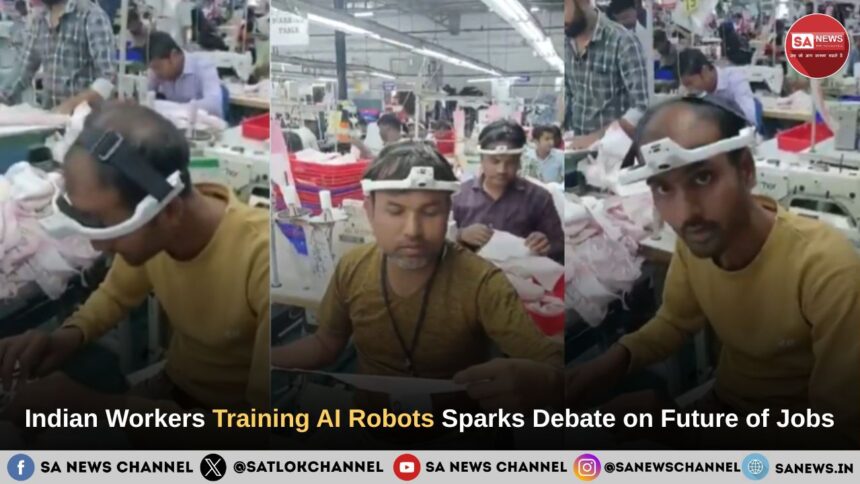
Indian workers are increasingly participating in the training of AI-powered robots by recording and demonstrating real-world tasks through wearable devices and sensors. The collected data is being used to help robots learn how work is performed. While workers are being compensated for this activity, the development has also triggered discussions about automation, workplace transformation, and the future of employment in an AI-driven economy.
- Key Takeaways: Indian Workers Training AI Robots
- How Indian Workers Are Helping Train AI Robots
- Role of Wearable Devices and Data Collection
- Workers Receiving Compensation for Participation
- Why the Development Is Generating Discussion
- Experts Point to Both Challenges and Opportunities
- Growth of AI and Humanoid Robotics
- What This Means for the Future of Work
- Technology and the Purpose of Human Life
- FAQs on Indian Workers Training AI Robots
Key Takeaways: Indian Workers Training AI Robots
- Indian workers are helping train AI-powered robots through recorded work activities.
- Wearable devices and sensors are being used to capture task-related data.
- The collected information helps robots learn how specific jobs are performed.
- Workers participating in the process are reportedly receiving payment.
- The trend has raised questions about automation and its potential impact on future employment.
- Experts believe technological change may alter job roles while also creating new opportunities.
How Indian Workers Are Helping Train AI Robots
A growing number of workers in India are reportedly contributing to the development of AI-powered robots by allowing their daily work activities to be recorded. The process involves the use of wearable technology, including head-mounted cameras and motion-tracking sensors that capture how tasks are performed in real-world environments.
The recorded information is then used as training data for artificial intelligence systems and robots. By observing human actions, movements, and workflows, the technology can learn how specific tasks are completed.
Also Read: Are AI and Robotics Redefining Human Life?
This approach has become an important part of efforts to improve the capabilities of AI-powered machines and humanoid robots.
Role of Wearable Devices and Data Collection
The training process relies heavily on data gathered directly from workers while they perform their jobs.
Technologies Being Used
| Technology | Purpose |
| Head-mounted cameras | Record work activities from a worker’s perspective |
| Motion sensors | Capture physical movements and actions |
| AI training systems | Process collected data for robot learning |
These devices help create detailed datasets that allow robots to understand and replicate human work patterns more effectively.
The information gathered is considered valuable because it reflects actual workplace conditions rather than simulated environments.
Workers Receiving Compensation for Participation
According to the report, workers participating in the recording process are being compensated for their involvement.
The report states that some workers are receiving payments of up to ₹250 per hour for contributing data that can be used in AI and robotic training programs.
The compensation reflects the growing demand for real-world human-generated data, which is considered essential for improving the performance of AI systems and robotics technologies.
Why the Development Is Generating Discussion
The increasing use of human-generated data to train robots has sparked broader conversations about the future of work.
Some observers have questioned whether the same technologies being trained today could eventually perform tasks currently handled by human workers. As AI systems become more capable, discussions around automation and workforce transformation are becoming increasingly common.
The development has therefore attracted attention not only as a technological advancement but also as a workplace and economic issue.
Key Areas of Discussion
- Automation of routine tasks
- Changing workplace requirements
- Future workforce skills
- Human and machine collaboration
- Employment transitions in technology-driven industries
These discussions continue as AI adoption expands across different sectors.
Experts Point to Both Challenges and Opportunities
Experts cited in discussions surrounding AI and automation suggest that technological change does not necessarily result in the complete elimination of jobs.
Instead, emerging technologies often reshape how work is performed. While some existing roles may be affected by automation, new opportunities can also emerge as industries adapt to technological advancements.
This perspective highlights the importance of understanding AI not only as a replacement tool but also as a technology that may create different forms of employment and skill requirements over time.
Growth of AI and Humanoid Robotics
The report also highlights increasing interest in AI-powered humanoid robots and the broader robotics sector.
As companies continue investing in artificial intelligence and machine learning systems, the demand for high-quality training data remains significant. Human demonstrations provide valuable insights that help improve robotic learning and decision-making capabilities.
The continued development of these technologies is expected to play an important role in shaping future workplaces and industrial processes.
What This Means for the Future of Work
The participation of Indian workers in AI training projects illustrates how human expertise remains central to the development of advanced technologies.
While concerns about automation continue to be debated, the current process demonstrates that human knowledge and real-world experience are essential for teaching AI systems how tasks are performed. The ongoing conversation is likely to remain focused on balancing technological progress with workforce adaptation as AI capabilities continue to evolve.
Technology and the Purpose of Human Life
As discussions around artificial intelligence and automation continue, technology remains a reflection of human innovation and progress. However, spiritual teachings emphasize that material advancement alone does not explain the complete purpose of human life. According to the teachings of Tatvdarshi Sant Rampal Ji Maharaj, no matter how far technology advances, the true path of worship and spiritual realization can only be understood through the Knowledge imparted by a Tatvdarshi Saint sent by Supreme God.
These advancements in science and technology are also viewed as opportunities that can help people access knowledge, understand the purpose of human existence, and seek spiritual awareness. Tatvdarshi Sant Rampal Ji Maharaj Ji explains that the primary objective of human life is to recognize Supreme God, engage in true devotion, and strive to attain Satlok, the eternal abode from where souls are believed to have become separated due to past mistakes. In this perspective, technology serves as a medium that can help spread spiritual knowledge and connect people with the path of devotion and self-realization.
For more information visit our
Website: www.jagatgururampalji.org
YouTube: Sant Rampal Ji Maharaj
Facebook: Spiritual Leader Saint Rampal Ji
X (Twitter): @SaintRampalJiM
FAQs on Indian Workers Training AI Robots
1. What are Indian workers doing to train AI robots?
Workers are recording and demonstrating real-world tasks that are used as training data for AI-powered robots.
2. What devices are being used in the training process?
Head-mounted cameras and motion-tracking sensors are being used to capture work activities and movements.
3. Are workers being paid for participating?
Yes. The report states that some workers are receiving up to ₹250 per hour for contributing training data.
4. Why is this development attracting attention?
It has sparked discussions about automation, workplace transformation, and the future impact of AI on employment.
5. Do experts believe AI will eliminate all jobs?
Experts suggest AI may change job roles and create new opportunities rather than simply eliminating employment.