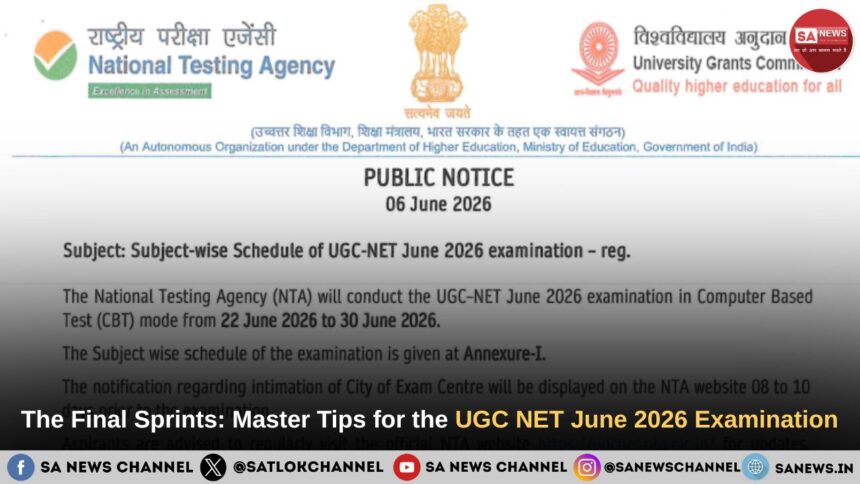
The month of June brings a familiar wave of anxiety and determination across study desks in India. With the National Testing Agency (NTA) locking in the UGC NET June 2026 examination window from June 22 to June 30, candidates are officially entering the final, high-stakes preparation phase. Cracking this nationwide exam is the ultimate gateway to securing a Junior Research Fellowship (JRF) or qualifying as an Assistant Professor, making the next few weeks critical for academic career paths.
Navigating this final stretch requires more than just long study hours; it demands absolute structural clarity and strategic endurance. From managing a grueling three-hour continuous computer-based test (CBT) to keeping up with crucial digital releases like city intimation slips and hall tickets, preparation must be precise. For the lakhs of candidates currently revising their notes, here is your essential guide to navigating the final countdown efficiently and confidently.
Key Points at Glance
- The Core Window: The UGC NET June 2026 examination will be conducted across the nation between June 22 and June 30, 2026.
- Continuous Testing Format: The exam features a single, uninterrupted 180-minute block covering both Paper I (Aptitude) and Paper II (Subject-specific domain).
- Two-Shift System: To accommodate the massive applicant pool, testing centers will run a morning shift (9:00 AM to 12:00 PM) and an afternoon shift (3:00 PM to 6:00 PM).
- Crucial Document Timeline: Exam city intimation slips are expected by June 10, with official admit cards targeted for release around June 15.
- Expanded Academic Scope: This cycle officially includes new specialized subjects like Forestry and Statistics, expanding the total roster to 87 disciplines.
The 180-Minute Endurance Run
The biggest psychological hurdle of the UGC NET is its continuous, no-break testing format. Sitting in front of a computer screen for three hours straight to solve 150 complex questions requires immense mental stamina. Paper I tests your core teaching and research aptitude, while Paper II dives deep into your specific postgraduate subject.
To survive this matrix without burning out halfway through, aspirants should practice full-length mock tests during their exact allotted shift timings. Simulating the pressure of the exam room helps train the brain to maintain focus, prevent fatigue, and master the art of shifting gears seamlessly from general mathematical reasoning to heavy, subject-specific theories.
Navigating the Digital Milestone Dates
As we edge closer to the middle of June, candidates must keep a vigilant eye on the official NTA portal. The first major update will be the city intimation slip. This document is not your final entry pass, but it provides the exact geographic city where your center is located, allowing outstation students to lock in their travel plans well in advance.
Following the city slip, the official Admit Card will drop online around mid-June. Downloading this document is entirely digitized, requiring your unique application registration number and date of birth. When you print your hall ticket, do not treat it as a casual piece of paper. Carefully inspect every letter of your name, your category, your uploaded photograph, and the exact shift timing assigned to you. Any discrepancy must be flagged to the NTA helpdesk immediately to avoid last-minute complications at the exam center gate.
Strategic Revision: Quality Over Quantity
In these final weeks, trying to learn entirely new topics from scratch is a trap that often leads to confusion and anxiety. Instead, successful candidates pivot toward consolidating what they already know. Focus heavily on solving previous years’ question papers (PYQs) to understand recurring themes, trends, and question framing techniques.
For Paper I, prioritize high-yielding, logical sections like Data Interpretation, Research Methodology, and Information and Communication Technology (ICT). For Paper II, rely on your core conceptual notes, definitions, and theories. Remember, the goal of the final sprint is not to read everything, but to ensure that the facts and concepts you have already studied are absolute, ironclad, and readily accessible under exam pressure. Stay focused, manage your time wisely, and step into the testing center with a calm, analytical mind.
FAQs Related to UGC NET June 2026
1. What are the official dates for the UGC NET June 2026 exam?
The National Testing Agency (NTA) will conduct the UGC NET June 2026 examination from June 22 to June 30, 2026, at various computer-based testing centers across India.
2. Is there a break between Paper I and Paper II during the exam?
No. The UGC NET is conducted as a single, continuous session lasting 3 hours (180 minutes). Candidates can move between Paper I and Paper II seamlessly, but there is no scheduled interval or break.
3. What are the daily shift timings for the UGC NET exam?
The exam is conducted in two distinct daily shifts. Shift 1 runs in the morning from 9:00 AM to 12:00 PM, while Shift 2 takes place in the afternoon from 3:00 PM to 6:00 PM.
4. When will the UGC NET June 2026 Admit Card be released?
The official exam city intimation slips are expected to be available online by June 10, 2026, followed by the release of the final download link for the Admit Cards around June 15, 2026.
5. How many subjects are included in the June 2026 cycle?
The UGC NET June 2026 cycle covers a total of 87 subjects, which includes the official integration of newly introduced specialized disciplines such as Forestry and Statistics.