

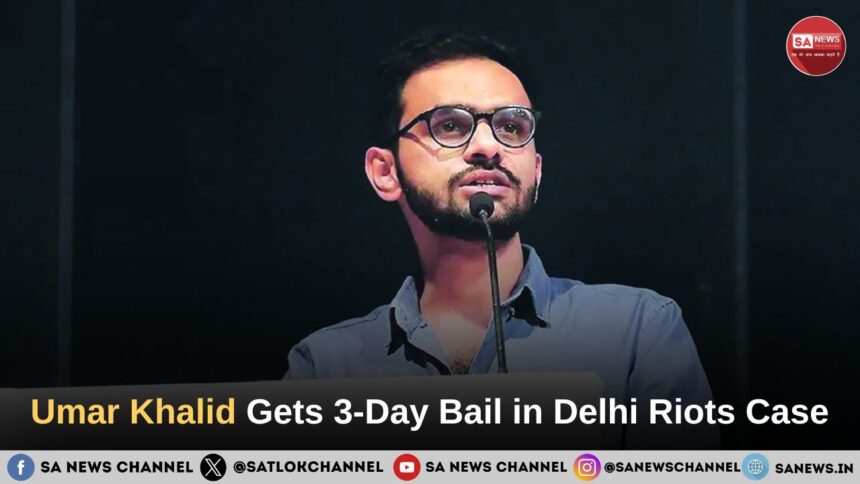
In a significant development in the 2020 Delhi riots “larger conspiracy” case, the Delhi High Court on Friday, May 22, 2026, granted three-day interim bail to former student leader and activist Umar Khalid under the Unlawful Activities (Prevention) Act (UAPA).
The relief was granted purely on humanitarian grounds to allow Khalid to be with his mother, who is scheduled to undergo surgery for the excision of a lump or cyst. The High Court adopted what observers described as an empathetic approach while considering the medical condition of his mother.
As per the court’s order, Khalid will be released on interim bail from 7 a.m. on June 1, 2026, until 5 p.m. on June 3, 2026. The bench clarified that the order was strictly temporary in nature and should not be interpreted as any observation on the merits of the larger case.
Court Rejects Request Related to Chehlum Ritual
While Umar Khalid had sought 15 days of interim bail, the High Court approved only a limited three-day window. Apart from his mother’s surgery, Khalid had also requested permission to attend the 40-day Chehlum ritual of his late uncle.
However, the court declined to grant additional time for participation in the religious ceremony. The judges made it clear that the interim relief was being provided solely for the medical needs of his mother and not for any other personal or ceremonial purpose.
This partial acceptance of the plea reflected the court’s attempt to balance humanitarian considerations with the seriousness of the allegations under the UAPA.
Trial Court Had Earlier Rejected Bail Plea
Before approaching the High Court, Umar Khalid’s interim bail plea had been rejected by the Karkardooma trial court on May 19, 2026. The lower court had reportedly termed the grounds presented in the application as unreasonable and insufficient for granting temporary bail.
Following the rejection, Khalid moved the Delhi High Court seeking urgent relief. The High Court, after hearing arguments from both sides, took a more compassionate view regarding the medical condition of his mother and granted restricted interim relief.
Delhi Police Opposed Interim Bail
Delhi Police strongly opposed the plea during the hearing. The prosecution argued that the proposed surgery was not of a serious or life-threatening nature and therefore did not justify temporary release under such grave charges.
Police also suggested that if necessary, Umar Khalid could be escorted to the hospital under security supervision instead of being granted interim bail.
The prosecution further emphasized that Khalid has been accused in a serious conspiracy case linked to the 2020 Delhi riots and is facing charges under stringent provisions of the UAPA. According to the police, repeated interim reliefs could weaken the seriousness attached to the ongoing proceedings.
Despite these objections, the High Court decided to provide narrowly tailored relief, emphasizing humanitarian considerations while simultaneously imposing strict conditions.
Strict Conditions Imposed by the High Court
The Delhi High Court imposed multiple stringent conditions while granting interim bail to Umar Khalid.
The court directed him to furnish a personal bond and surety bond of ₹1 lakh. In addition, Khalid has been instructed to remain strictly within the Delhi-NCR region during the bail period.
The order further specifies that he must stay only at his registered residential address except while visiting the hospital. He has also been permitted to use only one mobile phone number during the interim bail period.
The court barred him from engaging in any unrelated activity and ordered that he must surrender before authorities immediately after the expiry of the bail period.
The bench also warned that any violation of these conditions could lead to cancellation of the interim relief.
Nearly Six Years in Custody Without Trial Commencing
Umar Khalid has remained in judicial custody since September 2020 in connection with the Delhi riots conspiracy case. The case pertains to allegations of a broader conspiracy behind the communal violence that took place in Northeast Delhi in February 2020.
He has now spent nearly six years in jail, while the trial in the case has yet to formally commence. This prolonged incarceration without the start of trial proceedings has repeatedly triggered debate within legal and civil rights circles.
In January 2026, the Supreme Court rejected Umar Khalid’s plea for regular bail, leaving him with limited legal options apart from seeking temporary or interim relief on humanitarian grounds.
Interim Relief Granted Earlier as Well
This is not the first time Umar Khalid has been granted interim bail. In the past, courts have allowed him temporary relief for specific family-related circumstances and humanitarian situations.
Importantly, records presented before the court indicated that on previous occasions Khalid had surrendered on time after the expiry of interim bail periods. This aspect also formed part of the broader context during the latest hearing.
Fresh Debate in Political and Legal Circles
The Delhi High Court’s order has once again sparked debate across political and legal circles. Supporters of the decision argue that courts must remain sensitive to humanitarian concerns even in stringent UAPA cases.
Critics, however, contend that individuals accused in serious conspiracy and riot-related cases should not be granted repeated interim reliefs.
For now, the High Court has clearly stated that the order is a short-term humanitarian measure and should not be construed as any comment on the merits of the allegations, the investigation, or Umar Khalid’s pending regular bail claims.