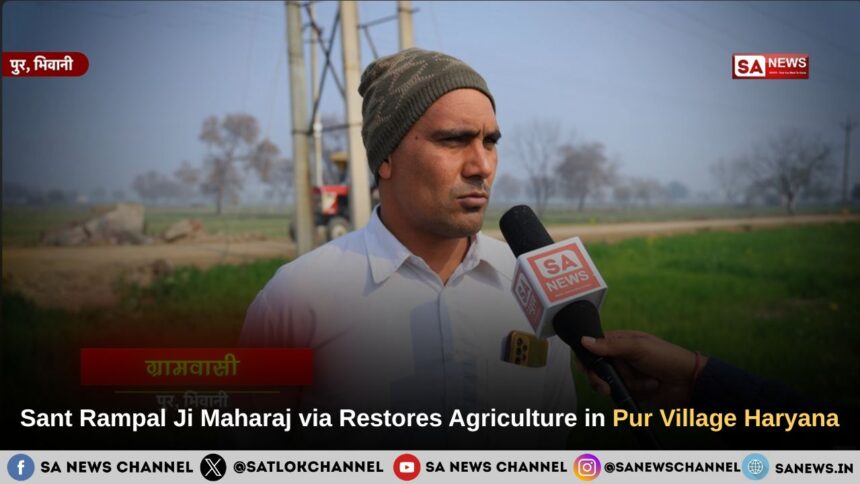
The village of Pur, located in the Bawani Khera Tehsil of Bhiwani District, Haryana, faced a severe environmental crisis due to massive waterlogging and flooding.
- Failure of Administrative Intervention and Local Appeals
- Technical Assistance Provided by Sant Rampal Ji Maharaj
- Economic Valuation and Operational Implementation
- Agricultural Recovery and Current Status of Sowing
- Statements from Beneficiaries and Community Members
- Long-term Restoration of Rural Livelihoods in Bhiwani
Approximately 1,000 to 1,200 acres of agricultural land were submerged under several feet of water, specifically reaching depths of three feet or up to knee-height in many areas.
This stagnant water prevented the sowing of the Rabi crop, following the total destruction of previous crops such as paddy. The flooding persisted for an extended duration, threatening the livelihood of the village’s farming community.
Failure of Administrative Intervention and Local Appeals
Prior to receiving aid, the village representatives, including Sarpanch Ajay Kumar and various local farmers, approached the state government and the local MLA for assistance. The following sequence of events occurred:
- Villagers visited the local MLA multiple times to request water-pumping machinery.
- The MLA provided verbal assurances, claiming that pipes and motors were being diverted from other locations or borders.
- Despite multiple visits and time-consuming administrative processes, no physical equipment or technical aid was delivered to the village by the government.
- Facing the prospect of a barren agricultural season, the village panchayat decided to seek help from a non-governmental source.
Technical Assistance Provided by Sant Rampal Ji Maharaj
Upon being approached by the village representatives, Sant Rampal Ji Maharaj provided immediate technical and material support through the Annapurna Muhim. The assistance was executed in three distinct phases due to the vast scale of the flooding:
- Immediate Response: The request for the third phase of aid was approved within 15 minutes of the villagers reaching the Ashram.
- Machinery and Equipment: Sant Rampal Ji Maharaj provided a total of four large water-pumping motors, including a high-capacity 20 HP motor.
- Piping Infrastructure: A total of 37,000 feet (approximately 11 kilometers) of 8-inch diameter piping was supplied.
- Recent Distribution: In the final consignment alone, 17,600 feet of 8-inch pipes and one 20 HP motor were delivered to Pur village.
- Operational Duration: The provided motors were operated continuously for one and a half months to successfully drain the fields.
Economic Valuation and Operational Implementation
Sarpanch Ajay Kumar stated that if the village panchayat or the state government had undertaken this project, the cost would have exceeded 1 crore INR. Sant Rampal Ji Maharaj provided all equipment, fuel-related logistics, and technical teams at no cost to the village. The implementation included:
- Technical Teams: Sant Rampal Ji Maharaj sent specialized teams to inspect the site and oversee the installation of the machinery.
- Infrastructure Strategy: Villagers have permanently buried the 11 kilometers of piping underground to prevent future waterlogging crises and ensure long-term drainage.
- Zero Cost Policy: No donations, fees, or receipts were requested from the villagers; the service was provided entirely as a selfless initiative.
Agricultural Recovery and Current Status of Sowing
Following the continuous operation of the machinery provided by Sant Rampal Ji Maharaj, 95% of the previously submerged land has been reclaimed for cultivation. The current agricultural status as reported by residents Kamal (Panch), Suresh Kumar, Rajesh Kumar, and Ramveer includes:
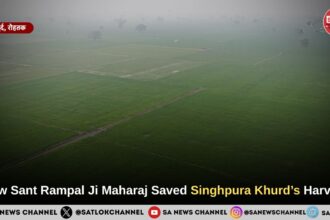
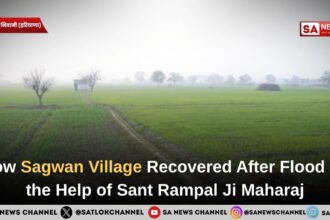
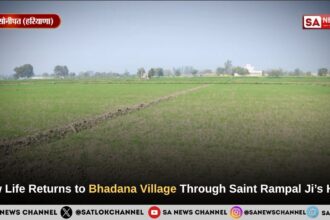
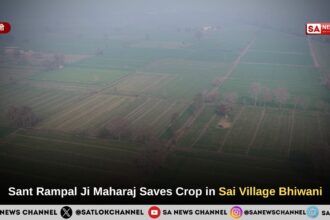
- Crop Progress: Wheat has been sown across the majority of the reclaimed 1,200 acres.
- Growth Statistics: Wheat plants have currently reached a height of “one and a half hands” (approximately 2-2.5 feet) and have begun the heading stage (emergence of ears/balen).
- Residual Sowing: About 5% to 7% of the land, specifically the lowest-lying areas, is currently undergoing the final stages of sowing as the last of the water is removed.
- Livestock Support: The reclamation of land has allowed for the sowing of animal fodder, which was previously unavailable due to the floods.
Summary of Aid and Impact in Pur Village
| Category | Details |
| Location | Village Pur, Tehsil Bawani Khera, District Bhiwani, Haryana |
| Provider of Aid | Sant Rampal Ji Maharaj via Annapurna Muhim |
| Total Land Reclaimed | 1,200 Acres |
| Total Pipe Length | 37,000 Feet (11 Kilometers) |
| Pipe Specification | 8-inch Diameter |
| Machinery Provided | 4 Large Motors (including 20 HP units) |
| Estimated Market Value | Over 1 Crore INR |
| Current Sowing Status | 95% Completion |
| Primary Crops Sown | Wheat, Mustard, and Fodder |
Statements from Beneficiaries and Community Members
Individual testimonies from the village highlight the transition from crisis to stability:
- Kamal (Village Panch): Confirmed the water was three feet deep and stated that the sowed wheat is the direct result of the motors and pipes provided by Sant Rampal Ji Maharaj.
- Suresh Kumar: Stated that the village was in a critical condition two months ago and credited the current agricultural success to the intervention of Sant Rampal Ji Maharaj.
- Rajesh Kumar: While the government made them run in circles for months, the team from Sant Rampal Ji Maharaj arrived within two days of the request and provided meals and tea to the villagers during the process.
- Ramveer: Reported that the paddy crop had already been lost, but the timely drainage saved the wheat season and the subsequent crop cycle starting in April.
- Sanjay Sharma and Sonu: Observed that tractors are now able to traverse the fields which were previously only accessible by boat.
Long-term Restoration of Rural Livelihoods in Bhiwani
The intervention by Sant Rampal Ji Maharaj has resulted in the total restoration of the agricultural economy of Pur village. The stagnant water, which villagers feared would remain for years, was removed in weeks.
This has secured the food supply for the residents and fodder for the livestock, effectively preventing a long-term migration or economic collapse of the farming families in the Bawani Khera region.