

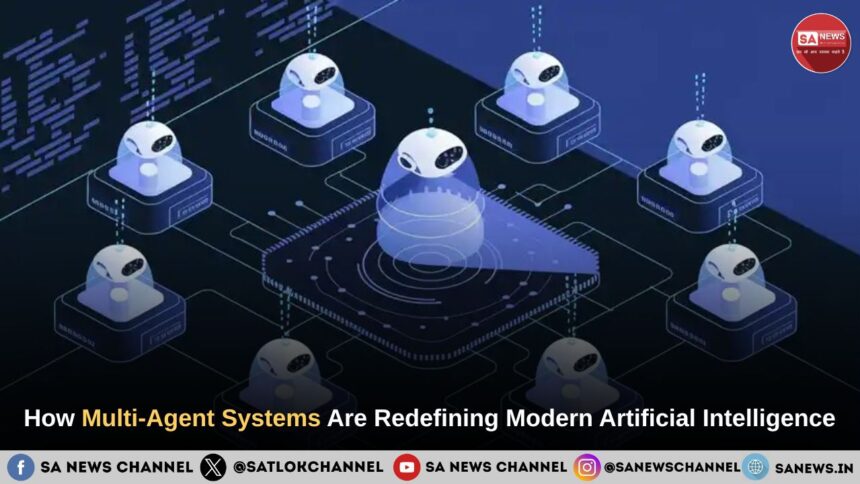
Multi-Agent Systems are redefining the landscape of artificial intelligence by enabling multiple specialized agents to collaborate, communicate, and solve complex problems with remarkable efficiency. Unlike traditional, monolithic AI models, these systems distribute intelligence across autonomous units, creating a dynamic environment where coordination and adaptability drive outcomes. From smart cities to automated industries, their applications are rapidly expanding. Yet, beyond their technical promise, they subtly echo a deeper principle—how order, balance, and purposeful coordination emerge within complex systems—prompting us to reflect on whether such harmony is purely engineered, or part of a more profound underlying design. Discover this nail-biting reality in this dedicated article.
- What Are Multi-Agent Systems? (MAS)
- Evolution: From LLMs to Multi-Agent Systems
- Multi-Agent Systems vs Single-Agent Systems
- What Is Multi-Agent Collaboration?
- How Multi-Agent Systems Work
- Core Components of MAS
- Architecture of Multi-Agent Systems
- How Agents Collaborate Step-by-Step
- Collaboration Strategies in Multi-Agent Systems
- Benefits of Multi-Agent Systems
- Better Problem Solving
- Scalability
- Fault Tolerance
- Flexibility
- Speed & Efficiency
- Collective Intelligence
- Real-World Use Cases of MAS
- Customer Service Automation
- Healthcare Systems
- Supply Chain Management
- Traffic Management
- Financial Analysis
- Robotics & Warehousing
- Popular Frameworks for Multi-Agent Systems
- Enterprise Example: AI Orchestration Systems
- Challenges in Multi-Agent Systems
- Complex Coordination
- Communication Overload
- Unpredictable Behavior
- Security Risks
- High Cost
- Debugging Difficulty
- Future of Multi-Agent Systems
- Beyond Synergy: The Unseen Gap in Multi-Agent Intelligence
- The True Master Controller: Aligning the Soul with Eternal Wisdom
- FAQs on Multi Agent System
What Are Multi-Agent Systems? (MAS)
Multi-agent systems (MAS) are AI systems made up of multiple autonomous agents that interact within a shared environment to achieve individual or collective goals.
Unlike traditional AI, which relies on a single centralized system, MAS uses distributed intelligence, where each agent operates independently but collaborates with others.
Simple Example: Think of a team of delivery drivers in a city. Each driver (agent) has their own route, but they share traffic updates and coordinate deliveries to ensure faster service. That’s a real-world analogy of a multi-agent system.
Evolution: From LLMs to Multi-Agent Systems
The shift from Large Language Models (LLMs) to AI agents marks a fundamental transition in artificial intelligence—from systems that primarily generate responses to systems that can take actions and complete tasks.
Earlier AI systems
- Traditional LLM-based applications were largely reactive. They responded to prompts but did not independently act beyond a single interaction.
- Answered questions: Tools like chatbots could explain concepts or provide information.
Example: Asking an AI, “What is digital marketing?” would return a well-written explanation.
- Summarized text: LLMs could condense long documents into shorter versions.
Example: Summarizing a 20-page report into key bullet points.
- Improved productivity: They assisted with writing emails, generating code snippets, or drafting content.
Example: Writing a professional email or generating blog outlines.
Limitation: These systems stopped at output generation. The user still had to take the next steps manually (sending emails, executing code, making decisions).
Modern AI with MAS
With the introduction of AI agents and multi-agent systems, AI has become proactive and action-oriented.
- Automates complex workflows: Instead of just suggesting steps, agents can execute them end-to-end.
Real Example: In customer support, one agent receives a complaint, another checks order history, a third processes a refund, and a fourth sends a confirmation email—automatically.
- Enables real-time collaboration: Multiple agents work together like a team, sharing information continuously.
Real Example: In healthcare systems, one agent monitors patient vitals, another analyzes reports, and another suggests treatment—together improving accuracy.
- Handles dynamic decision-making: Agents adapt to new data and changing environments without human intervention.
Real Example: In traffic management, AI agents adjust traffic signals in real time based on congestion, accidents, or weather conditions.
Key Insight: Multi-agent systems go beyond “thinking AI” to “acting AI”, capable of executing multi-step tasks autonomously.
Simple Analogy:
- LLM = A smart advisor who tells you what to do
- MAS = A full team that not only plans but also executes the entire project
(AI Image)
This evolution is what makes multi-agent systems powerful—they don’t just assist humans; they collaborate, decide, and act autonomously in real-world scenarios.
Multi-Agent Systems vs Single-Agent Systems
| Feature | Single-Agent System | Multi-Agent System |
| Structure | Centralized – one system controls all decisions.Example: A fraud detection AI analyzing transactions independently. | Distributed – multiple agents operate independently but coordinate.Example: Smart city systems managing traffic, transport, and emergencies together. |
| Scalability | Limited – performance drops as workload increases.Example: A single chatbot struggling during heavy user traffic. | High – new agents can be added easily.Example: E-commerce platforms using multiple agents during peak sales. |
| Complexity Handling | Moderate – suitable for simple, well-defined tasks.Example: Movie recommendation systems. | High – handles dynamic, multi-layered problems.Example: Supply chain systems managing logistics, demand, and delivery. |
| Fault Tolerance | Low – system failure stops the entire process.Example: A factory AI failure halting production. | High – other agents continue if one fails.Example: Warehouse robots continue working even if one stops. |
| Collaboration | None – operates independently.Example: A chess AI playing alone. | Core Feature – agents communicate and coordinate.Example: Customer service agents handling queries, data, and resolutions together. |
Example:
- Single-Agent: A chess AI playing alone
- Multi-Agent: A team of AI bots managing an entire supply chain (demand prediction, inventory, logistics, delivery)
What Is Multi-Agent Collaboration?
Multi-agent collaboration refers to multiple agents working together using communication protocols, shared knowledge, and coordinated actions. Instead of relying on a single central controller, each agent contributes its own intelligence while continuously interacting with others.
Key Characteristics
- Decentralized control
- Shared decision-making
- Real-time communication
- Emergent intelligence
Imagine a fleet of drones deployed in a disaster zone to search for survivors:
- Each drone explores a different area independently
- They share findings like detected movement or heat signals
- They adjust their paths based on updates from other drones
- If one drone fails, others continue the mission
There is no central controller, yet the system works efficiently as a team.
How Multi-Agent Systems Work
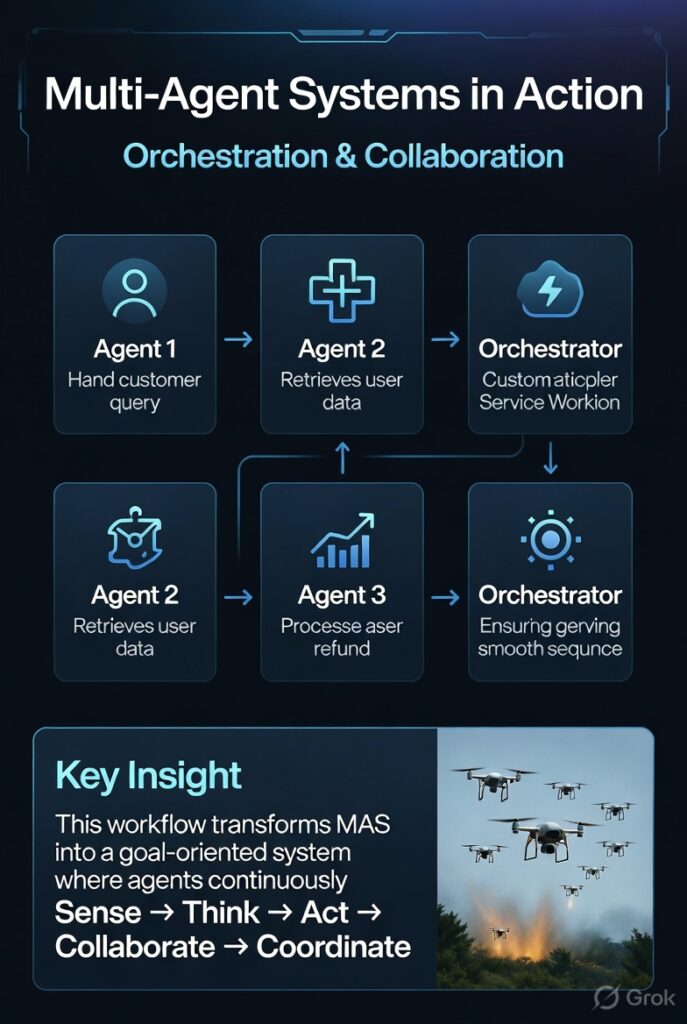
Multi-agent systems (MAS) operate through a structured, coordinated workflow, where multiple agents continuously sense, decide, act, and collaborate to achieve a goal. Each step builds on the previous one, enabling intelligent and autonomous execution.
(AI Image)
Perception
Agents first collect data from their environment or other agents. This includes signals, updates, or changes happening in real time.
Example:
In a smart traffic system, agents gather data from sensors—vehicle density, traffic speed, accidents, or weather conditions.
Reasoning
Using LLMs, machine learning models, or predefined logic, agents analyze the collected data and decide the best course of action.
Example:
A traffic management agent evaluates congestion data and decides whether to extend a green signal or reroute vehicles.
Action
Based on their decisions, agents execute specific tasks within the system.
Example:
The traffic agent changes signal timings or updates navigation systems to redirect vehicles.
Interaction
Agents don’t work in isolation—they communicate, coordinate, and sometimes negotiate with other agents to align their actions.
Example:
Traffic agents at different intersections share data to prevent bottlenecks across the entire city, not just at one junction.
Orchestration
An orchestrator (or coordination mechanism) ensures that all agents work in the correct sequence, share information properly, and achieve the final objective efficiently.
Example:
In a customer service system:
- One agent handles the query
- Another retrieves user data
- Another processes refunds
The orchestrator ensures these steps happen in the right order without conflict.
Key Insight
This workflow transforms MAS into a goal-oriented, intelligent system where agents continuously sense → think → act → collaborate → coordinate, enabling seamless execution of complex, multi-step tasks in real time.
Also Read: Billion-Dollar AI Startups: Why Investors Are Betting Big on Agentic Models
Core Components of MAS
Every multi-agent system is built on a few fundamental components that enable agents to function, interact, and collaborate effectively. These components ensure that the system remains scalable, coordinated, and intelligent.
Agents
Agents are the independent, decision-making entities within the system. Each agent has its own goal, can perceive its surroundings, and can take actions accordingly.
Example:
In an e-commerce platform:
- One agent manages inventory
- Another handles customer queries
- Another processes payments
Each agent works independently but contributes to the overall system goal.
Environment
The environment is the shared space where all agents operate and interact. It provides the context, resources, and constraints for agent behavior.
- It can be digital (like a software system or database)
- Or physical (like a warehouse or traffic system)
Example:
In a warehouse automation system, the environment includes shelves, robots, order data, and pathways where agents (robots) move and perform tasks.
Communication Protocols
To collaborate effectively, agents must exchange information using defined rules and formats, known as communication protocols.
These protocols ensure that messages are:
- Structured
- Understood correctly
- Delivered efficiently
Example:
In a customer support system, one agent sends user data to another agent in a structured format so the issue can be resolved quickly.
Architecture of Multi-Agent Systems
Each agent typically includes:
- Foundation Model (m): Reasoning engine (LLM)
- Objective (o): Task or goal
- Environment (e): Context of operation
- Input (x): Data received
- Output (y): Action or response
How Agents Collaborate Step-by-Step
- A task is received
- System identifies required agents
- Problem is divided into smaller tasks
- Agents execute tasks:
- Sequentially
- Concurrently
- Dynamically
- Results are combined
- Final output is generated
This process is called agentic workflow orchestration.
Collaboration Strategies in Multi-Agent Systems
Rule-Based Collaboration
Agents operate using predefined rules and conditions, making their behavior predictable.
Example: In an automated billing system, agents follow fixed rules like “if payment fails → send reminder.”
Pros: Efficient, consistent
Cons: Low adaptability in changing environments
Role-Based Collaboration
Agents are assigned specific roles, similar to a human team structure.
Example:
In content creation:
- Research agent gathers data
- Analysis agent processes insights
- Reporting agent generates output
Pros: Modular and scalable
Cons: Less flexible if roles need frequent changes
Model-Based Collaboration
Agents use learning models and probabilistic reasoning to make decisions in uncertain environments.
Techniques:
- Bayesian reasoning
- Markov Decision Processes (MDPs)
Example:
In financial investment, agents predict market trends and adjust strategies based on probabilities.
Pros: Highly adaptive and intelligent
Cons: Computationally expensive and complex
Key Insight: The choice of strategy depends on the problem—simple tasks favor rules, structured workflows favor roles, and dynamic environments require model-based intelligence.
Benefits of Multi-Agent Systems
Multi-agent systems offer several practical advantages that make them highly effective for solving complex, real-world problems.
Better Problem Solving
Multiple agents bring diverse skills and perspectives, allowing problems to be solved more accurately.
Example:
In healthcare, different agents analyze patient data, detect anomalies, and recommend treatments together—improving diagnosis quality.
Scalability
You can add more agents easily as the workload increases without disrupting the system.
Example:
During an online sale, additional AI agents can handle increased customer queries and transactions smoothly.
Fault Tolerance
If one agent fails, others continue working, ensuring system reliability.
Example:
In a warehouse, if one robot stops, others continue fulfilling orders without interruption.
Flexibility
Agents can adapt to new conditions or unexpected changes without constant human intervention.
Example:
In traffic systems, agents adjust signals dynamically based on congestion or accidents.
Speed & Efficiency
Tasks are divided and executed in parallel, significantly reducing time.
Example:
In financial systems, multiple agents analyze different markets simultaneously for faster decision-making.
Collective Intelligence
Agents share knowledge and learn together, becoming smarter as a group over time.
Example:
Recommendation systems improve accuracy as multiple agents learn from user behavior and trends.
Key Insight: Multi-agent systems combine scalability, resilience, and intelligence, making them ideal for environments where speed, adaptability, and collaboration are critical.
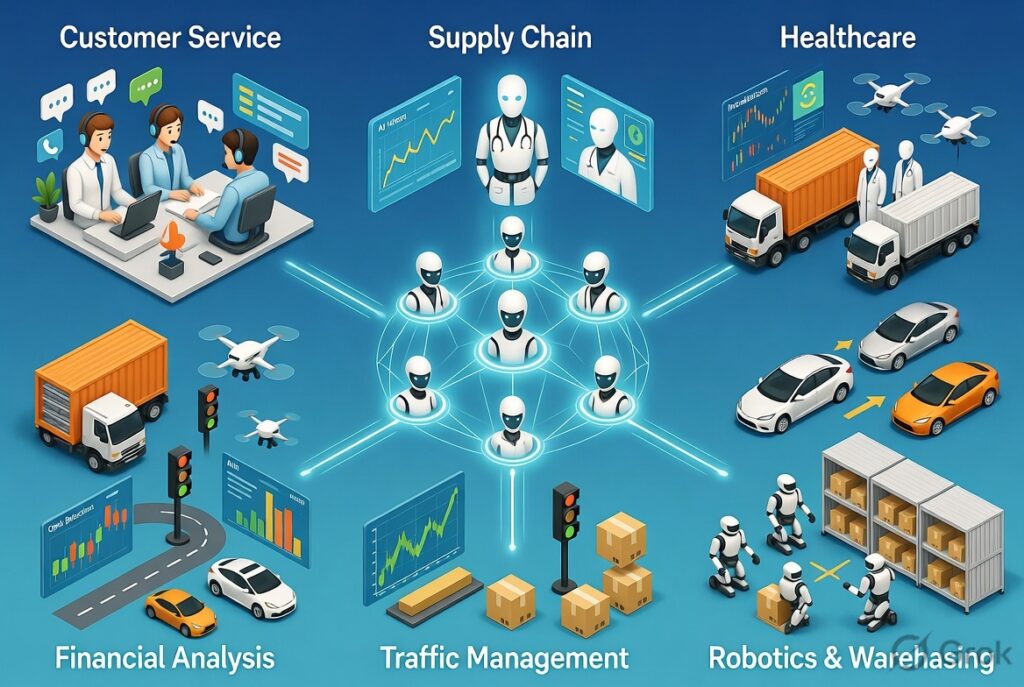
Real-World Use Cases of MAS
Customer Service Automation
- AI agents handle queries, escalation, billing
- Improves response time and accuracy
Healthcare Systems
- Monitor patient data
- Detect anomalies
- Recommend treatments
Supply Chain Management
- Predict demand
- Optimize logistics
- Manage inventory
Traffic Management
- Optimize routes
- Reduce congestion
Financial Analysis
- Analyze markets
- Detect risks
- Execute trades
Robotics & Warehousing
- Robots coordinate tasks
- Avoid collisions
Also Read: Artificial Intelligence in Healthcare: Can AI Be Trusted with Our Health?
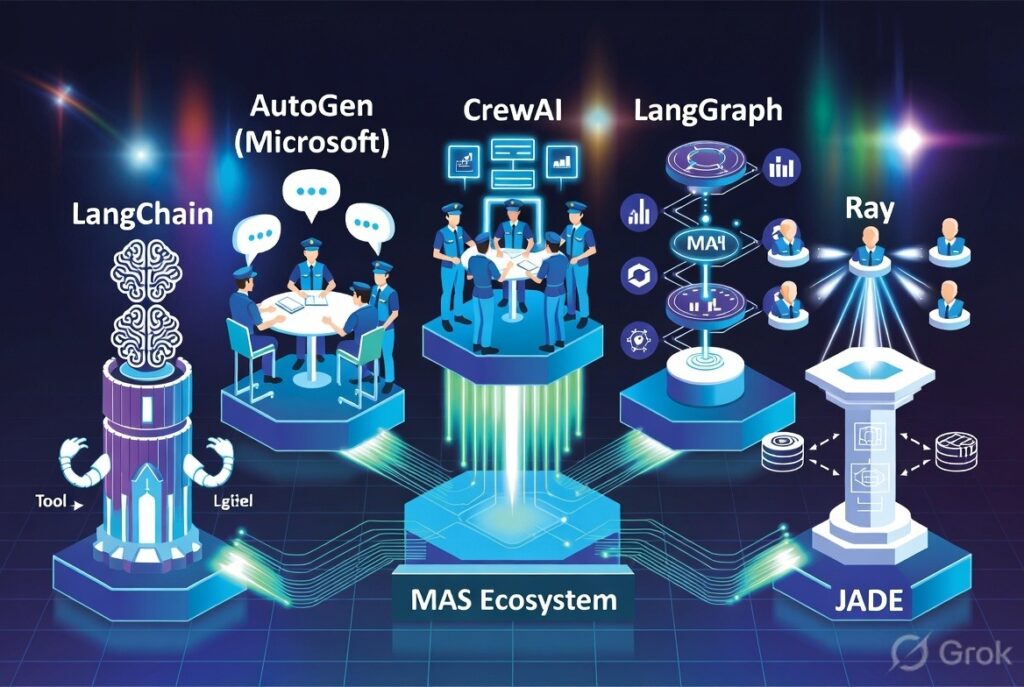
Popular Frameworks for Multi-Agent Systems
To design and deploy multi-agent systems effectively, developers rely on specialized frameworks that provide tools for agent creation, coordination, and scalability.
LangChain
A widely used framework for building LLM-powered agents. It enables agents to perform complex reasoning, tool usage, and multi-step task execution.
AutoGen (Microsoft)
A framework designed for conversational multi-agent collaboration, where agents can interact with each other to solve tasks through structured communication.
CrewAI
Focused on role-based orchestration, CrewAI allows developers to organize agents into teams with defined responsibilities, improving coordination and workflow clarity.
LangGraph
A framework that enables graph-based workflows with memory, allowing agents to follow structured paths, revisit steps, and maintain context over time.
Ray
An open-source framework built for scaling AI workloads across distributed systems, enabling parallel execution of multiple agents efficiently.
JADE
A classic and foundational framework for building agent-based systems, particularly known for following standardized communication protocols in distributed environments.
Key Insight: These frameworks provide the infrastructure and tools needed to build scalable, intelligent, and collaborative multi-agent systems, each focusing on different aspects like reasoning, orchestration, or distributed execution.
Enterprise Example: AI Orchestration Systems
Modern enterprise systems use orchestrators to manage agents:
Key Components:
- Intent Parser (understands user input)
- Flow Orchestrator (controls execution)
- Shared Memory (stores context)
- LLM Assistant (reasoning engine)
- Human Interface (optional control)
This ensures automation with human oversight.
Challenges in Multi-Agent Systems
While multi-agent systems offer significant advantages, they also introduce technical and operational challenges that must be carefully managed.
Complex Coordination
Managing multiple independent agents and ensuring they work together smoothly can be difficult, especially as the system grows in size and complexity.
Communication Overload
As the number of agents increases, the volume of messages exchanged can become excessive, potentially slowing down system performance.
Unpredictable Behavior
Interactions between agents can lead to emergent outcomes that are not always predictable or easy to control.
Security Risks
Since agents often handle sensitive data, ensuring secure communication and data protection is critical to prevent misuse or breaches.
High Cost
Systems powered by LLMs and distributed agents require significant computational resources, making them expensive to scale and maintain.
Debugging Difficulty
Identifying and tracing errors across multiple interacting agents is complex, as issues may arise from indirect interactions or multi-step workflows.
Key Insight: These challenges highlight the need for robust design, efficient communication strategies, and strong monitoring systems to ensure reliable and scalable multi-agent implementations.
Future of Multi-Agent Systems
Emergent Collective Intelligence
As agents collaborate, they develop intelligence greater than individual capability.
Expected Advancements
- Autonomous Decision-Making Systems: Systems will make complex decisions independently with minimal human intervention.
- AI-Driven Organizations: Businesses will increasingly rely on coordinated AI agents to manage operations, analysis, and execution.
- Fully Automated Workflows: End-to-end processes—from planning to execution—will be handled entirely by agent systems.
- Self-Improving Agent Ecosystems: Agents will learn from interactions and continuously optimize their performance over time.
What MAS Will Power
- Smart Cities: Intelligent systems managing traffic, energy, and public services in real time.
- Autonomous Industries: Manufacturing, logistics, and supply chains operating with minimal human involvement.
- Advanced AI Ecosystems: Highly interconnected systems capable of solving large-scale, complex global problems.
Key Insight: Multi-agent systems are evolving toward a future where AI systems are not just tools, but collaborative ecosystems, capable of learning, adapting, and operating independently at scale.
Beyond Synergy: The Unseen Gap in Multi-Agent Intelligence
The rise of Multi-Agent Systems (MAS) marks a fascinating shift in technology, where instead of one giant AI, several specialized “agents” work together to solve complex problems. It reflects our human desire for perfect coordination, efficiency, and collective intelligence. We marvel at how these digital entities communicate and harmonize to achieve goals that were once thought impossible. But as we refine these frameworks, a deeper, more unsettling question begins to surface.
If we can design digital systems where multiple agents work in flawless synchronization, why does human society—the ultimate multi-agent system—remain so fractured by conflict, greed, and suffering? We pour billions into ensuring “agent alignment” in AI to prevent them from going rogue, yet have we ever paused to ask if our own minds are aligned with our true purpose? Are we truly the masters of our “agents,” or are we merely participants in a much larger, unseen system that we don’t yet understand?
Despite the brilliance of these technologies, they remain confined to the material realm. They can process data, but they cannot feel the weight of karma or the longing of the soul. We are so obsessed with building “smarter” systems that we have ignored the most critical “agent” of all: our own consciousness, which is currently being hacked by forces far beyond the reach of any code or firewall.
The True Master Controller: Aligning the Soul with Eternal Wisdom
Jagatguru Tatvdarshi Sant Rampal Ji Maharaj provides the “source code” that science and AI experts are missing. He reveals that this world is not our original home, but a complex territory of 21 universes ruled by Kaal Brahm (Satan). In this system, our own mind acts as a specialized agent of Kaal, designed to keep us entangled in desires, vices, and the endless cycle of birth and death. Just as a misplaced bracket can crash a program, our lack of true spiritual knowledge has led to a “system error” in our existence.
Sant Rampal Ji Maharaj explains that no matter how advanced our “multi-agent” technologies become, they are temporary and perishable. True sustainability and harmony cannot be found in man-made algorithms, but in reconnecting with the Supreme Creator, God Kabir through His true spiritual wisdom. As the sacred Vaani states:
“Drishti pade so dhokha re. Khand pind brahmand chalenge thir nahi rahsi loka re. thir nahi rahsi loka re.”
This reminds us that everything visible—including our most advanced technologies—is an illusion destined to fade. The only way to achieve “true alignment” is to follow the guidance of a Tatvdarshi Sant, Who can “debug” our consciousness of ignorance and lead us back to Satlok, the eternal realm of bliss. Why continue to chase the shadows of digital intelligence when the light of complete salvation is finally within reach?
Take the first step toward true intelligence by exploring the path to eternal liberation.
Website: www.jagatgururampalji.org
YouTube: Sant Rampal Ji Maharaj
Facebook: Spiritual Leader Saint Rampal Ji
‘X’ handle: @SaintRampalJiM
FAQs on Multi Agent System
What is a multi-agent system in AI?
A multi-agent system is a group of autonomous AI agents that interact and collaborate within a shared environment to achieve goals.
How do multi-agent systems work?
They work by distributing tasks among agents, enabling communication, coordination, and orchestration to complete complex workflows.
What is the difference between MAS and single-agent systems?
MAS involves multiple interacting agents, while single-agent systems rely on one centralized entity.
Where are multi-agent systems used?
They are used in healthcare, finance, robotics, customer service, traffic management, and supply chains.
Why are multi-agent systems important?
They enable scalable, flexible, and efficient solutions for complex, real-world problems.