

The village of Gujrani, located in the Bhiwani District of Haryana, recently faced a significant flood crisis. The stagnant water was not limited to agricultural fields but caused a total failure of the village’s Water Works (Jalghar).
- Immediate Intervention by Sant Rampal Ji Maharaj
- Restoration of Agricultural Land and Sowing Success
- Summary of Relief Infrastructure and Impact
- Residential Damage and Structural Consequences
- Local Administrative Assessment and Economic Value
- Restoration of Agricultural Livelihoods and Current Field Status
The main water treatment facility was submerged under 8 to 10 feet of contaminated water, which resulted in the complete suspension of the drinking water supply. Residents were forced to depend on external water tankers.
The administration provided some motors, but these were ineffective as they discharged water into a nearby drain that was already overflowing, causing secondary flooding in neighboring villages.
Immediate Intervention by Sant Rampal Ji Maharaj
Following the failure of government-provided machinery, Sarpanch representative Vijay Sharma and the village panchayat submitted a formal request for assistance. Sant Rampal Ji Maharaj, through the Annapurna Muhim, responded to the appeal within a timeframe of two days. The following resources were delivered directly to the village square:
- 14,000 feet of high-quality 8-inch diameter pipeline.
- Two powerful 20-20 HP motors.
- A complete set of technical accessories including starters, cables, specialized couplings (sundia), and all necessary nuts and bolts.
The technical teams accompanying the equipment stated that all items were to remain the permanent property of the village to ensure preparedness for any future water-related emergencies.
Restoration of Agricultural Land and Sowing Success
The high-capacity machinery provided by Sant Rampal Ji Maharaj was operated continuously to expel the stagnant water directly into a canal. Before the intervention, agricultural fields were submerged under 4 to 7 feet of water. Key outcomes of this drainage include:
- Total Area Reclaimed: Approximately 100 to 150 acres of land were cleared of water.
- Sowing Percentage: Currently, 97% to 98% of the wheat sowing in Gujrani village has been successfully completed.
- Remaining Areas: The final 2% of the land is expected to be sown within the next 7 to 10 days as the soil reaches the required moisture level.
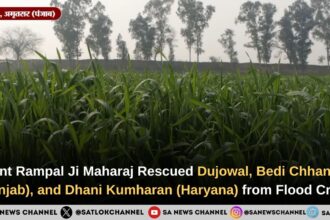
- Crop Observation: In fields previously underwater, wheat seeds have already sprouted and are visible above the soil.
Summary of Relief Infrastructure and Impact
| Parameter | Quantitative Data / Details |
| Pipeline Length | 14,000 Feet |
| Pipe Diameter | 8 Inches |
| Motor Specifications | Two 20 HP Motors |
| Submerged Depth (Jalghar) | 8 to 10 Feet |
| Submerged Depth (Fields) | 4 to 7 Feet |
| Estimated Project Cost | Several Crore INR (Calculated by local residents) |
| Response Time | 2 Days from request |
| Current Wheat Sowing | 98% Successfully Completed |
Residential Damage and Structural Consequences
The prolonged presence of water led to severe structural damage within the village. According to resident Mahesh Sharma and Sarpanch representative Vijay Sharma, the rising groundwater table (choah) and moisture caused the following issues:
- Structural Cracks: Significant cracks appeared in the walls of approximately 20% of the village houses.
- Floor Failures: The floors of numerous residential properties ruptured due to upward pressure from the water.
- Collapse: Several house walls and rooftops were reported to have collapsed entirely.
- Economic Loss: Farmers suffered a 100% loss in the preceding paddy (Dhaan) crop, and no government compensation has been issued to date.
Local Administrative Assessment and Economic Value
Sarpanch representative Vijay Sharma emphasized that the scale of the operation—calculated in the crores of rupees—was beyond the capacity of individual farmers or standard village funds. He noted that while other organizations and administrative bodies did not provide sufficient aid, Sant Rampal Ji Maharaj provided the required infrastructure without any charge, donation, or fee.
Residents including Sunil Kumar and Mahesh Sharma stated that without this intervention, the land would have remained uncultivable for at least another year, as the stagnant water from the previous season would have merged with the next monsoon cycle.
Restoration of Agricultural Livelihoods and Current Field Status
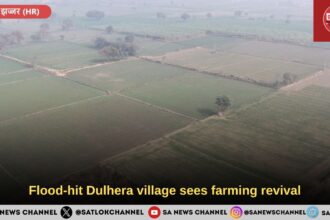
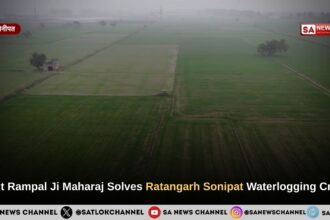
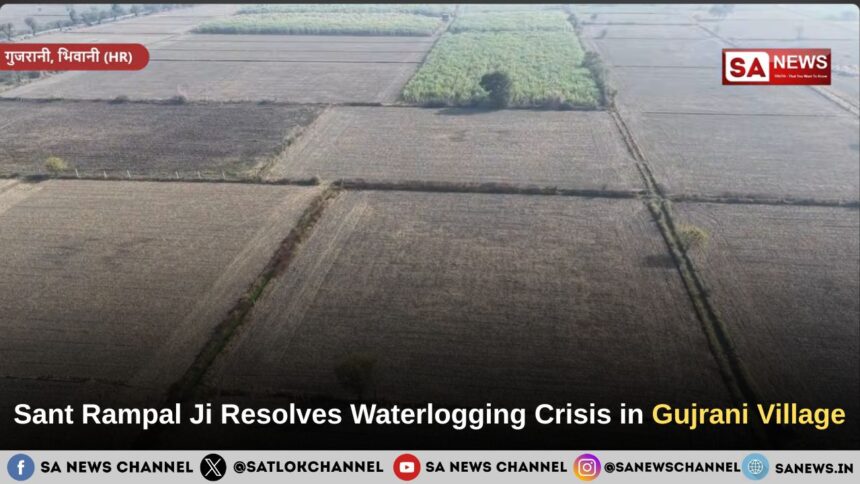
As of the latest reports, the stagnant water has been completely removed from the targeted areas. Drone surveys confirm that the formerly submerged landscape is now dry and productive.
The reddish soil, which was previously invisible under 5 feet of water, is now fully cultivated. Residents noted that the success of the wheat crop is critical for regional food security, and the intervention has effectively secured the “two rotis” (daily bread) for the farming families of Gujrani.