

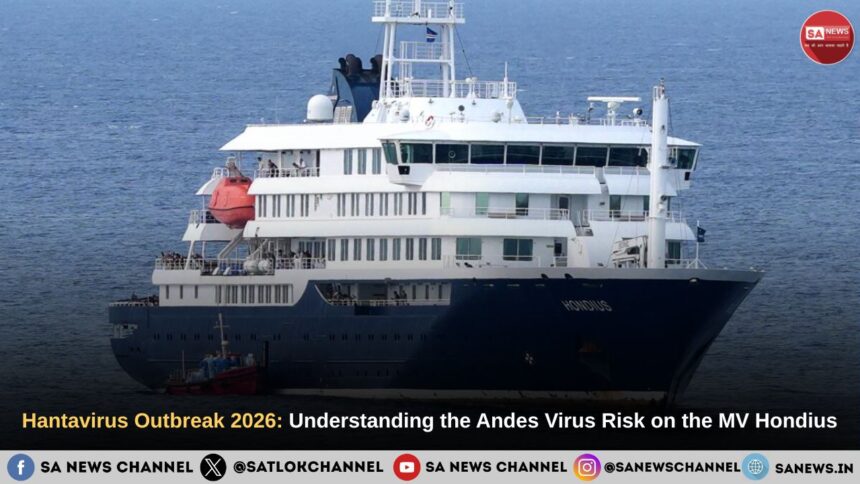
The global health community has shifted its focus toward the Atlantic following the emergence of a localized but concerning cluster of Hantavirus cases. As of May 8, 2026, international maritime and health authorities are managing a situation involving the Andes virus strain-a variant of Hantavirus known for its high mortality rate and unique transmission capabilities.
This report provides a comprehensive analysis of the current outbreak, the biological nature of the virus, and the necessary precautions for international travelers and residents in high-risk zones.
Current Outbreak Data: The May 2026 Cruise Incident
The following table summarizes the confirmed data regarding the cluster detected on the cruise ship MV Hondius.
| Feature | Details (as of May 2026) |
| Vessel Involved | MV Hondius (Atlantic Cruise) |
| Confirmed Cases | 5 |
| Suspected Cases | 3 |
| Fatalities | 3 |
| Primary Strain | Andes Virus (ANDV) |
| Initial Source | Zoonotic exposure in South America |
| WHO Risk Assessment | Low (Global) / Moderate (Regional maritime) |
What is Hantavirus? A 2026 Perspective
Hantaviruses are a group of viruses primarily carried by rodents, including mice, rats, and voles. While most Hantavirus strains are found in specific geographic regions, the Andes virus identified in the recent 2026 outbreak is particularly significant. Unlike the North American Sin Nombre virus, the Andes strain is the only Hantavirus documented to have limited human-to-human transmission.
The Mechanism of Infection
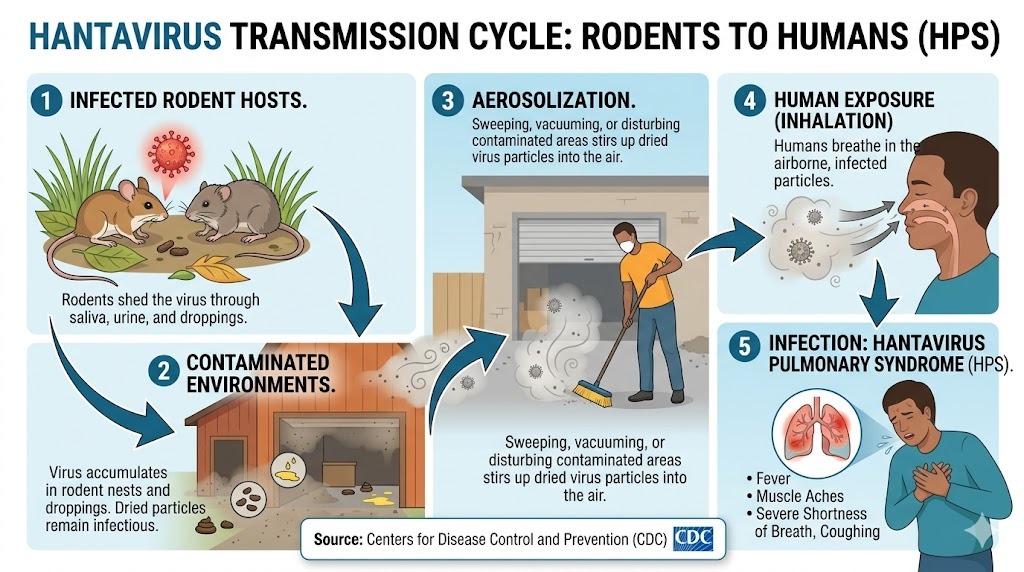
Hantavirus is a zoonotic disease. Humans typically become infected through:
- Aerosolization: Breathing in tiny particles of dried rodent urine, droppings, or saliva that have been stirred into the air.
- Direct Contact: Touching contaminated materials and then touching the eyes, nose, or mouth.
- Rodent Bites: Although rare, an infected rodent’s bite can transmit the virus directly.
Symptoms and Clinical Progression
One of the greatest challenges in managing Hantavirus is its long incubation period, which can range from 1 to 8 weeks. This makes it difficult for port authorities to identify infected passengers immediately upon boarding.
Early Stage (Prodromal Phase)
Symptoms often mimic the common flu, leading to potential misdiagnosis:
- High fever and chills
- Severe muscle aches (especially in large muscle groups like thighs and back)
- Fatigue and dizziness
- Abdominal pain, sometimes accompanied by nausea or vomiting
Late Stage (Hantavirus Pulmonary Syndrome – HPS)
If the infection progresses to HPS, the symptoms become life-threatening within 4 to 10 days:
- Shortness of breath and coughing
- Lungs filling with fluid (pulmonary edema)
- Low blood pressure and shock
Also Read: हंता वायरस (Hantavirus): हंता वायरस का आध्यात्मिक इलाज?
Your Safety Questions Answered
How can I prevent Hantavirus infection?
The most effective way to prevent infection is rodent control. Seal gaps in your home, keep food in rodent-proof containers, and use wet cleaning methods (disinfectants) rather than sweeping when cleaning areas where rodents may have been present.
Is Hantavirus contagious between humans?
Most strains are not. However, the Andes virus (the strain in the current 2026 cluster) can spread through close contact between people. This is why strict isolation protocols were implemented on the MV Hondius.
Is there a vaccine for Hantavirus?
As of May 2026, there is no widely available FDA or WHO-approved vaccine for Hantavirus Pulmonary Syndrome. Treatment remains primarily “supportive care,” which often requires intensive care unit (ICU) intervention and oxygen therapy.
The Invisible Threat: Finding the Ultimate Immunity in a Frail World
The sudden emergence of an invisible virus like Hantavirus, which can turn a luxury cruise into a site of mourning within days, serves as a stark reminder of the vulnerability of human life. Despite our advanced medical technology in 2026, a microscopic entity can still bring the world’s most powerful systems to a standstill. We spend billions on “securing” our bodies, yet the physical frame remains susceptible to decay and disease at any moment.
Sant Rampal Ji Maharaj explains in his spiritual discourses that the destruction of the body is inevitable in this mortal realm (Kaal Lok). While we must take every medical precaution to protect our physical health, we often neglect our true protector God Kabir. The fear of death arises because we have not recognized our true home, Satlok, where no disease, virus, or sorrow exists.
Garib, ajab nagar mein le gaye, hamko Satguru aan |
Jhilke bimb agaadh gati, sootey chaadar taan ||
Meaning – Garibdas ji has told that Satguru, that is, Supreme God Kabir Himself came from His personal place Satyalok and met me, and took me to the remarkable city, that is, the city in Satyalok. On seeing that place with my own eyes, I am walking on the path of bhakti told by God. I am doing the sadhna of Satyanaam and Saarnaam. Therefore, I (sootey chaadar taan) am tension free, that is, there is no doubt in my salvation.
Chaadar taan kar sona = to be tension free.
Sant Garibdas has further said in the Sukshm Ved obtained from Supreme God Kabir that if you had taken initiation by going in the refuge of Satguru (Tatvdarshi Saint), then the hard-ships of all the aforesaid deeds would have been removed, that is, you would neither become a ghost, nor a donkey, nor an ox.
You would have resided in Amar Lok (Eternal Place), that is, you would have gone to the Eternal Supreme Abode mentioned in Gita Chap-ter 18 Verse 62 and Chapter 15 Verse 4 and attained supreme peace. You would have never returned to this world, that is, the grievous cycle of birth and death would have ended forever. There is no sun-light or shade in that Eternal Place (Amar Lok/Satyalok), that is, when sunlight becomes miserable, a need for shade arises. There is only happiness in that Satyalok; there is no misery.
By taking initiation from a Complete Saint and practicing the “Satnam” (True Name), a person gains the spiritual strength to face the uncertainties of the world with equanimity. True protection comes not just from masks and disinfectants, but from the shelter of the Almighty, who is the only entity capable of saving a soul from the all the difficulties of life and ending cycle of birth and death. In a world full of biological threats, the only “permanent cure” is the attainment of God. To connect with Almighty take initiation ( Naam Diksha) through this link :https://online.jagatgururampalji.org/naam-diksha-inquiry
Understand the complete Spiritual knowledge through the official account
FAQs on Hantavirus
1. What is the mortality rate of the Andes virus strain of Hantavirus?
The Andes virus is highly lethal, with a case fatality rate that can range between 35% and 40% if not treated early.
2. Which rodent is the primary carrier of the Andes virus?
The long-tailed pygmy rice rat (Oligoryzomys longicaudatus) is the primary natural reservoir for the Andes virus.
3. What should I do if I find rodent droppings in my home?
Do not sweep or vacuum them. Spray the droppings with a mixture of bleach and water, let it soak for five minutes, and then wipe them up with paper towels while wearing gloves and a mask.
4. Can Hantavirus survive in the environment?
The virus is sensitive to sunlight and disinfectants. However, it can remain infectious in rodent waste for several days depending on temperature and humidity.
5. How is Hantavirus diagnosed in 2026?
Diagnosis is typically confirmed through blood tests that look for Hantavirus-specific antibodies (IgM and IgG) or via Polymerase Chain Reaction (PCR) tests to detect the virus’s RNA.