


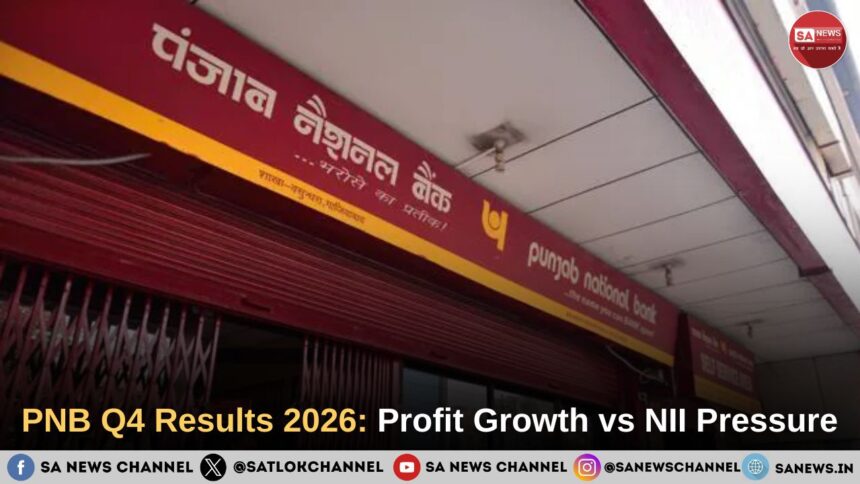
The PNB Q4 Results 2026 highlight a strong profit performance by Punjab National Bank, even as core income metrics showed signs of pressure. The bank reported a 14% year-on-year (YoY) rise in net profit to ₹5,225 crore, showcasing resilience in a challenging interest rate environment.
- Key Highlights of PNB Q4 FY26 Results
- Why Did PNB’s Profit Rise Despite Falling NII?
- NII and NIM Decline: A Concern?
- Asset Quality Improvement: A Major Positive
- Business Growth Remains Strong
- Dividend Announcement: What Investors Should Know
- PNB FY27 Guidance: What Lies Ahead?
- Industry Context: PSU Bank Trends
- PNB Q4 Results 2026: Why Material Profit Can Never Buy Permanent Peace
- FAQs on PNB Q4 Results
However, the decline in Net Interest Income (NII) and Net Interest Margins (NIM) indicates underlying pressure on core banking operations—an important signal for investors and analysts tracking PSU bank performance in India. Read the article to know complete details.
Key Highlights of PNB Q4 FY26 Results
| Metric | Q4 FY26 | YoY Change |
| Net Profit | ₹5,225 crore | ↑ 14.4% |
| Net Interest Income | ₹10,380 crore | ↓ ~3.5% |
| Operating Profit | ₹7,500 crore | ↑ 10.7% |
| Gross NPA | 2.95% | Improved |
| Net NPA | 0.29% | Improved |
| Dividend | ₹3/share | Announced |
Why Did PNB’s Profit Rise Despite Falling NII?
A key question investors are asking: How did PNB achieve profit growth despite declining NII?
Primary Drivers of Profit Growth:
- Lower Provisions: Dropped significantly to ₹424 crore from ₹1,150 crore (QoQ)
- Improved Asset Quality: Reduced bad loans boosted bottom line
- Strong Operating Profit: Up by 10.7% YoY
- Better Efficiency Ratios: Return on Assets (RoA) improved to 1.06%
Direct Answer: PNB’s profit increased mainly due to lower provisioning costs and improved asset quality, which offset the decline in core interest income.
NII and NIM Decline: A Concern?
Despite profit growth, Net Interest Income (NII) fell by ~3.5–4% YoY, while margins also compressed:
- Domestic NIM: 2.61% (vs 2.96% YoY)
- Global NIM: 2.47% (vs 2.81% YoY)
What This Means:
- Rising cost of funds or deposit rates
- Pressure on lending spreads
- Competitive banking environment
This trend aligns with broader Indian banking sector challenges, often highlighted in reports by the , which monitors liquidity and interest rate transmission.
Asset Quality Improvement: A Major Positive
One of the strongest aspects of the PNB financial performance is its improving asset quality.
Key Improvements:
- Gross NPA: Reduced to 2.95% (from 3.19% QoQ)
- Net NPA: Declined to 0.29%
- Significant reduction in absolute bad loans YoY
Why This Matters:
- Lower credit risk
- Reduced future provisioning burden
- Improved investor confidence
This positions PNB among improving PSU banks in India’s recovery cycle.
Also Read: RBI Savings Account Guidelines 2025: Key Updates on ATM Fees, KYC & Cheque Clearance
Business Growth Remains Strong
PNB’s growth across key segments signals long-term strength:
Business Expansion:
- Global Business: ₹29.72 lakh crore (↑ 10.7% YoY)
- Deposits: ₹17.11 lakh crore (↑ ~9.2%)
- Advances: ₹12.59 lakh crore (↑ ~12.7%)
Segment Growth:
- MSME Loans: ↑ 19.9%
- Agriculture Credit: ↑ 10.7%
- Retail Credit: ↑ 8.3%
This diversified growth reduces dependency on any single segment.
Dividend Announcement: What Investors Should Know
PNB declared a ₹3 per share dividend, equivalent to 150% of face value.
Investor Takeaways:
- Signals confidence in financial stability
- Subject to AGM approval
PNB FY27 Guidance: What Lies Ahead?
PNB has provided a forward-looking outlook:
- NII Growth: ~7% expected
- NIM Range: 2.60%–2.70%
- GNPA Target: Below 2.5%
- Net NPA: Below 0.3%
- Operating Profit Growth: 9–10%
While margin pressure may persist, asset quality and growth outlook remain strong.
Industry Context: PSU Bank Trends
According to RBI and industry reports:
- PSU banks have seen improved asset quality post-NPA cycle
- Profitability is rising due to lower credit costs
- However, margin compression remains a sector-wide challenge
PNB Q4 Results 2026: Why Material Profit Can Never Buy Permanent Peace
The PNB Q4 Results for 2026 reveal a striking paradox of profit growth amidst NII pressure, serving as a powerful reminder of the inherent instability found in worldly wealth. While we meticulously track interest margins and net earnings, have we ever considered why even our greatest financial achievements are perpetually shadowed by stress and uncertainty? This pressure exists because we seek stability in a mortal realm of 21 universes ruled by Kaal Brahm, where every material resource is destined for decay and depletion. Jagatguru Tatvdarshi Sant Rampal Ji Maharaj clarifies that worldly gains are merely temporary rewards of past karmas. Holy Scriptures warns:
“Tapeshwari so Rajeshwari, Rajeshwari so Narkeshwari”
It means worldly prestige is not salvation but a karmic reward that still binds the soul to suffering. True ‘profit’ lies in the spiritual credit earned through scripture-based worship, which leads the soul back to Satlok—our eternal home of infinite abundance. Why labor for fluctuating assets when the path to eternal peace is finally available through the Complete Saint of this era, Sant Rampal Ji Maharaj.
Secure your soul’s eternal future today by seeking the true knowledge of Sant Rampal Ji Maharaj.
Website: www.jagatgururampalji.org
YouTube: Sant Rampal Ji Maharaj
Facebook: Spiritual Leader Saint Rampal Ji
‘X’ handle: @SaintRampalJiM
FAQs on PNB Q4 Results
What is the net profit of PNB in Q4 FY26?
PNB reported a net profit of ₹5,225 crore, up 14% YoY.
Why did PNB’s NII decline?
NII declined due to margin compression and higher cost of funds.
Is PNB’s asset quality improving?
Yes, GNPA and NNPA both declined, indicating strong improvement.
What dividend did PNB announce?
PNB announced a ₹3 per share dividend for FY26.
What is PNB’s outlook for FY27?
The bank expects 7% NII growth and improved asset quality, though margins may remain stable.