


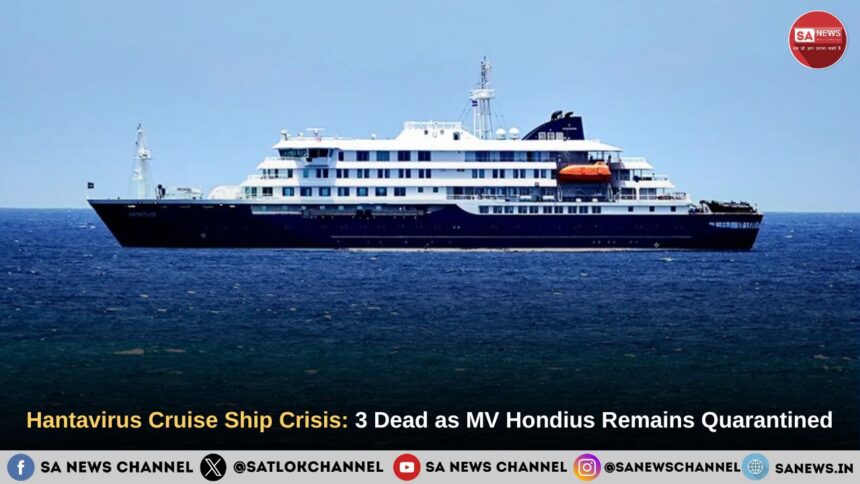
Global health authorities are monitoring a rare and alarming medical crisis aboard the MV Hondius, an Atlantic expedition cruise ship linked to a suspected hantavirus outbreak that has left three people dead. According to World Health Organization-linked reporting, seven people connected to the vessel have been identified as confirmed or suspected cases, including two confirmed hantavirus infections and five suspected cases.
The ship, carrying 147 people, has been held under strict quarantine protocols as medical teams assess passengers and crew, conduct testing and coordinate evacuations. Distressing social media videos from American travel bloggers onboard have gone viral, turning a remote maritime health emergency into an international public concern.
Hantavirus Outbreak at Sea: What Has Happened?
Three Deaths and Seven Linked Cases
The MV Hondius outbreak has become one of the most unusual cruise-related health emergencies in recent memory. Reuters reported that, as of May 5, 2026, seven people aboard or linked to the cruise ship were either confirmed or suspected to have contracted hantavirus, and three had died. The deaths reportedly include a Dutch couple and a German passenger, while a British passenger remains in intensive care isolation in Johannesburg.
The vessel has been anchored off Cape Verde while authorities evaluate the situation. Guardian reporting stated that a British and a Dutch crew member with serious respiratory symptoms were being urgently evacuated under Dutch supervision, while Spain agreed to receive and medically assess the ship in the Canary Islands because Cape Verde had limited capacity to manage the crisis.
Quarantine and Disinfection Measures
Passengers have reportedly been confined to cabins while disinfection, monitoring and health checks take place. The operator, Oceanwide Expeditions, has activated its highest-level emergency response, while national governments coordinate support for affected citizens. The UK government has said it is working with international partners to support 23 British nationals onboard, including passengers and crew.
This crisis has drawn comparisons with pandemic-era cruise ship outbreaks because ships create a difficult public health environment: people live close together, medical resources are limited, evacuation is complicated, and uncertainty can spread quickly.
Also Read: What to Do When Your Child Has a Fever: A Parent’s Guide
What Is Hantavirus?
A Rodent-Borne Virus
Hantaviruses are a group of viruses carried by rodents. The Centers for Disease Control and Prevention says people usually get hantavirus through contact with infected rodents, especially their urine, droppings and saliva. Infection through a bite or scratch is possible but rare.
The World Health Organization states that hantavirus infections can cause severe disease and death. In the Americas, hantaviruses can cause hantavirus cardiopulmonary syndrome, a severe respiratory illness with a case fatality rate reported up to 50%.
Why a Cruise Ship Outbreak Is Unusual
Hantavirus is not commonly associated with cruise ships. Most infections are linked to environments where people inhale virus particles from contaminated rodent droppings, urine or nesting material. Health experts are therefore investigating whether exposure occurred during a land excursion, onboard contamination, cargo-related rodent exposure or another route.
Guardian reporting stated that authorities believe infection may have occurred during a wildlife-related land excursion, although the investigation is ongoing and limited human-to-human transmission has not been ruled out in public reporting.
The Viral Travel Blogger Footage
American Influencers Describe Fear and Uncertainty
The crisis gained global attention after American travel bloggers and influencers onboard shared emotional videos describing confusion, fear and the desire to return home. ABC Australia reported that U.S. influencer Jake Rosmarin described uncertainty after three people died and more people were suspected to be infected while the ship was barred from docking at Cape Verde.
The videos are distressing because they show the human side of quarantine. Passengers are not only dealing with medical fear but also isolation, limited information, separation from family and uncertainty about evacuation.
Social Media Raises Pressure
Social media footage can help alert the world to a crisis, but it can also spread panic if facts are incomplete. In this case, health authorities must communicate clearly: what is confirmed, what is suspected, what is being tested and what passengers should do.
Transparent communication is essential because uncertainty can create fear faster than disease itself.
Why Authorities Are Taking Strict Measures
Severe Respiratory Risk
Hantavirus can progress into serious respiratory illness. Symptoms may begin with fever, muscle pain, fatigue, headache, nausea or stomach symptoms, then worsen into breathing difficulty. Because some cases can become severe quickly, early medical care is critical.
The deaths aboard or linked to the MV Hondius show why authorities cannot treat the outbreak casually. Even if the global risk is assessed as low, the risk to exposed passengers and crew can be serious.
Preventing Wider Exposure
Strict quarantine helps prevent potential spread while investigators determine exposure routes. Medical teams need to identify symptomatic individuals, isolate suspected cases, collect samples, trace contacts and clean areas that may have been contaminated.
If rodent exposure occurred onboard, authorities will need to inspect food storage, waste areas, cabins, cargo zones and ventilation-sensitive spaces. If exposure occurred on land, they must reconstruct excursion routes and identify others who may have been exposed.
Health Risk to the Wider World
Global Risk Appears Low, But Monitoring Continues
WHO-linked updates indicate that the risk to the global population is currently considered low, but monitoring continues. This is because hantavirus is generally not spread through casual human-to-human contact in most forms, and infections are usually linked to rodent exposure.
However, authorities are still tracing travel contacts. India Today reported that WHO was tracing 88 flight passengers who travelled with a hantavirus-infected flyer from Saint Helena to Johannesburg.
This shows that health officials are not assuming safety; they are actively checking possible exposure chains.
Cruise Ships Need Better Preparedness
This incident highlights the need for stronger medical readiness on expedition ships, especially those travelling remote routes. Vessels should have outbreak protocols, rapid testing pathways, evacuation plans, rodent-control systems, medical isolation capacity and direct communication with port health authorities.
Expedition tourism often takes passengers to remote places where medical access is limited. That makes prevention and preparedness essential.
Also Read: The Human Microbiome: How Trillions of Microbes Control Our Health More Than Genes
Compassion, Fear and the Lesson of Responsibility
The MV Hondius crisis reminds humanity that health, travel and life are uncertain. A joyful journey can become a medical emergency within days. The teachings of Sant Rampal Ji Maharaj and Sat Gyaan emphasize truth, compassion, humility, righteous conduct and true worship according to holy scriptures. His teachings guide people away from intoxication, dishonesty, corruption, violence, greed and harmful habits.
In the context of this outbreak, the spiritual message is clear: during crisis, society must respond with care, truth and discipline, not panic or blame. Patients, crew, families and health workers need compassion. Sat Gyaan teaches that human life is precious and temporary, and that real security comes not only from worldly arrangements but from true devotion, moral living and connection with the Supreme God.
FAQs on the Hantavirus Cruise Ship Crisis
1. Which cruise ship is involved in the outbreak?
The outbreak is linked to the MV Hondius, an expedition cruise ship travelling in the Atlantic and currently associated with quarantine and medical assessment measures.
2. How many people have died?
Three people linked to the outbreak have died, while seven confirmed or suspected cases have been reported by health authorities and major news agencies.
3. How many hantavirus cases are confirmed?
Public reporting says two cases have been confirmed and five others are suspected, though testing and investigation are still ongoing.
4. How does hantavirus spread?
Hantavirus usually spreads through exposure to infected rodents or their urine, droppings and saliva. Rarely, infection can occur through rodent bites or scratches.
5. Can hantavirus spread easily between people?
Most hantaviruses are not easily spread person to person. However, authorities are still investigating the exact exposure route in this cruise ship outbreak and monitoring contacts carefully.
6. Why is the ship under quarantine?
The ship is under quarantine to identify symptomatic people, collect samples, prevent further exposure, disinfect possible contaminated areas and safely coordinate medical evacuation where needed.