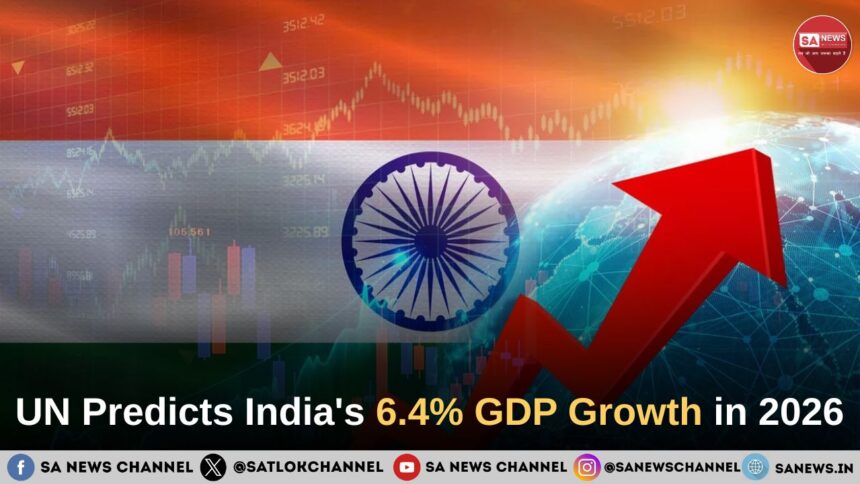
India’s economic story continues to capture global attention. According to the United Nations, India is projected to grow at 6.4% in 2026, reinforcing its position as one of the fastest-growing major economies. While global economies face uncertainty, India’s resilience, domestic demand, and services sector strength are keeping it ahead. But growth alone is not enough – the bigger question is whether India can truly emerge as Asia’s leading economic powerhouse.
- Understanding India’s 6.4% GDP Growth Forecast
- Sector-Wise Breakdown of India’s Growth Story
- Employment and Job Creation Challenges
- Role of Infrastructure in Economic Growth
- Digital Economy – India’s Silent Growth Engine
- India vs China – The Economic Shift
- Importance of Global Trade Relations
- Inflation and Monetary Policy Impact
- Inclusive Growth – The Real Challenge
- Environmental Sustainability and Growth
- Can India Truly Lead Asia?
- Challenges India Must Overcome
- 1. Global Trade Pressures
- 2. Inflation Risks
- 3. Informal Sector Struggles
- 4. Global Geopolitical Risks
- Can India Lead Asia’s Economy?
- India’s Global Economic Position
- The Role of Technology and Innovation
- Risks That Could Slow India Down
- Beyond Wealth: The Role of Ethics and Inner Peace in True Development
- Satbhakti: The Path to Peace and Prosperity
- What Lies Ahead?
- FAQs on India’s GDP Growth in 2026
In this blog, we explore India’s growth drivers, challenges, global positioning, and what the future holds for Asia’s economic leadership.
Understanding India’s 6.4% GDP Growth Forecast
The United Nations Economic and Social Commission for Asia and the Pacific (ESCAP) has projected India’s GDP growth at 6.4% in 2026, followed by 6.6% in 2027.
This forecast places India among the fastest-growing large economies globally. Even though this represents a slight moderation from the 7.4% growth in 2025, it still indicates strong economic stability.
Sector-Wise Breakdown of India’s Growth Story
India’s agriculture sector continues to act as a backbone for the economy, especially for rural livelihoods. Despite climate challenges, improved irrigation, government subsidies, and digital farming initiatives are supporting steady output.
With a large rural population dependent on farming, stable agricultural growth ensures food security and supports rural consumption, which directly boosts GDP growth.
Manufacturing Sector Expansion
India is focusing heavily on boosting its manufacturing sector through initiatives like “Make in India” and Production Linked Incentive (PLI) schemes.
Key industries driving this growth include:
- Electronics manufacturing
- Automobile sector
- Pharmaceuticals
- Textile exports
If India successfully expands manufacturing, it can reduce import dependency and strengthen exports – both crucial for long-term economic leadership in Asia.
Services Sector Dominance
The services sector remains the largest contributor to India’s GDP. IT services, business outsourcing, fintech, and digital platforms are leading the charge.
India’s tech talent and global outsourcing capabilities continue to attract multinational companies. Cities like Bengaluru, Hyderabad, and Pune are becoming global tech hubs.
This sector alone plays a major role in maintaining India’s high growth rate.
Also Read: World Bank का बड़ा अनुमान: भारत की अर्थव्यवस्था 6.6% की रफ्तार से बढ़ेगी, लेकिन चुनौतियां बरकरार
Employment and Job Creation Challenges
While GDP growth looks promising, job creation remains a critical concern.
Youth Employment Pressure
India has one of the youngest populations in the world. Every year, millions enter the workforce, creating pressure on the economy to generate jobs.
If employment opportunities do not grow at the same pace as GDP, it could lead to:
- Rising unemployment
- Income inequality
- Social instability
Skill Development Gap
There is often a mismatch between industry requirements and workforce skills.
To sustain economic growth, India needs:
- Skill-based education
- Vocational training programs
- Industry-academia collaboration
- Government initiatives like Skill India are helping, but more efforts are needed to bridge the gap.
Role of Infrastructure in Economic Growth
Infrastructure development is one of the strongest pillars supporting India’s economic expansion.
Transport and Connectivity
Massive investments in highways, railways, airports, and ports are improving connectivity across the country.
Urban Development
Smart cities, metro projects, and housing schemes are transforming urban India.
Urbanization plays a key role in boosting:
- Real estate growth
- Employment opportunities
- Consumer spending

Digital Economy – India’s Silent Growth Engine
India’s digital revolution is reshaping its economy at an unprecedented pace.
Rise of Digital Payments
India is one of the global leaders in digital payments, thanks to platforms like UPI.
This has:
- Increased financial inclusion
- Reduced cash dependency
- Boosted transparency
Startup Ecosystem Growth
India is now home to thousands of startups and unicorns.
Key sectors include:
- EdTech
- FinTech
- HealthTech
- E-commerce
Startups are not only driving innovation but also generating employment and attracting foreign investments.
Also Read: IEA Warning: Middle East War Delays Energy Production by 2 Years
India vs China – The Economic Shift
For decades, China has dominated Asia’s economic landscape. However, the dynamics are changing.
China’s Slowdown
China is facing several challenges:
- Aging population
- Real estate crisis
- Slower industrial growth
India’s Opportunity
India, on the other hand, has:
- A young workforce
- Growing domestic market
- Increasing global trust
Many global companies are now adopting a “China +1” strategy, shifting part of their operations to India.
This creates a huge opportunity for India to emerge as Asia’s leading economy.
Importance of Global Trade Relations
India’s future growth also depends on its global trade partnerships.
Export Diversification
India is working towards diversifying its export markets to reduce dependency on a few countries.
Key export sectors include:
- IT services
- Pharmaceuticals
- Textiles
- Engineering goods
Free Trade Agreements (FTAs)
India is actively signing trade agreements with countries and regions to boost exports.
These agreements can:
- Open new markets
- Increase foreign investment
- Strengthen economic ties
Inflation and Monetary Policy Impact
Inflation plays a crucial role in shaping economic growth.
Controlled Inflation Levels
India’s inflation is expected to remain around 4.4%, which is relatively stable.
Controlled inflation ensures:
- Stable purchasing power
- Better investment environment
- Economic confidence
RBI’s Role
The Reserve Bank of India (RBI) plays a key role in managing inflation and interest rates.
Balanced monetary policies help sustain economic growth without overheating the economy.
Inclusive Growth – The Real Challenge
Economic growth should not be limited to numbers; it must benefit all sections of society.
Rural vs Urban Divide
There is still a gap between rural and urban development.
Efforts are needed to:
- Improve rural infrastructure
- Increase access to education and healthcare
- Boost rural employment
Income Inequality
Rising inequality can slow down long-term growth.
Inclusive policies are necessary to ensure that growth reaches every individual.
Environmental Sustainability and Growth
Economic growth must be balanced with environmental protection.
Renewable Energy Push
India is investing heavily in renewable energy sources like:
- Solar power
- Wind energy
- Green hydrogen
Climate Challenges
Climate change can impact:
- Agriculture
- Water resources
- Public health
Sustainable growth strategies are essential for long-term economic stability.
Can India Truly Lead Asia?
India’s projected 6.4% GDP growth in 2026 reflects strong economic fundamentals.
With its young population, digital transformation, and policy reforms, India is well-positioned to become a major economic leader in Asia.
However, leadership will depend on how effectively India:
- Manages global challenges
- Creates jobs
- Ensures inclusive growth
- Maintains economic stability
If these factors are addressed, India has the potential not just to lead Asia but to emerge as a global economic powerhouse in the coming decades.
Challenges India Must Overcome
Despite strong growth, several challenges could impact India’s economic trajectory.
1. Global Trade Pressures
Exports to the US declined by 25% due to tariffs, affecting economic momentum.
2. Inflation Risks
Inflation is expected to remain around 4.4%, slightly above the ideal target, limiting monetary flexibility.
3. Informal Sector Struggles
Stable India growth outlook masks hit to vast informal sector, say economists: Reuters poll
GDP growth at 6.4%! India will continue as fastest G-20 economy; banking sector to remain resilient in FY27
4. Global Geopolitical Risks
Conflicts and trade tensions can disrupt supply chains, fuel prices, and economic stability worldwide.
Can India Lead Asia’s Economy?
India is already a major growth engine in Asia-Pacific.
Why India Has an Edge:
- Young workforce
- Digital transformation
- Expanding middle class
- Strong services sector
The UN report suggests India will continue to play a crucial role in regional growth momentum.
Comparison with Other Asian Economies:
China: Slower growth due to structural challenges
Japan: Aging population
Southeast Asia: Emerging but smaller scale
India’s combination of scale and growth makes it a strong contender for leadership.
India’s Global Economic Position
India is expected to become the third-largest economy by 2030, driven by reforms and sustained growth.
Additionally:
- India is already among the top G20 economies
- It continues to lead in growth rates among major economies
- This positions India as a key global economic influencer.
The Role of Technology and Innovation
Digital India initiatives, startups, and fintech growth are transforming the economy.
Key sectors:
- AI and tech services
- Digital payments
- E-commerce
- Renewable energy
These sectors are expected to further accelerate GDP growth.
Risks That Could Slow India Down
While the outlook is positive, risks remain:
- External shocks (wars, oil prices)
- Export dependency on key markets
- Employment generation challenges
- Income inequality
- Balancing growth with inclusivity will be crucial.
Beyond Wealth: The Role of Ethics and Inner Peace in True Development
True development lies in the harmony of material prosperity and balanced living. According to the SatGyan of Sant Rampal Ji Maharaj, material success is a hollow achievement if not supported by spiritual awareness, especially since worldly wealth is merely temporary. In the pursuit of economic growth, He reminds us that wealth should be utilized for the welfare of all, ensuring progress benefits every section of society.
Satbhakti: The Path to Peace and Prosperity
For those who perform Satbhakti after taking initiation from Sant Rampal Ji Maharaj, life is free from the exhausting “wealth race,” replaced by a happy and peaceful existence. His teachings are exemplified by His immense compassion; for instance, by spending billions to provide motors and pipes to farmers, He ensured successful harvests and saved countless lives. To understand these profound spiritual concepts and the path to true peace, you can read the book Gyan Ganga by visiting this link.
What Lies Ahead?
India’s economic future looks promising but requires:
- Strong policy decisions
- Continued reforms
- Global cooperation
- Inclusive growth strategies
If managed well, India has the potential to not only lead Asia but also shape the global economy.
FAQs on India’s GDP Growth in 2026
1. What is India’s GDP growth forecast for 2026?
India’s GDP is projected to grow at 6.4% in 2026 according to the United Nations.
2. Why is India’s economy growing fast?
Strong domestic demand, a booming services sector, and government reforms are key reasons.
3. Can India become Asia’s leading economy?
Yes, with consistent growth and reforms, India has strong potential to lead Asia.
4. What challenges does India face in economic growth?
Global trade tensions, inflation, and informal sector challenges are major concerns.
5. What sectors drive India’s economic growth?
Services, technology, infrastructure, and consumer demand are the main growth drivers.