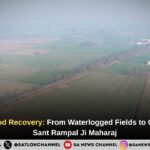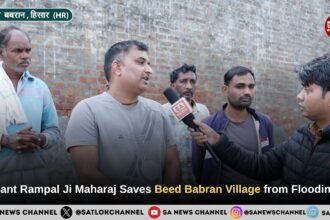


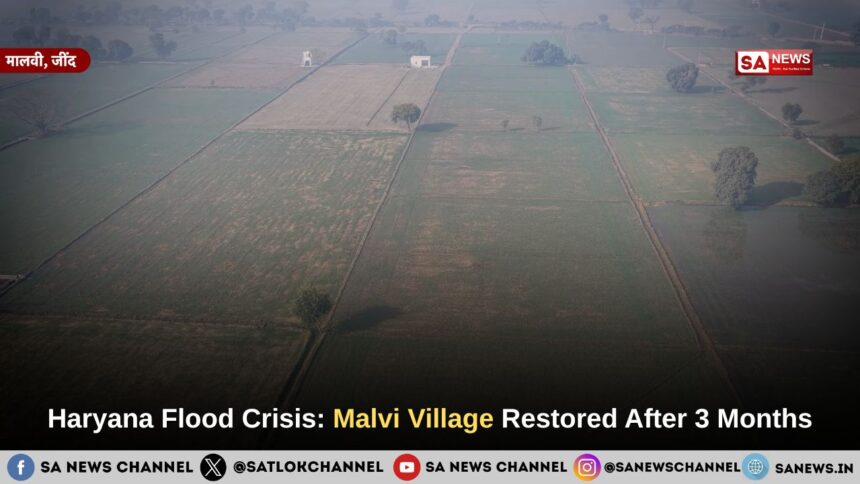
Malvi, a small village in the Julana tehsil of Jind district in Haryana, had been facing a disaster for the past three months that completely disrupted normal life. The streets of the village were no longer pathways but were filled with water stretching far and wide. It seemed as if the entire village had turned into a white ocean. With water filling the spaces between houses, many homes appeared like isolated islands.
- Impact of the Flood: Destruction from Fields to Homes
- Economic Condition of Farmers: Burden of Debt and Uncertainty
- Role of Administration: More Assurances, Less Action
- Beginning of Relief: Support from Saint Rampal Ji Maharaj
- Technical Solution: Water Drained through Pipeline and Motors
- Ground Transformation: From Barren Land to Green Fields Again
- Voices of Farmers: In Their Own Words
- Contribution of Saint Rampal Ji Maharaj: Timely and Non-Discriminatory Help
- Malvi Village Recovering from Crisis with the Grace of Saint Rampal Ji Maharaj
The fields, which sustain the farmers’ livelihoods, were completely submerged, and the paddy crop had been destroyed. This was not just a natural disaster but also a period of economic and mental crisis for the farmers.
Impact of the Flood: Destruction from Fields to Homes
The flood situation in the village was so severe that 4 to 6 feet of stagnant, rotten water stood in the fields. According to the farmers, this water also affected the fertility of the soil. The paddy crop was completely destroyed, and many farmers did not even get a chance to harvest. Even the remaining crop had spoiled grains.
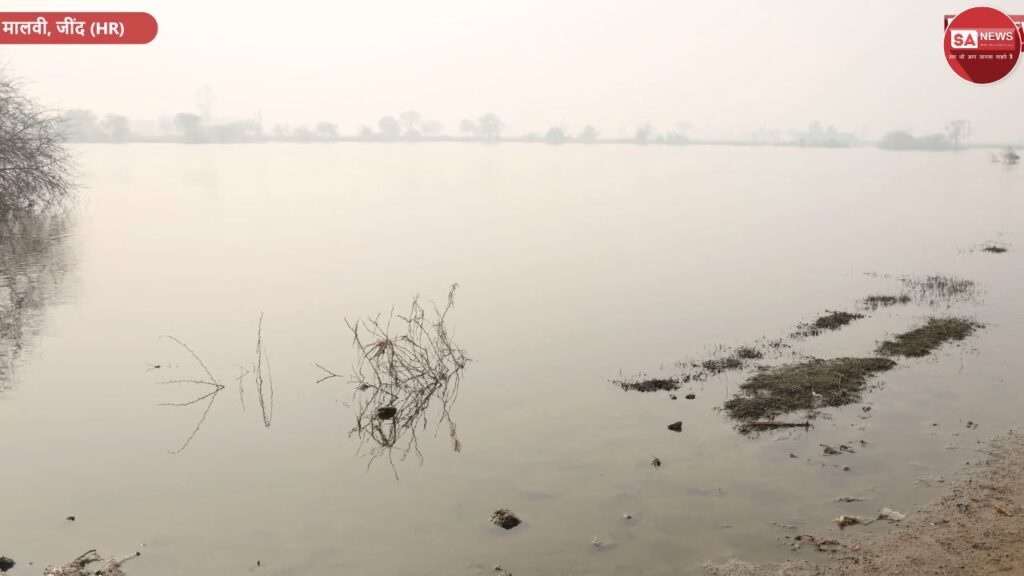
Elderly villagers say that the situation had worsened to such an extent that even reaching the fields became difficult. Roads were completely blocked, and stepping out of the house became a challenge. Water had started entering several homes, forcing families to search for safer places.
Economic Condition of Farmers: Burden of Debt and Uncertainty
The farmers of Malvi village were already dependent on agriculture, and the flood further weakened their financial condition. After the loss of the paddy crop, the biggest concern was the sowing of the next wheat crop. If the water did not drain in time, the next crop would also be affected, deepening the debt crisis.
A farmer, Satyavan, says, “We were completely finished. Seeing the water standing in the fields felt like everything had slipped out of our hands. If the water had remained like this, we wouldn’t have been able to sow wheat.”
Another farmer, Monu Sharma, says, “Water had filled around 700–800 killas. We had no idea what would happen next. Many people were even struggling to manage household expenses.”
Role of Administration: More Assurances, Less Action
The village head and other residents contacted the administration multiple times regarding the issue. The matter was even raised with MLAs and ministers, but no concrete action was seen on the ground. People kept receiving only dates and assurances. Villagers say that no effective step was taken at the administrative level. Neither were machines provided on time nor was any solid plan made to drain the water. This negligence worsened the village’s suffering.
A villager says, “We pleaded everywhere, but no one listened. We felt that now we would have to do something ourselves, otherwise the village would be destroyed.”
Beginning of Relief: Support from Saint Rampal Ji Maharaj
When all efforts failed, the village panchayat appealed to Saint Rampal Ji Maharaj for help. According to villagers, immediate action was taken on this request, and within a week, relief work began in the village.
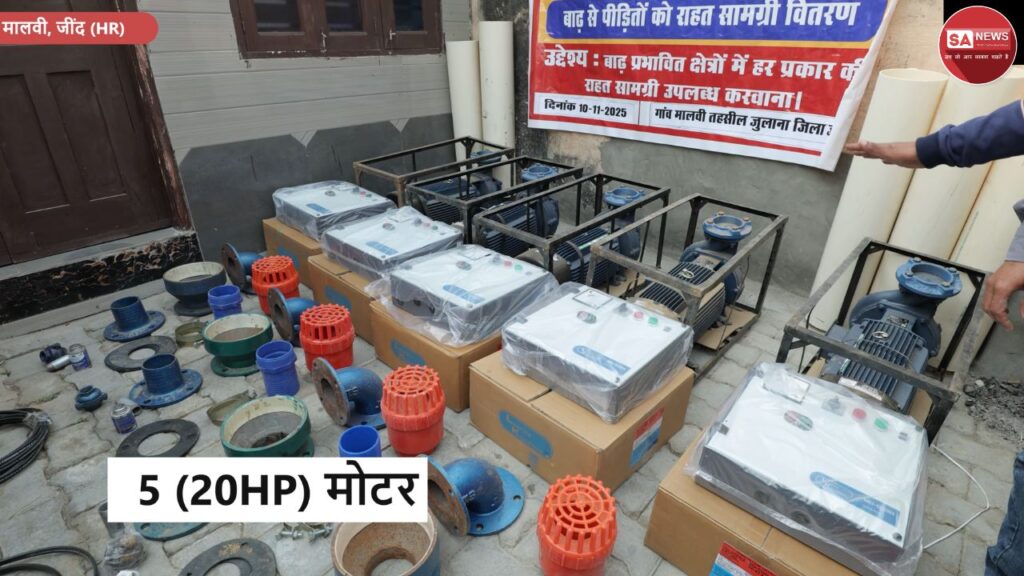
Around 18,000 feet of pipeline and five 20-horsepower motors were sent to the village. Along with this, necessary equipment such as cables, starters, and other materials were also provided. Notably, not a single rupee was demanded from the village for this entire work.
Technical Solution: Water Drained through Pipeline and Motors
Under the relief work, a pipeline was laid up to a canal located about 17–18 kilometers away from the village. This was a major technical solution that helped in draining the continuously accumulated water.
Volunteers and villagers worked together day and night. Through motors, water was pumped out from the fields into the canal. This process continued for several days, gradually drying the fields.
A farmer says, “There was four to five feet of water, but after installing the machines, a lot of water was drained within a few days. Now work in the fields has started again.”
Ground Transformation: From Barren Land to Green Fields Again
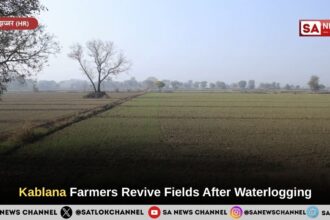
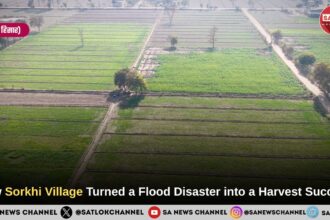
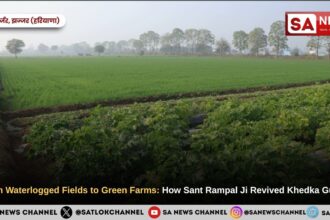
Where there was once silence in the fields, now the sound of tractors can be heard. After the water drained, farmers quickly began sowing wheat. Agricultural work has resumed in almost the entire village. Monu Sharma says, “Almost all the water has been drained now. Only about 10–15 killas of land still has some water left, which will disappear in a few days. Timely sowing has been done, and that is the biggest relief.”
While the flood had pushed the village into despair, this relief effort has reignited hope among the people. Roads have reopened, and life is gradually returning to normal.
Villagers say that a permanent solution is also being planned for the future. There is a plan to bury the pipeline underground so that such a problem does not arise again.
Voices of Farmers: In Their Own Words
Satyavan says, “Earlier, the situation was so bad that even walking in the village was difficult. Now everything has changed. Roads are open, fields are dry, and work has resumed.”
Monu Sharma says, “The help that came to our village brought us great relief. Such a big task was done without any money—it is a huge thing for us.”
Another farmer says, “If this help had not come on time, our entire year would have been ruined. Now we hope that our crop will be good.”
Contribution of Saint Rampal Ji Maharaj: Timely and Non-Discriminatory Help
Villagers believe that during this entire crisis, the support of Saint Rampal Ji Maharaj proved decisive. The help was not only timely but also well-organized and technically effective.
The most important aspect was that there was no discrimination in this assistance. Every farmer and every family benefited equally.
Malvi Village Recovering from Crisis with the Grace of Saint Rampal Ji Maharaj
This story of Malvi village is not just about relief from a flood but also about the power of collective effort and timely assistance. Where the administrative system proved weak, an alternative support gave the village a new direction.
Today, greenery is returning to the fields, and hope is visible on the faces of farmers. This incident shows that the right decision at the right time and proper use of resources can avert even the biggest crisis. Saint Rampal Ji Maharaj stands with every needy person without any discrimination of caste or class.
He treats everyone equally, and while many so-called religious leaders exploit people and fill their own coffers, Saint Rampal Ji Maharaj has generously contributed for the treatment, housing, education, and food of the poor and needy. He has also extended wholehearted support to farmers. Such work is beyond the capacity of an ordinary person; therefore, he is not just a saint but God.