

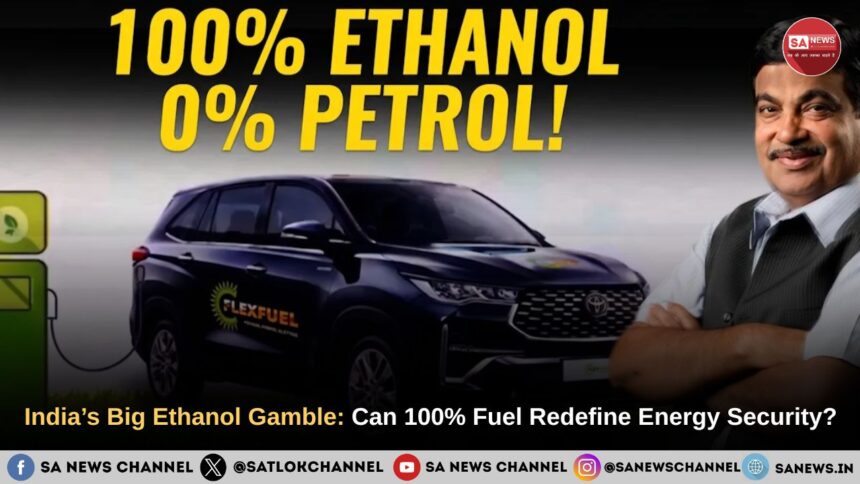
100% Ethanol Fuel Shift: India is being urged to accelerate its transition towards 100% ethanol-blended fuel as concerns over energy security grow amid disruptions in oil exports from West Asia. Union Minister Nitin Gadkari has highlighted the need for self-reliance in the energy sector, citing high import dependence and rising costs. The proposal builds on India’s ongoing ethanol blending program, including the rollout of E20 fuel and future plans involving flex-fuel vehicles and higher ethanol blends.
- Key Takeaways: India’s 100% Ethanol Blending Vision
- Push for 100% Ethanol Blending Amid Energy Crisis
- Understanding E100 Fuel and Its Composition
- India’s Current Ethanol Blending Status and Policy Direction
- Launch and Distribution of E100 Fuel in India
- Global Scenario: Where India Stands
- Economic and Environmental Rationale Behind Ethanol Push
- Challenges for Manufacturers and Automotive Industry
- Hydrogen as a Parallel Energy Solution
- Policy Perspective and Industry Concerns
- India’s Gradual Shift Towards Energy Self-Reliance
- Spiritual Perspective on True Abundance
- FAQs on 100% Ethanol Fuel
Key Takeaways: India’s 100% Ethanol Blending Vision
- Nitin Gadkari urges India to aim for 100% ethanol blending in the near future
- Energy crisis linked to West Asia conflict and disrupted oil trade
- India currently imports 87% of its oil needs
- Annual fossil fuel import cost stands at ₹22 lakh crore
- E20 fuel rolled out from April 1, 2026
- CAFE III norms to be implemented from April 1, 2027
- E100 fuel introduced in 2024 by Hardeep Singh Puri
- Brazil remains the only country using E100 at scale
- Shift requires engine modifications and flex-fuel vehicle adoption
Push for 100% Ethanol Blending Amid Energy Crisis
Speaking at the Indian Federation of Green Energy’s Green Transport Conclave, Nitin Gadkari said that India should aspire to achieve 100 per cent ethanol blending in the near future. He stated that the ongoing crisis in West Asia and disruptions in oil trade for nearly two months, along with the US blockade, have exposed vulnerabilities in fuel imports.
He said, “In the near future, India should aspire to achieve 100 per cent ethanol blending. Today, we are facing an energy crisis due to the war in West Asia, so it is necessary for us to become self-reliant in the energy sector.”
Also Read: Ethanol Blending in India: Policy, Benefits, 2030 Targets & Impact on Sustainable Transport
Understanding E100 Fuel and Its Composition
E100 refers to a fuel blend that consists primarily of ethanol, typically ranging from 95 to 100 per cent ethanol by volume. In India, the officially introduced “Ethanol 100” fuel by IndianOil contains approximately:
- 93 to 93.5 per cent ethanol
- About 5 per cent petrol
- Around 1.5 per cent co-solvent for safety
This formulation ensures usability while maintaining safety standards for high ethanol content fuels.
India’s Current Ethanol Blending Status and Policy Direction
The progress of India in the Ethanol sector has been enormous in recent years. The country officially rolled out E20 (20 per cent ethanol-blended petrol) from April 1, 2026. Earlier, in 2023, Narendra Modi launched petrol blended with 20 per cent ethanol.
At present, vehicles in India can operate on E20 petrol with minor engine modifications to prevent corrosion and related issues. The government is now focusing on the next phase, which includes:
- Transition to Flex-Fuel Vehicles (FFVs) capable of using E85 or E100
- Draft notification for E85 fuel in final stages
- Implementation of Corporate Average Fuel Efficiency (CAFE III) norms from April 1, 2027
Gadkari also noted that CAFE III standards will have little impact on electric and flex-fuel vehicles.
Also Read: Nissan Gravite Launched in India at Rs 5.65 Lakh; Bookings Open, CNG Version Planned
Launch and Distribution of E100 Fuel in India
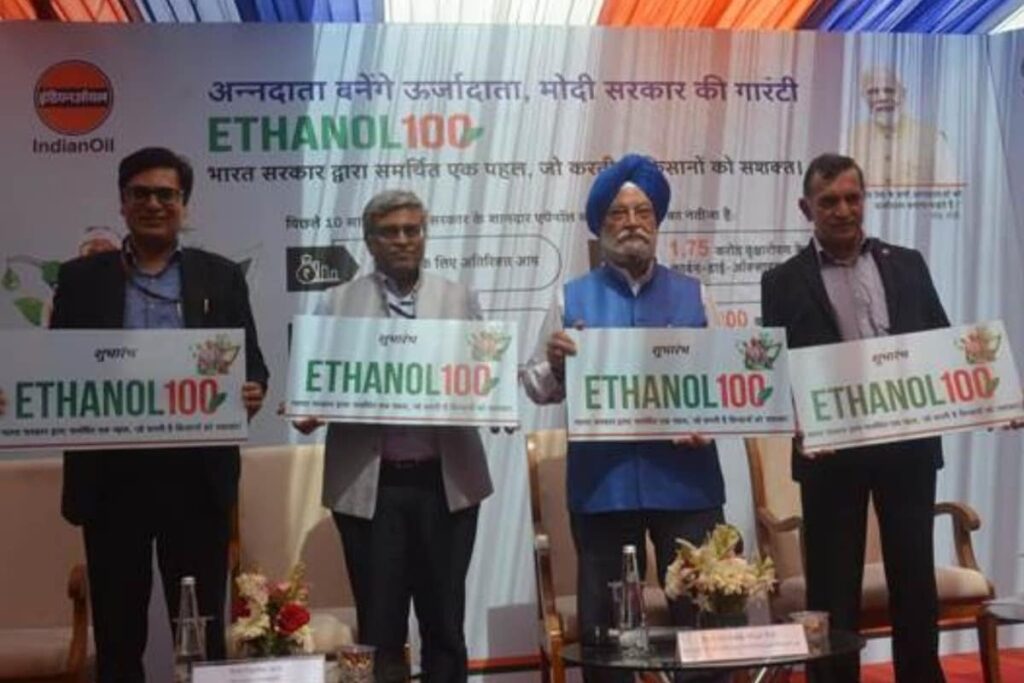
India saw the launch of E100 fuel in 2024 by Hardeep Singh Puri. Indian Oil introduced the fuel and began distribution through 183 retail outlets across five states:
- Maharashtra
- Karnataka
- Uttar Pradesh
- New Delhi
- Tamil Nadu
This marked a significant step toward higher ethanol blending adoption in the country.
Global Scenario: Where India Stands
Currently, Brazil is the only country that uses 100 per cent ethanol fuel for road vehicles at a meaningful scale. Some countries such as Sweden use E85 fuel, while most European countries operate within E5 to E10 blending levels.
This places India among nations actively expanding ethanol usage but still in a transition phase.
Economic and Environmental Rationale Behind Ethanol Push
India’s dependence on imported fossil fuels remains high, with 87 per cent of oil requirements met through imports. According to Gadkari, this results in an annual expenditure of ₹22 lakh crore.
He stated, “We import fossil fuels worth ₹22 lakh crore, which is also causing pollution, so we need to work on increasing production of alternative fuel and bio-fuel.”
The shift towards ethanol is aimed at:
- Reducing import dependency
- Lowering fuel costs through domestic production
- Addressing pollution concerns
- Strengthening energy security
Challenges for Manufacturers and Automotive Industry
The transition to higher ethanol blends presents technical challenges for automobile manufacturers. Ethanol is more corrosive than standard petrol, requiring engines to be specifically designed or modified to handle higher concentrations.
Key challenges include:
- Developing engines compatible with E85 and E100 fuels
- Ensuring durability and performance under high ethanol conditions
- Maintaining environmental efficiency standards
Gadkari advised automobile companies to focus on quality rather than cost to expand into new markets.
Hydrogen as a Parallel Energy Solution
Alongside ethanol, Gadkari also highlighted the potential of green hydrogen as a future fuel. He pointed out several challenges, including transportation and cost.
He stated that producing hydrogen at USD 1 per kilogram is essential to make India an energy exporter. Additionally, there is a need to produce hydrogen from waste and reduce the cost of operating hydrogen fuel stations to make them financially viable.
Policy Perspective and Industry Concerns
Gadkari emphasized that while there is a need to discourage petrol and diesel vehicles, people cannot be forced to stop purchasing them. He also addressed concerns raised on social media regarding E20 fuel, stating that the petroleum sector is lobbying against the move.
He further noted that focusing on a circular economy could generate more employment opportunities in the country.
India’s Gradual Shift Towards Energy Self-Reliance
India’s approach to ethanol blending reflects a phased transition rather than an immediate shift to E100. Starting with E20, moving toward E85, and eventually aiming for E100, the policy direction is aligned with long-term energy security goals.
The current developments highlight a broader strategy to reduce dependence on imported fossil fuels while promoting alternative energy sources and domestic production.
Spiritual Perspective on True Abundance
In times when nations face challenges such as energy dependence and resource constraints, the idea of true abundance remains significant. Even when shortages arise in different sectors, spiritual understanding teaches that the Supreme power’s domain is beyond all limitations. As explained by Tatvdarshi Sant Rampal Ji Maharaj, true spiritual knowledge given by Him connects individuals with a higher purpose and stability. He explains that true fulfilment is not limited to material resources but lies in spiritual awareness and alignment with the Supreme.
In this context, a spiritual gathering (Bhandara) has also been organised on 1, 2 and 3 May 2026, where people from across the world are invited. Such initiatives reflect the idea of universal participation, harmony, and collective well-being. The message emphasizes that while material systems may face limitations, the Supreme’s domain remains complete, encouraging individuals to seek balance and inner growth alongside external progress.
For more information visit our
Website: www.jagatgururampalji.org
YouTube: Sant Rampal Ji Maharaj
Facebook: Spiritual Leader Saint Rampal Ji
X (Twitter): @SaintRampalJiM
FAQs on 100% Ethanol Fuel
1. What is E100 fuel?
E100 is a fuel containing 95–100% ethanol, used as an alternative to petrol in specially designed engines.
2. Why is India promoting ethanol blending?
To reduce oil imports, lower costs, address pollution, and improve energy self-reliance.
3. Can current vehicles run on E100 fuel?
No, vehicles require specific engine modifications or flex-fuel technology for high ethanol blends.
4. When was E20 fuel introduced in India?
E20 fuel was rolled out nationwide from April 1, 2026.
5. Which country uses E100 fuel widely?
Brazil is currently the only country using E100 fuel at a large scale.