


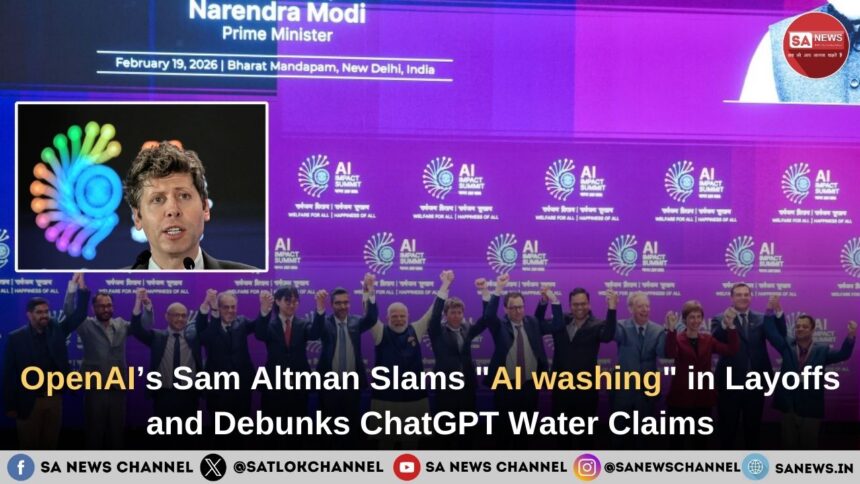
During his high-profile visit to India for the India AI Impact Summit (February 2026), OpenAI CEO Sam Altman addressed two of the most stinging criticisms of the AI industry: mass job displacement and environmental degradation. Altman argued that many current layoffs attributed to AI are actually “AI washing” by corporations, and he vehemently denied viral reports suggesting that ChatGPT queries consume excessive amounts of water.
News Highlights:
- The Scapegoat: Altman claims companies are blaming AI for layoffs to mask pandemic-era over-hiring and mismanagement.
- Water Myth Debunked: Called the “17 gallons of water per query” claim “totally insane” and “divorced from reality.”
- Energy Comparison: Sparked debate by stating that training a human for 20 years consumes more total energy than training an AI model.
- Future Infrastructure: Called for a global push toward nuclear and solar energy to power the next generation of data centers.
What Did Mr. Altman Say?
Speaking at the Express Adda in New Delhi, Sam Altman took a defensive yet firm stance on the social and environmental costs of artificial intelligence. Addressing the wave of global tech layoffs, Altman introduced the concept of “AI washing.” He explained that while AI will eventually cause real job shifts, many current staff reductions are being blamed on AI simply because it sounds “innovative” or “inevitable,” rather than admitting to financial errors or shifting market demands.
On the environmental front, Altman addressed a widely circulated study claiming ChatGPT “drinks” a significant amount of water for cooling. He clarified that modern data centers have pivoted to closed-loop or non-evaporative cooling systems, making some operations nearly water-independent. In a provocative comparison, he noted that the biological “energy cost” of raising and educating a human to a professional level is vastly higher than the electrical cost of an AI inference, suggesting that AI might actually be a more efficient way to process information in the long run.
OpenAI CEO Sam Altman addressed two of the biggest controversies surrounding artificial intelligence job losses and environmental impact during the India AI Impact Summit.
His comments have sparked significant debate by dismissing certain claims as “AI washing” and “insane.”
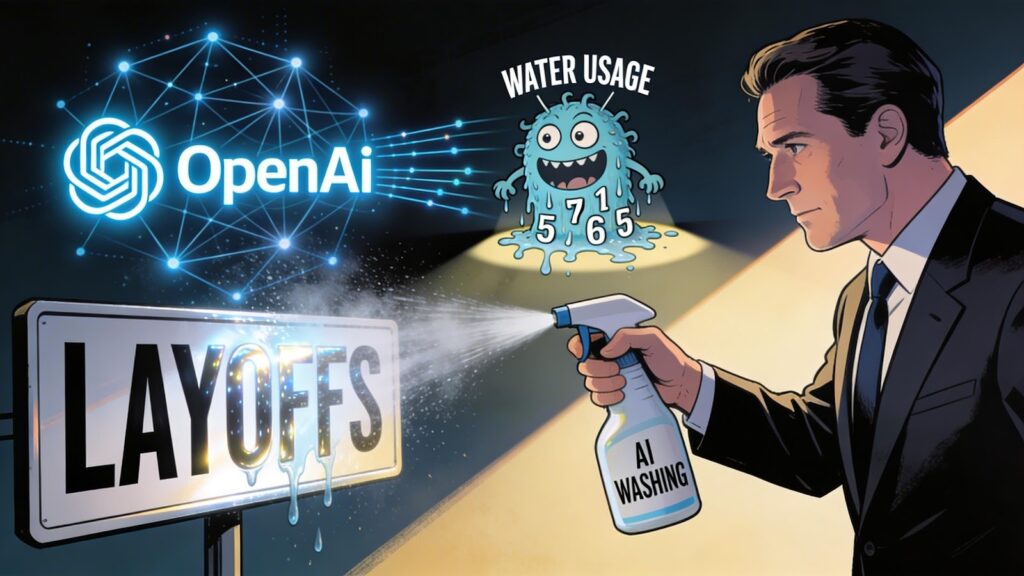
“AI washing” in Layoffs
Altman warned that many companies are using AI as a convenient “scapegoat” to justify layoffs that would have happened regardless.
- The Narrative Shield: He coined the term “AI washing” to describe how firms blame AI for workforce reductions to hide mundane reasons like pandemic-era over-hiring, poor management, or simple cost-cutting.
- Real vs. Fake Displacement: While he admitted that AI will cause “real displacement” of jobs in the coming years, he noted that currently, the percentage of layoffs actually caused by AI is much lower than corporate narratives suggest.
- The Outlook: Altman expects the real impact on jobs to become “palpable” within the next few years, but maintains that new types of jobs will emerge, similar to previous technological revolutions.
Dismissing Water Usage Claims
Altman took a hard stance against viral reports regarding ChatGPT’s water consumption.
- ”Totally Insane”: He dismissed claims that a single ChatGPT query consumes “gallons of water” (specifically citing a viral figure of 17 gallons) as “completely untrue” and having “no connection to reality.”
- Technological Shift: He explained that the high water usage claims are outdated because they rely on evaporative cooling methods. He stated that modern data centers have largely moved away from this, with some being “100% not reliant on water.”
The “Human Training” Defense
In a move that drew mixed reactions on social media, Altman compared the energy used by AI to the energy required to “train” a human being.
- The Argument: He argued that it is unfair to evaluate AI training costs without considering that raising and educating a human for 20 years also requires vast energy and resources.
- Efficiency: He suggested that once a model is trained, the energy cost of an AI “inference” (answering a question) is likely already more efficient than a human doing the same task.
- Legitimate Concerns: Despite his pushback, he conceded that total energy consumption (not per query, but globally) is a “fair concern” and stressed the need to move toward nuclear, wind, and solar energy quickly.
Tatvagyaan
In the context of SatGyan (True Knowledge), this news highlights the importance of Vivek (Discernment). Just as Altman warns against “AI washing” a form of corporate deception SatGyan teaches us to look beyond the surface (Maya) to find the underlying truth.
The debate over “Human vs. AI energy” reminds us that human consciousness is a profound gift that requires years of nurturing, while AI is a tool created by that very consciousness. True knowledge lies in using these tools ethically (Dharma) without letting “labels” or “misinformation” cloud our understanding of reality.
FAQs:
- What is “AI washing” in terms of layoffs? It refers to companies falsely claiming that staff cuts are due to AI automation, when the real reasons are often budget cuts, over-hiring, or poor business performance.
- Does ChatGPT really use 17 gallons of water per query? According to Sam Altman, this is “totally insane” and incorrect. While early data centers used significant water for cooling, newer infrastructures use more efficient, water-free, or recycled-water technologies.
- Why did Altman compare AI training to human training? He used the comparison to show that “intelligence” always has an energy cost. He argued that the 20 years of food, heat, and resources needed to raise a human is a massive energy investment that people often ignore when criticizing AI’s electricity use.
- Is Sam Altman worried about AI taking jobs? Yes, he admits there will be “real displacement” in the future, but he believes the current narrative is exaggerated and that the transition will eventually lead to better, more creative jobs.