


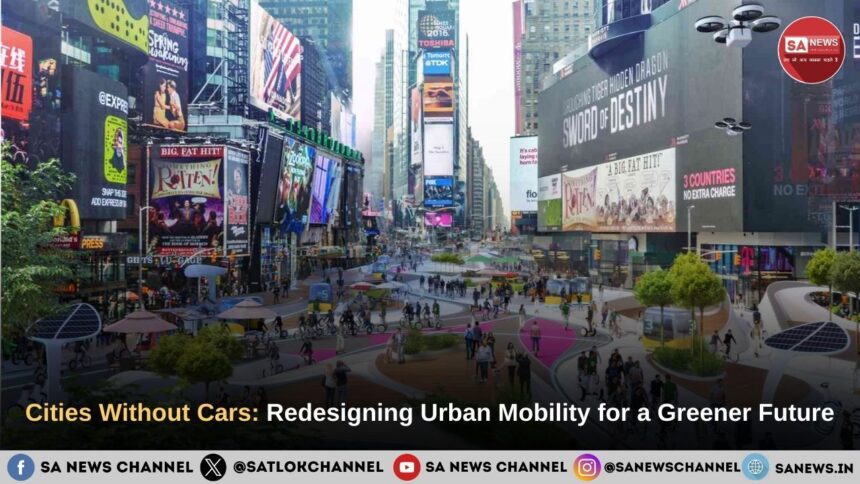
Cities Without Cars: Cities across the globe are struggling with traffic congestion, air pollution, noise, and declining quality of life. According to the World Health Organization, air pollution causes nearly 7 million premature deaths every year, and urban transport is a major contributor. To tackle this growing crisis, many countries are rethinking a radical idea – cities without cars. Car-free cities are not about banning vehicles completely but about redesigning urban mobility to prioritize walking, cycling, and public transport.
- Why the World Is Moving Toward Car-Free Cities
- Global Examples of Cities Redesigning Urban Mobility
- Paris, France – The 15-Minute City
- Copenhagen, Denmark – Cycling Capital of the World
- Barcelona, Spain – Superblocks Model
- Tokyo, Japan – Public Transport First
- Benefits of Cities Without Cars
- Cleaner Air and Lower Emissions
- Improved Physical and Mental Health
- Safer Streets
- Stronger Communities
- Challenges in Implementing Car-Free Cities
- Can India Move Toward Car-Free Cities?
- People-Centered Living: True Progress Beyond Machines
- FAQs on Cities Without Cars
From pedestrian-only city centers to “15-minute cities,” governments are focusing on people-first planning. These changes are reducing pollution, improving mental health, and creating safer streets.
Why the World Is Moving Toward Car-Free Cities
Rapid urbanization has made cities more crowded than ever. Roads are overloaded, commute times are increasing, and pollution levels are rising. Traditional car-centric city planning is proving unsustainable.
According to the International Energy Agency (IEA), road transport contributes nearly 25% of global CO₂ emissions from fuel combustion. This alarming data has pushed governments to rethink how cities function.
Car-free urban design focuses on:
- Reducing dependence on private vehicles
- Encouraging active transport (walking, cycling)
- Improving public transport infrastructure
- Creating healthier and safer urban environments
Also Read : Delhi NCR Air Pollution
Global Examples of Cities Redesigning Urban Mobility
Paris, France – The 15-Minute City
Paris has introduced the concept of the “15-minute city,” where residents can access work, schools, healthcare, and markets within a 15-minute walk or cycle. Roads along the Seine River have been converted into pedestrian zones.
Copenhagen, Denmark – Cycling Capital of the World
Over 60% of daily commutes in Copenhagen are done by bicycle. The city has invested heavily in cycling lanes, car-free streets, and bike-friendly policies.
Barcelona, Spain – Superblocks Model
Barcelona’s “Superblocks” limit vehicle access within residential areas, giving priority to pedestrians and cyclists. Traffic is reduced by up to 40%, while green spaces increase.
Tokyo, Japan – Public Transport First
Tokyo proves that car ownership is not necessary in mega cities. Efficient rail and bus networks make public transport the primary mode of mobility.
Also Read : National Pollution Control Day : वातावरण के प्रदूषण के साथ ही खत्म करे सामाजिक प्रदूषण!
Benefits of Cities Without Cars
Cleaner Air and Lower Emissions
Reducing car usage directly cuts down air pollution and greenhouse gases. Cities adopting car-free zones report noticeable improvements in air quality.
Improved Physical and Mental Health
Walking and cycling reduce obesity, heart disease, and stress. WHO confirms that active mobility significantly improves mental well-being.
Safer Streets
Fewer cars mean fewer accidents. Pedestrian-friendly streets reduce road fatalities, especially among children and elderly citizens.
Stronger Communities
Public spaces without traffic encourage social interaction, local businesses, and community bonding.

Challenges in Implementing Car-Free Cities
Despite the benefits, challenges remain:
- Resistance from car owners
- Need for strong public transport systems
- Initial infrastructure costs
- Accessibility concerns for elderly and disabled people
However, phased implementation and public awareness have helped many cities overcome these barriers.
Can India Move Toward Car-Free Cities?
Indian cities like Delhi, Bengaluru, and Mumbai face severe congestion and pollution. While complete car-free cities may be difficult, pedestrian zones, metro expansion, cycling tracks, and electric public transport are practical steps. Projects like Delhi’s Chandni Chowk pedestrianization show positive results.
People-Centered Living: True Progress Beyond Machines
True progress is measured by what we can live without, not what we accumulate. Today, it is common to see a single family owning 4 or 5 cars just for “show-off,” a trend that leads nowhere but to increased pollution and mental stress. Sant Rampal Ji Maharaj teaches us to stay away from such hollow displays and emphasizes the principle of “Simple Living, High Thinking”.
In his life-changing book Way of Living (Jeene Ki Raah), He shows the true path to a peaceful, balanced life that prioritizes nature and humanity over material ego. Beyond words, by His grace, His followers actively restore the environment through massive PlantationDrive, planting lakhs of trees to create a greener world. By choosing need over show and following these spiritual teachings, we can transform our cities and our souls.
FAQs on Cities Without Cars
Q1. What does a car-free city mean?
A car-free city prioritizes walking, cycling, and public transport while limiting private vehicle usage.
Q2. Are car-free cities realistic for large populations?
Yes, with strong public transport, phased planning, and policy support, even large cities can reduce car dependence.
Q3. Which country has the most car-free initiatives?
European countries like Denmark, France, and Spain lead in car-free urban planning.
Q4. Do car-free cities improve air quality?
Yes, studies show significant reductions in pollution and noise levels.
Q5. Can Indian cities adopt this model?
While challenging, partial car-free zones and improved public transport make it achievable.