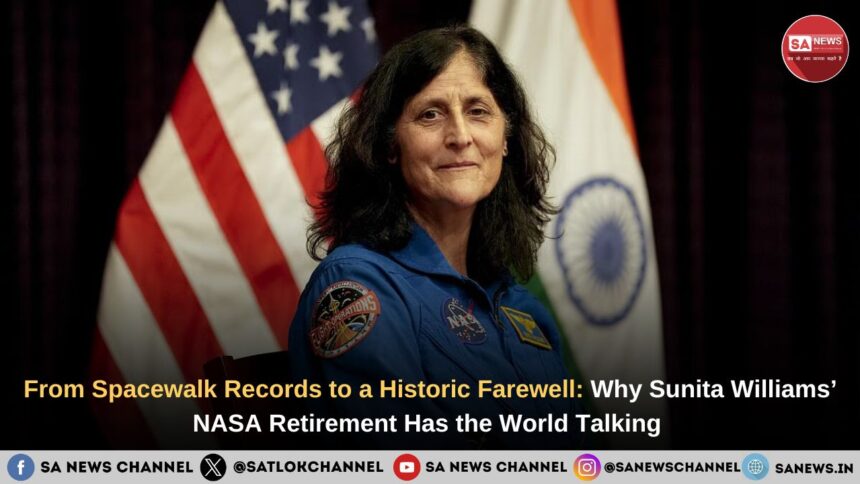
Sunita Williams Retires: NASA astronaut Sunita Williams has retired after a distinguished 27-year career with the US space agency, NASA announced on January 20. Her retirement took effect at the end of December 2025. Williams, 60, completed three missions aboard the International Space Station (ISS) and logged 608 days in space, the second-highest cumulative time by a NASA astronaut.
- Key Takeaways on Sunita Williams’ Retirement
- A 27-year career at NASA
- Recent public appearances and reflections
- Records and achievements in space
- Early life and education
- Naval career before NASA
- Space missions and leadership roles
- Tributes from NASA and colleagues
- Looking ahead after retirement
- Beyond Stellar Achievements and Lifeless Planets
- The Final Frontier: Returning to Our Eternal Home
- FAQs on NASA astronaut Sunita Williams’ retirement
She set multiple records in human spaceflight, including the most spacewalk time by a woman. NASA’s new administrator Jared Isaacman described her as a “trailblazer in human spaceflight”. Williams most recently returned to Earth in March 2025 following an extended mission involving Boeing’s Starliner and SpaceX’s Crew-9.
Key Takeaways on Sunita Williams’ Retirement
- Sunita Williams retired from NASA after 27 years of service, effective December 27, 2025
- She completed three ISS missions and logged 608 days in space
- Williams carried out nine spacewalks totalling 62 hours and six minutes
- She ranks second among NASA astronauts for cumulative time in space
- NASA administrator Jared Isaacman called her a “trailblazer in human spaceflight”
A 27-year career at NASA
NASA astronaut Sunita Williams has retired from the space agency, capping a career that spanned more than 27 years and included some of the most demanding missions in human spaceflight. NASA said in a statement issued on January 20 that Williams’ retirement took effect on December 27, 2025.
Williams, 60, completed three missions aboard the International Space Station and set numerous records during her time as an astronaut. According to NASA, she logged 608 days in space, placing her second on the list of cumulative time in space by a NASA astronaut.
Also Read: UGC New Rules 2026: Rules Applicable Nationwide, Students and Teachers Concerned
NASA’s new administrator Jared Isaacman, announcing her retirement, described Williams as “a trailblazer in human spaceflight,” adding that her leadership aboard the space station helped shape the future of exploration and commercial missions to low Earth orbit.
Recent public appearances and reflections
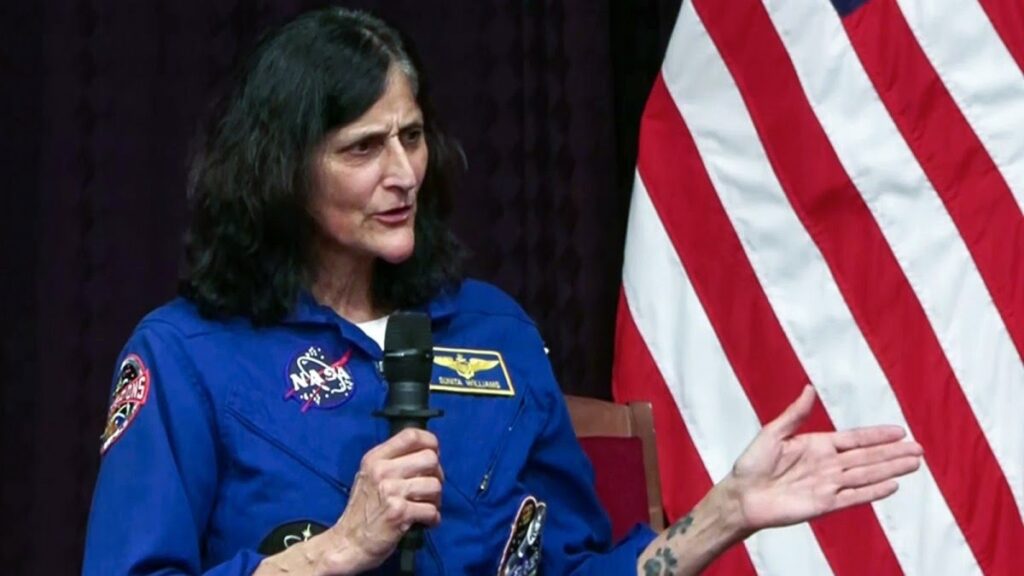
Williams is currently visiting India. On Tuesday afternoon, January 20, 2026, she participated in an interactive session hosted at the American Center. Posters at the venue described her as “NASA Astronaut, Ret. and U.S. Navy Captain, Ret.”
During the conversation, Williams shared her experiences from the time when an eight-day mission to the ISS turned into what she described as a challenge of a lifetime. Problems on their Boeing space flight extended her stay in orbit to over nine months.
She has often spoken about her connection to India, calling her visit to the country a “homecoming”. During a recent visit to Delhi, she said that seeing Earth from space made differences between people seem smaller, adding, “It really makes you feel like we are just one”.
Records and achievements in space
Throughout her career, Williams set multiple records in human spaceflight. NASA said she completed nine spacewalks totalling 62 hours and six minutes, ranking as the woman with the most spacewalking time and fourth on the all-time cumulative spacewalk duration list.
She also ranks sixth among Americans for the longest single spaceflight, tied with astronaut Butch Wilmore, with both logging 286 days during NASA’s Boeing Starliner and SpaceX Crew-9 missions. NASA also noted that Williams was the first person to run a marathon in space.
Also Read: Sunita Williams and Butch Wilmore to Return to Earth After Long Stay in Space
According to an Associated Press report, Williams was one of two astronauts who were stuck for months at the ISS due to technical issues with Boeing’s Starliner capsule.
Early life and education
Sunita ‘Suni’ Williams was born on September 19, 1965, in Euclid, Ohio, in the US. She was born to a Gujarati father, Deepak Pandya, from Jhulasan in Mehsana district, and a Slovenian mother, Ursuline Bonnie Pandya.
Williams completed her schooling at Needham High School in Needham, Massachusetts, in 1983. She later pursued a bachelor’s degree in physical science from the United States Naval Academy, graduating in 1987. In 1995, she earned a master’s degree in engineering management from the Florida Institute of Technology in Melbourne, Florida.
Naval career before NASA
A retired U.S. Navy captain, Williams was commissioned as an Ensign in the United States Navy upon graduating from the Naval Academy in May 1987. Following a six-month assignment at the Naval Coastal System Command, she qualified as a basic diving officer.
In July 1989, she was designated a naval aviator and trained with helicopter combat support squadron 3 on the H-46 Sea Knight. She later joined helicopter combat support squadron 8 in Norfolk, Virginia, and participated in overseas deployments to the Mediterranean, Red Sea, and Persian Gulf in support of Desert Shield and Operation Provide Comfort.
Also Read: ब्रह्मांड का रहस्य: एक अद्भुत वैज्ञानिक और आध्यात्मिक खुलासा
In September 1992, Williams led an H-46 detachment for Hurricane Andrew relief operations aboard the USS Sylvania. She was selected for the United States Naval Test Pilot School in January 1993 and graduated in December that year.
Space missions and leadership roles
Williams launched into space for the first time aboard space shuttle Discovery with the STS-116 mission in December 2006 and returned aboard space shuttle Atlantis with the STS-117 crew. Serving as a flight engineer for Expeditions 14 and 15, a then-record four spacewalks during that mission, was completed by her.
In 2012, she launched from the Baikonur Cosmodrome in Kazakhstan for a 127-day mission as part of Expeditions 32 and 33. During this mission, she served as space station commander and carried out three spacewalks to repair a leak on a station radiator and replace a critical power component.
Her most recent mission began in June 2024, when Williams and Butch Wilmore launched aboard Boeing’s Starliner spacecraft as part of NASA’s Crew Flight Test mission. What was planned as a short mission stretched to over nine months due to technical issues. The pair returned to Earth in March 2025 aboard SpaceX’s Crew-9 mission.
Tributes from NASA and colleagues
In a statement, NASA administrator Jared Isaacman said Williams’ work advancing science and technology laid the foundation for Artemis missions to the Moon and future exploration of Mars.
“Congratulations on your well-deserved retirement, and thank you for your service to NASA and our nation,” he said.
Scott Tingle, chief of the Astronaut Office at NASA Johnson, described Williams as “incredibly sharp” and an “all-around great friend and colleague,” adding that she inspired many within the astronaut corps.
Looking ahead after retirement
Reflecting on her career, Williams said space was her “absolute favourite place to be.” She said serving in the Astronaut Office and flying in space three times was an incredible honour, made possible by the support of her colleagues.
Williams said the International Space Station, its people, engineering, and science were awe-inspiring and had made future exploration to the Moon and Mars possible. She added that she was excited to watch NASA and its partner agencies take the next steps and make history.
Beyond Stellar Achievements and Lifeless Planets
The retirement of Sunita Williams reflects humanity’s relentless drive to explore the ‘unreachable’. While we celebrate analyzing distant terrains, why are we obsessed with lifeless planets that were never meant to sustain life?. If science provides the ‘how’ of exploration but cannot reveal the ‘why’ of our existence, is our progress merely a distraction?. Even the most glorious career is eventually bound by the law of time and decay.
The Final Frontier: Returning to Our Eternal Home
Jagatguru Tatvdarshi Sant Rampal Ji Maharaj reveals that real success isn’t in chasing ‘lifeless stones’ or revolving celestial bodies. This universe is a temporary place of exile ruled by Kaal Brahm. Saint Garibdas Ji Maharaj warns:
“Drishti pade so dhokha re. Khand pind brahmand chalenge thir nahi rahsi loka re. thir nahi rahsi loka re.”
The soul’s true mission is to escape the cycle of 8.4 million births and return to Satlok—our eternal home of blissful abundance. Only the scripture-based worship provided by a Complete Saint, Who is currently Sant Rampal Ji Maharaj, can grant this ultimate liberation.
Would you like to discover the hidden truth about your origin and the way back to your eternal home?
- Website: www.jagatgururampalji.org
- YouTube: Sant Rampal Ji Maharaj
- Facebook: Spiritual Leader Saint Rampal Ji
- ‘X’ handle: @SaintRampalJiM
FAQs on NASA astronaut Sunita Williams’ retirement
Q1. When did Sunita Williams retire from NASA?
Her retirement took effect on December 27, 2025, NASA said.
Q2. How many days did Sunita Williams spend in space?
She logged 608 days in space over three ISS missions.
Q3. What spaceflight records did Sunita Williams set?
She set records for most spacewalk time by a woman and second-highest cumulative NASA space time.
Q4. What was Sunita Williams’ most recent mission?
She flew on Boeing’s Starliner test mission in 2024 and returned via SpaceX Crew-9 in March 2025.
Q5. What did NASA say about Sunita Williams’ career?
NASA called her a trailblazer whose leadership shaped future human spaceflight and exploration.