

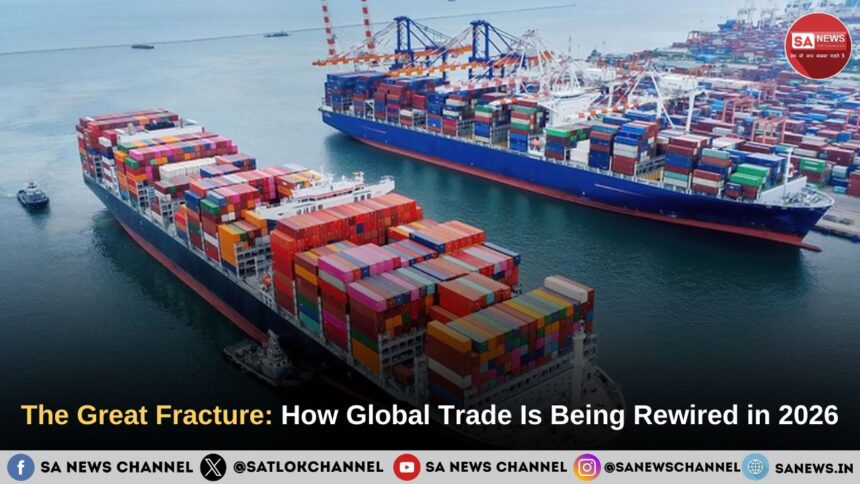
As 2025 draws to a close, the global trading system has entered a period of structural transformation. The long-standing model of globalisation, centred on extreme efficiency, cost minimisation and tightly integrated supply chains, has been fundamentally re-engineered amid rising geopolitical tensions. Within this shifting global trade landscape, India has emerged as a pivotal economy, reshaping its role in international trade and supply chains. This article analyses the changing dynamics of global trade, India’s evolving position within it, and what the emerging trade order could mean for global economies in 2026.
- Highlights
- From Hyper-Efficiency to Strategic Resilience
- Friendshoring and the Rise of Middle Powers in the World
- Connector Economies and the Persistence of Trade
- Europe’s Pursuit of Strategic Autonomy
- Technology, Semiconductors and Trade Sovereignty
- Corporate Strategy in a Fragmented World
- Implications for Jobs, Prices and Consumers in 2026
- Before Equilibrium: The Turbulent Transition to a New World Order
- The Prophecy of Darkness and the Rise of the World Saviour
- FAQs
Highlights
- According to UNCTAD’s Global Trade Update released in December 2025, world trade is projected to exceed USD 35 trillion, representing a 7 per cent increase over 2024.
- Despite trade moving slowly across countries, the UNCTAD’s report indicates a record in strained economic times.
- Crucially, this expansion reflects growth in traded volumes as well as values, indicating that trade routes have been rerouted rather than abandoned.
- What makes this transition historically significant is not the presence of disruption, but the absence of collapse.
- Despite renewed protectionism, escalating strategic rivalry, and fragmented regulatory regimes, global commerce has remained resilient.
- India definitely stands as one of the beneficiaries of its non-aligned network strategy during these tough times when the trade dynamics has been the most volatile.
From Hyper-Efficiency to Strategic Resilience
The most consequential economic shift of 2025 has been the retreat from the ‘efficiency-first’ doctrine that dominated global supply chains for over three decades. The just-in-time model, once celebrated for minimising costs and inventories, has proven fragile in a world shaped by geopolitical rivalry, sanctions, climate shocks and security-driven trade barriers.
What brought about this shift? Let us analyse briefly:
- The change in the economic policies of one of the biggest consumer markets in the world, the USA, led to significant changes in trade patterns and international partnerships.
- The inflection point arrived in early 2025, when the United States enacted a series of tariff measures aimed at recalibrating its trade exposure.
- The US executive actions introduced a universal baseline tariff, followed by a 25 per cent duty on imports from Mexico and Canada (with reduced rates applied to energy products) and a minimum 20 per cent tariff on Chinese goods. These tariffs vary for certain select segments.
- For India, the USA has slapped a 50% import duty fee beginning 6th August 2025. Earlier it was 25%.
- These measures lifted the effective weighted-average US tariff rate approximately into the 17-19% range, varying by sector and substitution behaviour.
- Early forecasts predicted inflationary spirals and a contraction in global demand.
- Instead, firms responded with rapid adaptation with import front-loading, supplier diversification, inventory buffering, and logistical rerouting through geopolitically neutral or aligned economies.
- This disruption requires industries to factor in a certain cost to be able to withstand them and subsequently recover from them.
- This cost, also known as resilience premium, further reflects in higher inventory costs, duplicated production capacity and regionalised manufacturing. This premium is not temporary friction; it represents a structural repricing of geopolitical risk.
- Additionally, geopolitical tensions and wars have also brought about change in partnerships with importers choosing more neutral countries than conflict-affected.
Despite the erratic market, surprisingly, no economy has collapsed so far. So, how have these changes affected the global economy and the dynamics among economies?
Friendshoring and the Rise of Middle Powers in the World
As trust replaces efficiency as the organising principle of trade, the global economy is no longer structured around a single integrated system. Instead, friendshoring or the relocation of production and sourcing to politically reliable jurisdictions, has become the dominant strategy.
This shift has elevated a group of middle powers that function as connectors rather than ideological participants in rival blocs. These economies benefit from flexibility and not dominance.
While this topic has a scope for an in-depth discussion, however, in this article, particularly in this section, we will focus on India.
India’s Strategic Repositioning
India’s role in 2025 thoroughly illustrates this transformation. Without entering rigid alliance structures, New Delhi has expanded its trade architecture through a sequence of high-impact agreements, such as:
- India-United Kingdom Free Trade Agreement formalised in May 2025 aims at improving access for textiles, pharmaceuticals and high-value services.
- India-EFTA Agreement signed in March 2025, also known as the Trade and Economic Partnership Agreement (TEPA), seeks to anchor long-term investment commitments estimated at USD 100 billion, particularly in manufacturing and clean technology. This agreement has come into force since 1st October 2025 and is India’s first of its kind free trade agreement with developed countries in Europe.
- The recently signed India-Oman Comprehensive Economic Partnership Agreement (CEPA) focuses on ‘labour-intensive sectors’.
- India-New Zealand Free Trade Agreement concluded on 22nd December 2025, will provide full duty-free access for Indian exports. This is India’s latest and most swiftly-concluded FTA. This hasn’t been signed yet, but could be India’s latest FTA if formalised successfully.
The importance of these agreements lies not only in market access, but in signalling. India is positioning itself as a structural stabiliser in a fragmented system. It seeks to position itself as economically indispensable, politically non-aligned and increasingly central to services-led trade growth.
Connector Economies and the Persistence of Trade
Despite rising protectionism, global trade flows have not fragmented evenly. Instead, they have been channelled through a limited number of connector economies capable of complying with complex trade rules while maintaining access to major markets. Two examples to illustrate this point:
- Mexico and Vietnam have emerged as prime examples.
- Mexico has leveraged rules-of-origin provisions under the USMCA (United States-Mexico-Canada Agreement) framework so effectively that majority of its exports to the United States remain tariff-exempt, functioning as a regional processing and assembly hub.
- Vietnam has played a similar role in Asia, absorbing redirected manufacturing capacity while maintaining export access to Western economies.
These cases illustrate a broader truth: trade fragmentation does not eliminate globalisation – it reconfigures it through compliant intermediaries.
Also Read: India Imposes Import Restrictions on Bangladesh Amid Growing Trade Tensions
Europe’s Pursuit of Strategic Autonomy
The European Union’s trade position in 2025 has been uniquely constrained by asymmetric exposure. Europe remains commercially intertwined with China while being strategically aligned with the United States. In response, the EU has sought to internalise resilience through regulatory and policy instruments.
A few developments that can help us understand this aspect:
- A transatlantic framework agreement concluded late in 2025 capped US tariffs on European exports at 15 per cent, providing short-term stability.
- Simultaneously, the EU expanded its use of the Carbon Border Adjustment Mechanism (CBAM), applying carbon-linked levies to imported goods.
- CBAM effectively externalises European environmental standards, reshaping global cost structures and protecting high-compliance domestic industries.
- The CBAM expansion will come into complete effect 1st January 2028 onwards.
Trade policy, in this context, has become a tool of regulatory power rather than market liberalisation.
Technology, Semiconductors and Trade Sovereignty
The intersection of trade and national security has been most visible in advanced technology markets. Expanded export controls imposed by the United States, Japan and the Netherlands in early 2025 have entrenched a bifurcated semiconductor ecosystem. Some insights shared below:
- These restrictions have accelerated industrial policy worldwide.
- Semiconductor fabrication capacity has expanded across the United States, supported by enhanced subsidy regimes, while governments increasingly treat chip manufacturing as critical infrastructure.
- At the same time, digitally delivered services have emerged as a powerful counterweight to manufacturing fragmentation.
- Simultaneously, India has been acing its semiconductor segment expansion too.
- In the final quarter of 2025, India and China recorded significant growth in digital and AI-enabled services exports, reinforcing the growing importance of non-physical trade.
- India reports services sector revenue as USD 387.54 billion in the period of 2024-2025. A recap of 2025 was shared by the Union Minister of Commerce and Industry Piyush Goyal on his official X handle.
Trade, once a mechanism of efficiency, has become a mechanism of technological control and sovereignty.
Corporate Strategy in a Fragmented World
For multinational firms, the strategic lesson of 2025 has been unambiguous – concentration risk is no longer rewarded. The efficiency gains of centralised production are now outweighed by exposure to tariffs, sanctions and political disruption.
As a result, firms are adopting local-for-local production models, manufacturing within the same regional bloc in which goods are sold. While this raises fixed costs and capital requirements, it reduces vulnerability to cross-border shocks.
The continued expansion of South-South trade, which grew by 8 per cent in 2025, suggests that growth is increasingly generated within regional circuits rather than through a single global system.
Implications for Jobs, Prices and Consumers in 2026
For households and workers, the effects of this transition are subtle but persistent, as per industry experts. However, how these ‘subtle’ effects transition into real life is something only households and workers can answer.
Here are some observations to note:
- The resilience premium has translated into moderately higher prices, particularly for manufactured consumer goods.
- However, these increases have been accompanied by greater supply reliability and reduced volatility.
- On the labour side, the re-regionalisation of production has supported job creation in manufacturing and logistics, though with higher skill requirements.
- Services-led trade growth has favoured digitally skilled workforces. This reinforces the importance of education and training, according to job recruiters.
The trade-off here cannot be written as a thumb rule for all. Though industry insiders would like us to believe there are just marginally higher costs in exchange for systemic stability. The truth, however, is far away from the projected consequences.
Before Equilibrium: The Turbulent Transition to a New World Order
As 2026 approaches, global trade can be best understood as operating across three overlapping gravitational centres:
- The US-North American bloc: It is characterised by technological depth, energy security and policy protection.
- The China-Global South bloc: It is anchored in manufacturing scale, infrastructure investment and access to critical minerals.
- The non-aligned network, led by India, the European Union and ASEAN, is defined by flexible bilateralism and strategic autonomy.
The era of lowest-cost global optimisation has ended. The defining advantage of the coming decade will be adaptive capacity, which means the ability to operate across fragmented systems while minimising geopolitical exposure.
Though the shifts in the global economy and the realignment of diplomatic relationships may appear to be reactions to recent wars, crises and geopolitical tensions, they are not random outcomes of circumstance. Nor are they isolated events driven by chance. These developments reflect a deeper, preordained transformation unfolding across the world order.
The rise of India as a formidable economic and trade power is not an accident of timing, nor merely the result of policy choices or market forces. It is part of a broader structural realignment – one that is reshaping global influence, production and power.
A new world order is steadily taking shape. However, before equilibrium is restored, periods of profound disruption and instability are inevitable. The coming phase is unlikely to be incremental; it may be marked by volatility on a scale the modern world has not yet experienced.
The question is no longer whether change is coming, but whether the world is prepared to confront the turbulence that precedes it.
The Prophecy of Darkness and the Rise of the World Saviour
For centuries, prophetic traditions across cultures have spoken of the emergence of a World Saviour during an age marked by profound darkness – an era defined by sorrow, widespread suffering, moral decay and near-total destruction. Renowned seers and astrologers, including the famed French visionary Nostradamus, whose predictions have repeatedly withstood the test of time, pointed towards the rise of a Saint from India during such a turbulent period.
The instability visible across the world today, whether economic, geopolitical, social or moral, is not merely the result of isolated crises or recent wars. It reflects a deeper erosion of humanity’s moral fabric. This phase corresponds to what many predictions, astrologers and philosophers describe as the dark age preceding a global reset. An age in which calamities intensify, whether they are pandemics, natural disasters, economic breakdowns, wars, and widespread human distress converge simultaneously.
Since the once-unimaginable Covid-19 pandemic, the world has witnessed a persistent decline across nearly every dimension of human life. Nations stand divided, economies strained, livelihoods threatened and mental and physical health crises escalating. As humanity edges dangerously close to a global conflict, the question grows ever more urgent: Who will guide the world out of this darkness? When will the promised Saviour emerge?
For a growing part of the world, that emergence is no longer a matter of the future, it is already unfolding. The Saviour foretold by Nostradamus has appeared in India. That Messiah is Jagatguru Tatvdarshi Sant Rampal Ji Maharaj. He has begun the work of illuminating humanity with true spiritual knowledge, knowledge that alone can restore ethical consciousness, heal fractured societies and re-establish balance in the world.
Under the guidance of Sant Rampal Ji Maharaj, India is not destined merely to rise as a global economic force, but to emerge as the spiritual epicentre of the world – a source of moral leadership at a time when humanity desperately needs it.
The words Saviour or Messiah often conjure images of grandeur and spectacle. Yet this Messiah defies history. Simply clad and deeply grounded, Sant Rampal Ji Maharaj embodies the very qualities that define the true World Saviour, identified by Nostradamus as Chyren. Millions of His followers have already experienced profound personal and moral transformation through His teachings, including being resurrected back to life from death.
Discover how Sant Rampal Ji Maharaj is the singular force capable of not only rescuing humanity from this dark age, but uniting the world under a single ‘flag’ by eradicating vice, restoring righteousness, and laying the foundation for a just and harmonious new world order that will worship the Real Creator – God Kabir, in this eye-opening video:
FAQs
Q1) How is global trade changing in 2026?
Answer: Global trade in 2026 is becoming more regional and geopolitically driven, with countries prioritising supply chain resilience and strategic partnerships over lowest-cost sourcing.
Q2) Why is India becoming important in global trade in 2026?
Answer: India’s importance in global trade in 2026 stems from its expanding trade agreements, services-led exports, and its role as a neutral connector between major economic blocs.