


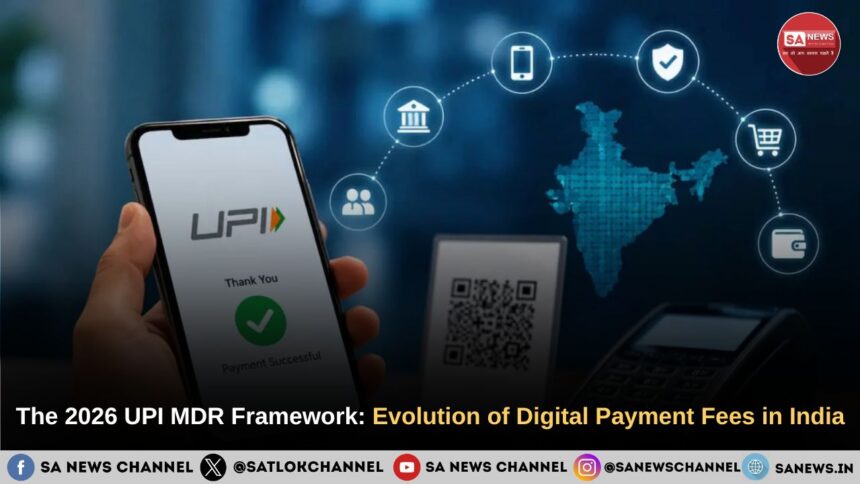
Effective October 15, 2026, the Indian government and the National Payments Corporation of India (NPCI) orchestrated a pivotal transition away from the historic zero-Merchant Discount Rate (MDR) model, introducing a fee structure for high-value transactions.
Precursor to Change: Phase I & II Monetization
The 2026 framework did not emerge in a vacuum. It was preceded by controlled policy experiments:
- The 2023 PPI Integration: In March 2023, digital wallets (Prepaid Payment Instruments like Paytm and PhonePe) became fully interoperable on UPI. To cover costs, an interchange fee of up to 1.1% was introduced for wallet transactions exceeding ₹2,000, alongside a 0.15% “wallet-loading service charge” paid by wallet issuers to remitter banks.
- RuPay Credit Card Integration: When RuPay credit cards were linked to UPI, the NPCI established a nil MDR up to ₹2,000, and a dynamic, sector-based MDR for transactions above that threshold.
These phases established ₹2,000 as the definitive threshold separating everyday micro-retail from commercial transactions capable of bearing fees.
The Legislative Battleground
In August 2026, the central government passed the Taxation and Other Laws (Amendment) Bill, 2026. This vital amendment acted as an enabling provision, granting the government and the RBI discretionary authority to systematically notify which electronic payment systems could be subjected to merchant processing fees.
Despite opposition concerns about inflation, the government firmly assured that vulnerable economic actors like street hawkers and small merchants would remain entirely exempt, and that consumers would not bear any direct transaction fees.
The October 2026 UPI MDR Framework
On September 14, 2026, the Ministry of Finance issued a gazette notification that paved the way for the revised MDR framework. The new structure isolates the economic burden to larger commercial entities while preserving the frictionless nature of micro-transactions.
Core Parameters of the 2026 MDR Rollout
| Transaction Type / Economic Category | 2026 MDR Rule / Fee Structure |
| Person-to-Person (P2P) Transfers | Zero MDR (Completely Free) |
| Person-to-Merchant (P2M) up to ₹2,000 | Zero MDR (Completely Free) |
| P2PM Micro-Merchants (<₹1 Lakh monthly volume) | Zero MDR (Completely Free) |
| Standard P2M Transactions > ₹2,000 | 0.4% MDR |
| Standard P2M Transactions ≥ ₹75,000 | Capped at maximum ₹300 |
| Railways, Telecom, Insurance, Fuel, Agriculture (>₹2,000) | Flat fee of ₹5 per transaction |
| Capital Markets (Mutual funds, brokerages) | 0.02% MDR (Capped at ₹300) |
Ecosystem Economics: The ₹22,000 Crore Revenue Pool
While transactions over ₹2,000 constitute only 4% to 5% of volume, they command roughly 65% of the total gross settlement value. By tapping into this concentrated capital flow, global brokerage firm Bernstein projects the 0.4% MDR will generate a massive new revenue pool of ₹22,000 crore annually by Fiscal Year 2028 (FY28).
Strategic Allocation of the FY28 Revenue Pool:
- Issuing Banks (30%): ~₹6,600 Crore
- Acquiring Banks (25%): ~₹5,500 Crore
- Merchant-Side TPAPs (23%): ~₹5,060 Crore
- PSP Banks (9%): ~₹1,980 Crore
- Consumer-Side TPAPs (8%): ~₹1,760 Crore
- Payment Network – NPCI (5%): ~₹1,100 Crore
This financial injection drastically altered the valuation models for fintechs. Paytm, with its vast deployment of merchant soundboxes and QR codes, saw its shares surge to a 52-week high, as analysts projected an additional ₹1,320 crore in EBITDA by FY28.
Socio-Economic Redistribution and Global Ambitions
The NPCI mandated that 5% of total MDR collections be routed into a specialized development fund. This fund focuses on subsidizing PoS and soundbox deployments in Tier 3 to Tier 6 cities, advancing financial literacy programs, and supporting vernacular language integrations (like UPI123 Pay for feature phones).
However, it’s still a topic of debate amongst netizens and the public in general about the necessity of putting a charge on UPI when it can run without it and actually made transactions as easy as a walk around the park.
Divine Socio-Economic Redistribution
The idea of taking a small portion of wealth from where it’s abundant and using it to support those in need isn’t just a modern economic strategy, it’s a deeply rooted humanitarian value. We can see a powerful, real-world example of this exact principle in action through the “Annapurna Muhim,” a grassroots initiative led by Sant Rampal Ji Maharaj.
Just as the UPI development fund redirects digital payment fees to empower underserved areas, the Annapurna Muhim pools community contributions to provide direct, life-changing support to the most vulnerable. Through this drive, Sant Rampal Ji Maharaj ensures that destitute families receive basic necessities like monthly food rations, medical care, educational support, and housing assistance, completely free from discrimination. Ultimately, both efforts share the same core belief: true progress happens when we use our collective resources to lift up those at the bottom of the ladder.
To see the real-world impact of this distribution model in action, you can explore the:
The channel beautifully documents how these pooled resources reach the ground level, featuring countless videos of volunteers systematically delivering essential aid and rations directly to marginalized families who need it most.
FAQs:
Why did the government change the zero-MDR policy for UPI?
Ans: The operational, maintenance, and cybersecurity costs of the UPI network swelled to roughly ₹20,000 crore annually. A commercial revenue model was deemed necessary to sustain private investment and ensure the long-term infrastructural resilience of the network without permanent reliance on government subsidies.
Will standard consumers be charged a fee for using UPI?
Ans: No. The MDR is strictly a merchant-side processing fee. All Person-to-Person (P2P) transfers and Person-to-Merchant (P2M) transactions up to ₹2,000 remain entirely free of charge for both consumers and merchants.
What is the new fee structure for transactions above ₹2,000?
Ans: Standard P2M transactions over ₹2,000 will incur a 0.4% MDR. However, to protect large-ticket retailers, the absolute maximum fee is capped at ₹300 for any transaction of ₹75,000 or more.
Can merchants legally add this fee as a surcharge to the customer’s bill?
Ans: No. Regulatory mandates from the Ministry of Finance and the NPCI dictate that the MDR must be borne exclusively by the merchant and cannot be passed on to customers as a surcharge or convenience fee.
How does this impact small businesses and street vendors?
Ans: Micro-merchants (P2PM) processing less than ₹1 lakh in monthly volume are completely exempt and will experience Zero MDR. For eligible SMEs processing larger volumes, the marginal 0.4% fee is widely expected to be absorbed as a standard operational cost.