


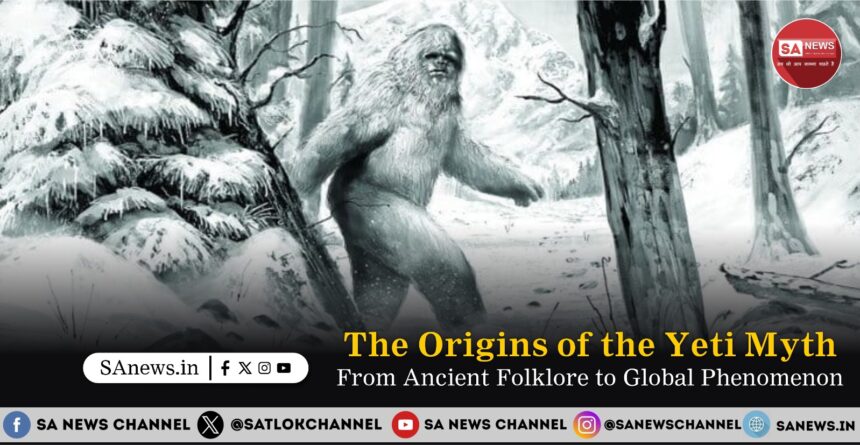
What lurks in the frozen peaks of the Himalayas? For centuries, local communities have whispered tales of a towering, ape like creature roaming the treacherous mountain ranges of Nepal, Tibet, and Bhutan. For hundreds of years, local residents have passed down legends and myths about the Yeti, and explorers, scientists, and ordinary people have repeatedly claimed to have sighted the Yeti in the Himalayan mountain range. Known as the Yeti or the Abominable Snowman, this cryptid has sparked debates among scientists, adventurers, and believers alike.
- The Origins of the Yeti Myth: From Ancient Folklore to Global Phenomenon
- Understanding the Cultural Roots of the Abominable Snowman Legend
- How Western Explorers Popularised the Yeti Mystery
- Famous Yeti Sightings and Evidence: A Historical Timeline
- Scientific Evidence: What DNA Analysis Reveals About the Yeti
- The Bear Connection: Why Himalayan Bears Are Mistaken for Yeti
- The Cultural Significance: Why the Yeti Legend Endures
- The Spiritual and Religious Importance in Himalayan Communities
- Impact on Tourism and Popular Culture
- The Expert Verdict: Do Yeti Really Exist?
- Yeti vs Bigfoot: Comparing the World’s Most Famous Cryptids
- Beyond the Abominable Snowman: A Journey to Spiritual Understanding
Often described as huge and ape like, stories of the Yeti date back hundreds of years among the local Himalayan people, but the creature came to the forefront of Western civilisation during the 20th century, as explorers began climbing these treacherous peaks. Even Edmund Hillary and Tenzing Norgay, the first party to reach the summit of Mt Everest, reported finding gigantic footprints in the snow during their historic 1953 expedition. This revelation ignited worldwide fascination, transforming an ancient regional legend into a global phenomenon.
But here is where science enters the picture: comprehensive DNA studies have analysed over 24 samples of purported Yeti evidence, and the results are both revealing and surprising. Does the Yeti actually exist, or have we been misidentifying known animals all along? Let us uncover the truth behind this enduring mystery.
The Origins of the Yeti Myth: From Ancient Folklore to Global Phenomenon
Understanding the Cultural Roots of the Abominable Snowman Legend
The legends of the Yeti originated in the folklore of the ancestors of the Himalayan people. The term “Yeti” itself carries deep cultural significance. The word Yeti is derived from the Tibetan word གཡའ་དྲེད, pronounced “yeh teh” in Sherpa, which means “small, human like animal”. In English, it translates as “rock bear” or “bear like.”
Stories of the Yeti, an ape-like cryptid said to roam the Himalayas, have circulated for centuries. Some Indigenous groups of the region believed in the existence of a “wild man,” and the creature even appears in several stories linked to Tibetan Buddhism. In the religion, Yeti sightings are sometimes considered a bad omen.
Tibet, Nepal, and Bhutan all have important spiritual and folkloric practices that involve the yeti. In these places, the yeti is known by many names, such as “Migoi” and “Kang Admi.” For a long time, the Sherpa people have believed in this creature. They say it is a big, hairy, ape like monster that lives in the highest, most remote mountain areas. In traditional views, the yeti is not just a real animal but also a spiritual being that needs to be respected and avoided.
How Western Explorers Popularised the Yeti Mystery
The earliest records of yeti in Western countries were in 1899. At that time, a British Army lieutenant colonel named Laurence Waddell found Yeti tracks in northeastern Sikkim and wrote a book about the discovery, called “Among the Himalayas.”
British explorers reported seeing the creature during an expedition. They used the term metoh kangmi or “man bear snowman,” but the metoh was mistranslated by a journalist as “filthy” and later changed to “abominable”. The term “Abominable Snowman” stuck and remained associated with the mythical creature.
Also Read: Srinivasa Ramanujan: The Man Who Knew Infinity | Biography & Legacy
Famous Yeti Sightings and Evidence: A Historical Timeline
Documented Encounters That Sparked Global Interest
The first official sighting of a Himalayan Yeti creature was recorded in 1832 when the Journal of the Asiatic Society of Bengal published a report from British trekker B. H. Hodgson, who thought he saw an orangutan.
The notion of Yeti as a cryptozoological phenomenon arose in the 19th century, and it really gained steam in 1951, when the mountaineering explorer Eric Shipton, while trekking along the Menlung Glacier near the Tibet Nepal border, took a famous photograph of a large footprint next to a pickaxe.
In 1970, British mountaineer Don Whillans claimed to have witnessed a creature when scaling Annapurna. He reported that he once saw it moving on all fours.
| Year | Sighting or Evidence | Location | Outcome |
| 1832 | B.H. Hodgson’s reported sighting | Nepal | Described creature “like an orangutan” |
| 1899 | Laurence Waddell’s footprint discovery | Sikkim, India | Written account in Among the Himalayas |
| 1951 | Eric Shipton’s famous photograph | Menlung Glacier | Photos sparked global interest |
| 1953 | Hillary Norgay footprint discovery | Mount Everest | World’s attention captured |
| 1960 | Sir Edmund Hillary expedition | Nepal | Fur samples found later identified as Tibetan blue bear |
| 1970 | Don Whillans sighting | Annapurna | Reported seeing creature moving on all fours |
| 2017 | DNA analysis of 9 samples | Multiple locations | All samples identified as bears or dog |
Scientific Evidence: What DNA Analysis Reveals About the Yeti
The Most Rigorous Genetic Study in Cryptozoology History
The Yeti is usually regarded as a folklorish figure, but physical evidence like hair and bones has been found to back up centuries of sightings. Now, an international team of scientists has conducted one of the most detailed DNA studies to date on some of these samples, and they have uncovered what may be behind the legends of the so-called Abominable Snowman.
Of the nine “yeti” samples, eight turned out to be from bears native to the area, the researchers report in the Proceedings of the Royal Society B. The other sample came from a dog.
Lindqvist and colleagues examined the mitochondrial DNA of nine supposed yeti samples and published the results in the journal Proceedings of the Royal Society B. Seven of the nine claimed yeti samples came from Himalayan or Tibetan brown bears; one came from a black bear; and one came from a dog.
Research Methodology and Findings
Study leader Charlotte Lindqvist of the University at Buffalo in New York and her team examined nine Himalayan Yeti samples from museums and private collections. One was a tooth from a stuffed specimen at the Reinhold Messner Mountain Museum in Italy.
The conclusions were “based on much more DNA sequence data and rigorous analyses, including phylogenetic reconstruction of complete mitochondrial genomes from many black, polar and brown bear populations.”
The researchers concluded: “This study represents the most rigorous analysis to date of samples suspected to derive from anomalous or mythical ‘hominid’ like creatures, strongly suggesting that the biological basis of the yeti legend is local brown and black bears.”
| Sample Type | Origin | DNA Result |
| Hair sample | Ladakh, India | Himalayan brown bear |
| Tooth specimen | Messner Museum | Brown bear |
| Scat sample | Tibetan Plateau | Tibetan brown bear |
| Leg bone | Cave in Tibet | Brown bear |
| Skin sample | Monastery relic | Black bear |
| Fur samples | Nepal | Brown bear |
| Fecal sample | Himalayas | Tibetan brown bear |
| Hair sample | Bhutan | Brown bear |
| Skin sample | Private collection | Dog |
The Bear Connection: Why Himalayan Bears Are Mistaken for Yeti
Understanding the Misidentification Phenomenon
Bear species that fall within the “range” of the Yeti include Asiatic black bear and two subspecies of brown bears, the Tibetan and Himalayan.
The Himalayan brown bear (Ursus arctos isabellinus), closely related to the Tibetan blue bear (Ursus arctos pruinosus), is known for its shaggy, reddish brown fur and its adaptation to high altitude environments. It is conceivable that observations of these brown bears, combined with the challenging conditions of the mountainous terrain, could have contributed to the creation of the Yeti legend. For example, distant sightings of a bear standing on its back legs, which bears occasionally do, could have been interpreted as a human-like figure by those unfamiliar with the species.
“Analysing Yeti samples and showing that the majority are from bears provides a connection between the myths of a rare wildman and a real creature which can occasionally be scary,” says Ross Barnett, an evolutionary biologist and expert on ancient DNA at Durham University.
Is the yeti nothing more than a rare species of bear living in the remotest folds of the Himalaya? Quite possibly. After all, bears do occasionally stand on their hind legs, and they will attack people.
Scientific Theories Behind Yeti Sightings
Despite several decades of research, mystery still surrounds the species identity of so called anomalous primates such as the yeti in the Himalaya, almasty in central Asia and sasquatch or bigfoot in North America. On the one hand, numerous reports including eye witness and footprint evidence point to the existence of large unidentified primates in many regions of the world. On the other hand, no bodies or recent fossils of such creatures have ever been authenticated.
The Cultural Significance: Why the Yeti Legend Endures
The Spiritual and Religious Importance in Himalayan Communities
Stories of large, hairy ape-like creatures that walk upright like a human inhabiting remote parts of the Himalaya have been around for a long time. A creature or spirit that roughly matches up with our modern idea of the yeti was a part of the pre Buddhist mythology of several Himalayan peoples. Once Buddhism became the dominant religion in so much of the Himalaya and Tibet, the idea of the yeti was carried over into Buddhist mythology, and there are a number of tales of yetis helping important religious figures.
The 741 sq. km Sakteng Wildlife Sanctuary park is the only National Park on earth that protects the natural habitat of the Yeti or, as locals call it, the Migoi. The park is one of the country’s top attractions.
Impact on Tourism and Popular Culture
The yeti has become a mainstay of adventure tourism in Nepal and Tibet. The creature’s mystery draws curious tourists who want to walk through yeti territory, which helps the local economies a lot even though solid proof is still hard to come by.
Nepal’s tourism industry experienced remarkable growth in 2024, with international visitor arrivals reaching 1,147,567, a significant 13.1% increase compared to 2023. This figure represents 96% of pre-pandemic levels, marking a strong recovery for the sector.
Also Read: Henrietta Lacks: The Woman Whose Cells Changed the Future of Medicine
The Expert Verdict: Do Yeti Really Exist?
What Leading Scientists Say About the Abominable Snowman
There is currently no genetic evidence that the creature known as the Yeti is real.
“I do not know of any scientific evidence that can prove the existence of a new hominid or primate-like creature,” Lindqvist said. “But the myth is important to the Himalayan region and local folklore, similarly to myths in many other cultures. Our scientific work can help explore such myths and possibly their biological roots, but I imagine that they will still live on and be important in any culture.”
But even with the robust nature of the new genetic findings, Barnett adds, the legend of the Yeti will likely live on. “You cannot debunk a myth with anything as mundane as facts,” he says.
The Balance Between Science and Mystery
We may think of the Yeti as something of a cryptozoological hoax on par with the Loch Ness Monster. But something about the Yeti, long present in the lore of local cultures, may have been lost in translation. It may be that these Western strangers far from home may have simply suffered a failure of imagination and did not fully grasp the cultural context of the Yeti myth.
Over time, stories of encounters with the Himalayan bear might have distorted or merged with local folklore to create the larger than life image of the Yeti. While the existence of the Yeti remains unproven, it is an intriguing example of how nature, culture and myth can intersect to shape legends.
Yeti vs Bigfoot: Comparing the World’s Most Famous Cryptids
Sasquatch, commonly referred to as Bigfoot, is also a legendary creature that resembles a hybrid between a man and an ape. However, Bigfoot is rumoured to live in warmer climates, usually in North America, while folklorists place the Yeti in the snow covered Himalayan mountains of Asia. Some believe both Bigfoot and the Yeti are a surviving population of hominids and the missing link between apes and humans; however, DNA evidence has dispelled these ideas.
| Feature | Yeti | Bigfoot or Sasquatch |
| Location | Himalayan Mountains Nepal, Tibet, Bhutan | North America Pacific Northwest |
| Climate | Sub zero, high altitude | Temperate forests |
| Estimated Height | 6 to 9 feet | 7 to 10 feet |
| Hair Colour | White, grey, or reddish brown | Dark brown or black |
| Cultural Origin | Pre Buddhist Himalayan folklore | Native American legends |
| DNA Evidence | Bears, dogs | Various animals including bears |
Beyond the Abominable Snowman: A Journey to Spiritual Understanding
The mystery of the Yeti reminds us that our world contains countless unknowns, phenomena that challenge our understanding and invite deeper contemplation. While science has revealed that Himalayan bears likely explain most Yeti sightings, the legend persists because it speaks to something profound within us: our eternal quest for meaning, truth, and connection with the divine unknown.
Perhaps the real mystery is not whether a giant ape man roams the mountains, but rather why we are so drawn to seeking what lies beyond the visible world. This yearning points toward a deeper spiritual hunger, one that can only be satisfied through genuine enlightenment. For those seeking authentic answers to life’s greatest mysteries, the sacred texts “Gyan Ganga” and “Way of Living” by Saint Rampal Ji Maharaj offer profound wisdom that transcends worldly puzzles. These divine scriptures illuminate the path to true knowledge, helping seekers understand life’s ultimate purpose and connect with the Creator.