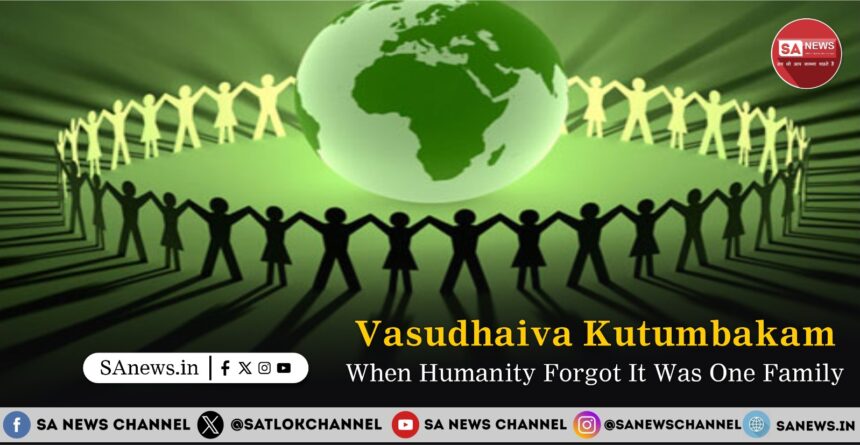
‘Vasudhaiva Kutumbakam’ (the world is one family) is often quoted today as a pleasant spiritual slogan. It appears in speeches, conferences and social media captions, usually stripped of its original weight. This ancient Indian thought was never meant to be decorative or sentimental. It was a radical worldview demanding inner transformation, ethical restraint and collective responsibility.
- Vasudhaiva Kutumbakam Explained: A Philosophy of Unity and Responsibility
- One Origin, One Source of Creation
- Interconnectedness of All Life
- The World as a Family Unit
- Duty as the Foundation of Ethics
- Relationship with Nature
- Impermanence and Ethical Awareness
- Leadership as Stewardship
- Inner Awareness as the Basis of Peace
- The Central Insight: What Vasudhaiva Kutumbakam Truly Signifies
- The Modern World: Hyper-Connected, Profoundly Divided
- The Rise of Western Individualism and the Death of Selflessness
- Western Individualism and Vasudhaiva Kutumbakam: Two Civilisational Answers
- False Globalisation: A World Connected, Yet Deeply Divided
- If Spirituality Is Everywhere, Why Is Peace Nowhere?
- A Once-in-Ages Spiritual Opportunity Humanity Cannot Afford to Miss
- FAQs: Vasudhaiva Kutumbakam
Today, as the world stands fractured by wars, ideological extremism, unchecked materialism and ecological collapse, where does Vasudhaiva Kutumbakam stand? This article is not an attempt to romanticise unity, but an uncompromising reflection of the current state of our world as we face the possibility of a third world war.
Vasudhaiva Kutumbakam Explained: A Philosophy of Unity and Responsibility
Vasudhaiva Kutumbakam is often rendered as ‘the world is one family’, yet this translation captures only its surface. In reality, it is a comprehensive worldview that defines how existence itself is organised spiritually, socially and ethically.
Rather than offering moral advice, it presents a foundational understanding of how life is interconnected and what that interconnectedness demands from human beings.
For those readers who have been unaware of ‘Vasudhaiva Kutumbakam’, the following sections will provide a simplified and concise understanding of this concept, without being overtly technical.
One Origin, One Source of Creation
Vasudhaiva Kutumbakam centres on the recognition of a single divine origin behind all existence. While cultures and religions describe this source in different ways, the origin itself is one.
Separation, therefore, is a human construction, not a cosmic one.
It is imperative to note at this point – Who is that single divine origin behind all existence? Is ‘God is one’ merely a phrase or the biggest reality of our lives?
Interconnectedness of All Life
This philosophy asserts that all forms of life arise from the same essence. Human beings, animals, plants, rivers and ecosystems are distinct in form, but not disconnected in value.
When life is seen this way, compassion is no longer a virtue to be cultivated, it becomes a natural response. Harm inflicted on another, whether human or non-human, ultimately returns to the whole.
The World as a Family Unit
The term kutumb signifies family, not society. A family does not function through competition or contracts, instead, it survives through care, responsibility and mutual dependence.
Vasudhaiva Kutumbakam views the world not as a collection of competing individuals, but as a shared living system where imbalance in one part affects the rest.
Duty as the Foundation of Ethics
Unlike modern frameworks that emphasise entitlement, this worldview places responsibility at the centre of ethics. The guiding question is not ‘What am I owed?’ but ‘What is required of me?’
Justice, in this sense, is proactive. Social balance is maintained through inner discipline rather than external enforcement.
A noteworthy point here is – What is the most effective way of bringing in inner discipline that doesn’t need external policing?
Relationship with Nature
Nature is not treated as a resource to be exploited, but as a living participant in existence. The earth is regarded as a nurturer, not property, and rivers as sustenance, not utilities.
Environmental destruction, therefore, reflects a breakdown in perception before it becomes a physical crisis.
With the current breakdown of natural resources, how would it be possible for us to repair the damage already done?
Impermanence and Ethical Awareness
Vasudhaiva Kutumbakam recognises the temporary nature of material possession. Wealth, power, territory and even physical life itself are impermanent.
When this reality is internalised, accumulation loses urgency and conflict over ownership loses meaning. Awareness of mortality sharpens moral clarity rather than diminishing life’s value.
Here, we must understand that awareness of morality can come solely through true spiritual knowledge bestowed by a Complete Saint (Tatvdarshi Sant) that empowers an individual to discern right from wrong.
Leadership as Stewardship
Authority is viewed as a trust, not an entitlement. Those who govern are caretakers of collective well-being, accountable not only to people but to ethical responsibility.
Power divorced from service is seen as misuse, not success.
Inner Awareness as the Basis of Peace
This philosophy maintains that no external system whether political, economic or technological, can substitute for inner awareness. Greed, fear and ego, when left unchecked, inevitably surface as social unrest and global conflict.
Outer peace is impossible without inner order.
At this juncture, we circle back to our earlier question – how can humanity achieve inner order? This underrated question has a very profound answer that readers will discover as we progress through the article.
The Central Insight: What Vasudhaiva Kutumbakam Truly Signifies
At its core, Vasudhaiva Kutumbakam asserts that no individual, nation or faith exists in isolation. Every action ripples outward. Every choice carries consequences beyond personal gain.
But this principle was never merely social. It was spiritual.
Ancient seers understood that true unity cannot be legislated. It emerges only when the individual recognises their origin, purpose and moral accountability. Without inner awakening, declarations of global brotherhood collapse into hypocrisy. That is where modern interpretations fail.
The tragedy is not that this wisdom belongs to the past. The tragedy is that, in a world more connected than ever, we speak endlessly of unity while functioning entirely on competition, dominance and accumulation.
The Modern World: Hyper-Connected, Profoundly Divided
Never before has humanity been so technologically connected and so spiritually alienated.
We live in an era where:
- Nations stockpile weapons capable of annihilating the planet.
- Wars are justified as strategy, not tragedy.
- Human suffering is measured in statistics, not conscience.
- Economic growth is prioritised over human dignity.
The looming threat of a third world war is not merely geopolitical, it is also philosophical. It reflects a world that has lost its ethical compass.
The uncomfortable truth is this: global conflict is not caused by lack of intelligence, but by lack of self-restraint. Lack of self-restraint is a direct consequence of the lack of the refuge of a Complete Saint (Tatvdarshi Sant).
Also Read: Who won World War 2 and Who Lost? | [Explained]
The Rise of Western Individualism and the Death of Selflessness
Western individualism did not arise as an ideology of selfishness, rather, it emerged gradually as a response to historical, philosophical and social pressures. Over time, what began as a necessary focus on personal agency evolved into a worldview where the individual became the central reference point of meaning, morality and success.
Let us understand briefly:
- The earliest roots of this shift can be traced to ancient Greek philosophy, where human reason was elevated as the primary tool for understanding reality.
- Thinkers such as Plato and Aristotle placed emphasis on logic, debate and intellectual autonomy. Truth was pursued through rational inquiry rather than inner realisation or cosmic belonging. This marked a decisive turn: the individual mind became the centre of knowledge.
- While this laid the foundation for critical thinking and philosophy, it also introduced the idea of the self as a distinct, self-contained unit.
- This sense of separateness deepened with the rise of Christian doctrine, where salvation became an individual matter.
- Each person was understood to possess a single soul, accountable for personal choices and destined for personal judgement.
- Spiritual responsibility was internalised, strengthening conscience and moral accountability. Yet salvation was no longer collective or cosmic. It became a personal journey. The community remained significant, but ultimate destiny was private.
- It is important to pause and reflect here, that though Western individualism began with salvation as one of its core objectives, today, salvation finds no mere mention in modern doctrines of rapid growth and materialism. Why did what began with one of its pillars as sacred as salvation, evolve into something totally opposite to the root of its thought?
- Continuing with how western individualism evolved, historical circumstances reinforced this inward turn. Throughout the medieval period, much of Europe was marked by recurring wars, disease, famine and political instability.
- In such environments, survival required self-reliance. Trust narrowed and identity contracted. Loyalty shifted from broader communities to immediate circles, and eventually to the individual. Over generations, self-preservation hardened into cultural instinct.
- The transformation reached its intellectual peak during the ‘Enlightenment Period’, when reality was reframed around the thinking subject. Nature was no longer experienced as a living whole, but as an external object to be studied and controlled. This shift enabled advancements in science, governance and human rights, but it also reinforced a deep division between humanity and the natural world.
- Economic structures further entrenched individualism. With the expansion of capitalist systems, personal success became the dominant measure of worth.
- Achievement was framed as individual effort, failure as individual responsibility. Competition replaced cooperation as the organising principle of society and community became secondary to productivity.
- What is often forgotten is that Western individualism initially carried a spiritual and ethical intention. It sought freedom from oppression, dignity for the person and moral responsibility for one’s actions. However, over time, the original concern with salvation and inner meaning was gradually displaced. The pursuit of material security, status and accumulation took precedence. Salvation was postponed indefinitely, as if life itself were endless.
The result is a world that has achieved unprecedented autonomy, yet struggles with isolation. The individual is empowered outwardly, but inwardly disconnected from community, nature and the ‘shared origin’.
Understanding this historical evolution is essential, because it explains why concepts like Vasudhaiva Kutumbakam feel unfamiliar to the modern mind. One worldview narrows identity until the self must defend itself against the world. The other expands identity until the world is recognised as part of the self.
This tension is not theoretical. It defines the moral and spiritual crossroads humanity now faces.
Western Individualism and Vasudhaiva Kutumbakam: Two Civilisational Answers
Every civilisation, consciously or not, answers one fundamental question: What is a human being and what does one owe to others?
The modern world stands deeply fractured because two radically different answers now coexist uneasily.
A brief analysis into the two belief systems of Vasudhaiva and Western individualism:
- Western individualism emerged not from moral failure, but from historical consequences. It was shaped by war, plague, scarcity and institutional collapse, survival demanded self-reliance.
- Over centuries, this survival instinct hardened into philosophy. From Greek rationalism to Christian personal salvation, to capitalist economics, the individual became the primary unit of meaning. Freedom was defined as independence, and success as personal achievement.
- What began as an individual quest for salvation slowly transformed into something else entirely. Community became optional, nature became a resource and life itself was reduced to measurable output. In gaining autonomy, humanity quietly lost belonging.
- Vasudhaiva Kutumbakam arises from a fundamentally different understanding of the self. It does not ask how the individual can be protected, but what the individual is made of. The answer is uncompromising: the same consciousness that animates all life.
- This is not sentimental universalism. It is a rigorous moral framework that refuses selective compassion. Rivers are not resources, forests are not commodities and human life is not ranked by nationality, faith or utility.
This contrast matters now because the crises engulfing the world are not technological failures but spiritual ones. A civilisation built on isolated selves cannot resolve collective collapse. A globally connected world without inner unity only accelerates conflict.
Also Read: The Great Fracture: How Global Trade Is Being Rewired in 2026
False Globalisation: A World Connected, Yet Deeply Divided
What the modern world calls globalisation is, in truth, a shallow imitation of unity. This form of globalisation elevates profit over people and consumption over conscience. It standardises lifestyles while eroding empathy, creating a world that looks connected on the surface but is internally broken.
Cultural dominance replaces mutual respect, and competition masquerades as progress. The result is a planet wired together superficially and yet perpetually on the brink of conflict. It is exactly what we are witnessing today as we stare at a world at the brink.
As geopolitical tensions escalate rapidly and global alliances realign each day to different combinations, humanity faces several question marks. A third world war, if it occurs, will not be a failure of diplomacy alone, it will be the complete collapse of ethical civilisation.
And no economic system, political ideology or technological advancement will save a world that refuses to recognise the true purpose of life itself .
What then, can save us from what seems like an inescapable reality of war?
If Spirituality Is Everywhere, Why Is Peace Nowhere?
One of the great paradoxes of our time is the rise of spiritual identity alongside moral erosion.
People pray, meditate, attend discourses and yet exploitation, violence and dishonesty persist unchecked. What could be missing?
In today’s world, where spirituality has also been commercialised, there exists solely one avenue that can restore peace, morality and happiness into humanity – the Tatvdarshi Saint (Complete Saint).
The appearance of a Tatvdarshi Saint (a truly Enlightened Saint) in the mortal realm is extraordinarily rare. Such an occurrence does not belong to ordinary historical cycles, it arrives once in ages, often once across countless lifetimes. When it does, it demands recognition, discernment and urgency; for opportunities of this nature do not return at human convenience.
A Tatvdarshi Saint alone possesses complete and authoritative spiritual knowledge, capable of awakening the soul at its very root. This knowledge is not speculative, borrowed or interpretative. It is grounding, revelatory and transformative, with solid evidence from sacred scriptures across religions backing it. When imparted, it does not merely inspire belief, it reorients life itself.
The change witnessed in the lives of true disciples is not cosmetic or temporary. It is profound, enduring and though unbelievable, quite unmistakable. Inner confusion dissolves, long-standing suffering finds meaning, and transformation unfolds in ways that defy ordinary explanation.
This raises a question that should be brushed aside lightly: Are we living in an age blessed with the presence of such a Tatvdarshi Saint?
And if so, will humanity recognise this rare grace?
A Once-in-Ages Spiritual Opportunity Humanity Cannot Afford to Miss
Jagatguru Tatvdarshi Sant Rampal Ji Maharaj is the singular Tatvdarshi Saint of today’s era – the sole trusted messenger of the Ultimate Creator, God Kabir. This unmistakable reality of our times, needs to deliberate upon.
The unparalleled spiritual knowledge of Sant Rampal Ji Maharaj is so unique and disruptive, that it challenges age-old stagnant beliefs that have led to the moral deterioration of humanity.
His teachings challenge the comfortable spirituality of the modern world. They reintroduce core questions humanity has avoided:
- Who is the true Supreme Power?
- What is the purpose of human life?
- What are the consequences of our actions both individually and collectively?
More importantly, His teachings emphasises practical human reform such as de-addiction, dowry-free marriages, social equality, ethical living and service without expectation of reward.
Across regions and communities, people speak of Sant Rampal Ji Maharaj’s historic disaster relief efforts that do not discriminate by religion or background, food initiatives that serve without conditions, and homes built for the needy without cost or publicity. These actions are not framed as charity, but as though going from a father to His own children.
Equally notable is the diversity of those drawn together through Sant Rampal Ji Maharaj’s one-of-a-kind spiritual movement. Followers from different faiths and cultures participate without erasing their identities, united instead by the true knowledge of our origin, our immortal root.
This is not just symbolic Vasudhaiva Kutumbakam. It is the lived reality of Vasudhaiva Kutumbakam.
Sant Rampal Ji Maharaj is reshaping lives across communities and nations, not through emotional persuasion, but through structured spiritual knowledge that brings in a never-seen-before discipline among disciples.
How does the ordinary man identify a Tatvdarshi Saint within a sea of spiritual gurus today? This video illustrates the core traits of a Tatvdarshi Saint:
FAQs: Vasudhaiva Kutumbakam
Q1) What does Vasudhaiva Kutumbakam mean?
Answer: It means the entire world is one shared human family.
Q2) Why is Vasudhaiva Kutumbakam important today?
Answer: It counters division, conflict, and extreme individualism.