


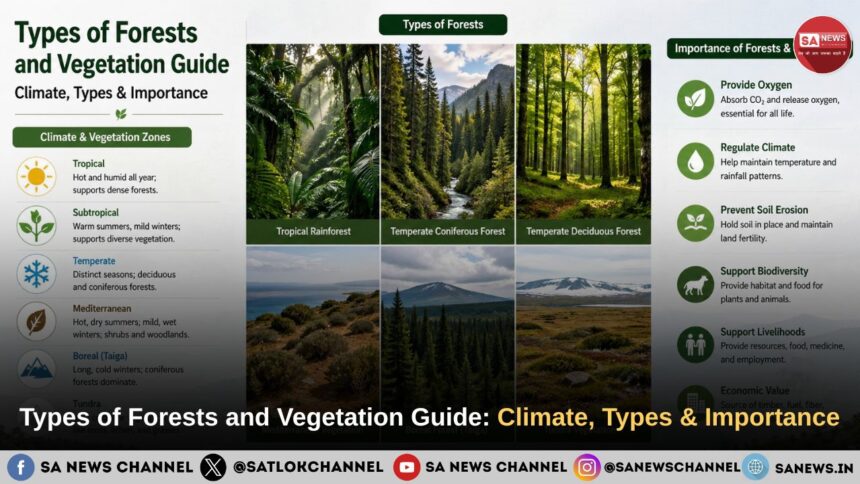
Almost one- third of the area of the earth is covered with Forests. Forests are one among the most vital natural resources of our planet. Forests are essential to maintain ecological balance, regulate the global climate and also support biodiversity on the earth.
- Classification of Forests Based on Climate and Geography
- Tropical Forests and Their Vegetation
- Temperate Forests and Their Vegetation
- Boreal Forests (Taiga) and Their Vegetation
- Montane Forests and Their Vegetation
- Mangrove Forests and Their Unique Vegetation
- Desert and Thorn Forests (Dry Forests)
- Layers of Forest Vegetation
- Importance of Forest Vegetation in Climate Regulation
- Threats to Forests and Vegetation
- Conservation of Forests and Vegetation
- Saint Rampal Ji Maharaj Ji’s Plantation Drive which earned Guinnees World Record
Vegetation includes all types of flora- from tall trees to herbs and from grasses to mosses. This vegetation not only provides habitat and food for the biodiversity but also provides oxygen, performs carbon storage and soil conservation. Know the types of forests and their vegetation in detail in this blog.
Classification of Forests Based on Climate and Geography
Climatic conditions including temperature, rainfall and other geographical locations decide the basis of classification of types of forests. These climatic conditions determine what type of vegetation can grow in a particular region.
Based on these factors, there are mainly six types of forests. These include
- Tropical Forests
- Temperate Forests
- Boreal Forests (taiga)
- Montane Forests
- Mangrove Forests
- Desert Forests
Each type of forest has its own unique characteristics and inhabit specific flora to its environment. Major other factors that decide the type of vegetation in a particular forest include soil type, altitude, and seasonal variations. Let us discuss every type and know their characteristics in detail.
Tropical Forests and Their Vegetation
These forests are located near the equator in a warm and humid environment. These forests receive heavy rainfall and thus are the most biologically diverse ecosystems on the Earth. The vegetation in tropical forests is also highly diverse, with multiple layers that support a wide variety of wildlife.The tropical rainforests are further divided into
- Tropical Rainforests
- Tropical Deciduous Rainforests
Tropical Rainforests
These are dense, evergreen forests with high rainfall exceeding 200cm annually. These rainforests inhabit tall trees which form thick canopies that block sunlight from reaching the forest floor. The common vegetation in these forests include
- Broad- Leaved Evergreen Trees: The broad-leaved evergreen trees dominate the tropical rainforests. These include Giant trees such as Mahogany (Swietenia macrophylla), Kapok (Ceiba pentandra) and various Dipterocarps.
- Epiphytes: Rather than growing on the soil, these plants grow on the branches of other trees to reach sunlight, which is not possible otherwise due to dense canopy. Orchids, bromeliads, ferns, mosses, and lichens are among the common examples of the epiphytes found in the tropical rainforests.
- Lianas (Woody Climbers): These plants grow on the soil but use the support of other trees to climb upwards to reach sunlight. These include rattan and various Philodendron species.
- Palms: These are found on both lowland as well as swampy areas of the tropical rainforests. These consist of Açaí palm (Euterpe oleracea) and various other tropical palm varieties.
- Understory and Ground-level Plants: Due to very low or no availability of sunlight, these consist of plants which are adapted to low sunlight. Plants such as Heliconia, tree ferns, and various shade-loving palms and parasitic plants such as Rafflesia or the Titan arum are found in this region.
Tropical Deciduous Forests
These are also known as monsoon forests. These rainforests receive only seasonal rainfall. The trees of tropical deciduous rainforests shed their leaves to reduce water loss. The common vegetation in these forests consist of
- Dominant Hardwoods and other Trees: This includes Teak (Tectona grandis) and Sal (Shorea robusta) and other economically significant trees.
Sandalwood, Shisham (Indian rosewood), Neem, Mahua, Pipal, and Arjun are also among other trees frequently found in the tropical deciduous rainforests.
- Bamboo and Dry- adapted species: The dominant vegetation in the tropical deciduous forests includes bamboo species. Several dry- adapted plants such as Khair, Tendu, Amla, and various acacia-like trees such as Babul are also found.
- Understory and Ground Level Plants: Because sunlight reaches the forest floor, the understory vegetation is much developed. During the rainy season it has various grasses (like Munj) and woody shrubs flourishing in the area.
Various woody climbers and lianas are present but they are less dominant than true rainforests.
Temperate Forests and Their Vegetation
The temperate forests are generally located in the region where the climate is moderate. They are mainly located between the tropical and polar areas. The vegetation is influenced by four different seasons.
Temperate Deciduous Forests
In these forests, trees shed their leaves during autumn. Common vegetation includes oak, maple, and birch trees. The forest floor is often covered with shrubs and herbs.
- Tree Layer: The Temperate Deciduous Forests include various hardwood trees such as oak (Quercus), maple (Acer), beech (Fagus), birch (Betula), hickory (Carya), chestnut (Castanea), elm, and magnolia.
- Understory and Forest Floor Vegetation: Smaller herbs and shrubs are found in these forests. The forest floor supports various plants, wildflowers, ferns, mosses, and lichens that grow rapidly in the spring before the canopy fully closes.
- Mixed Elements: In some areas of the Temperate Deciduous Forests, conifers like pine, spruce, and fir are found mixed among the deciduous hardwoods.
Temperate Evergreen Forests
These forests remain green throughout the year and are well adapted to cooler climates. The vegetation is affected by seasonal changes which affects the growth cycles and biodiversity. Major vegetations includes
- Dominant Conifers: Families such as Pinaceae and Cupressaceae form the primary vegetation. Trees such as pine (Pinus), fir (Abies), spruce (Picea), cedar (Cedrus), hemlock (Tsuga), and deodar (Cedrus deodara) are also found.
- Broad-leaved Evergreen Variants: There is prevalence of certain broad- leafed evergreen forests such as laurel forests (dominated by Lauraceae) or eucalyptus forests in the Southern Hemisphere.
The Aravalli Hills at Risk: Understanding the Geographic Impact of Changing Protections
Boreal Forests (Taiga) and Their Vegetation
Commonly known as Taiga, Boreal forests are found in the northern regions of the Northern Hemisphere. These forests experience long, cold and harsh winters and short summers.
The plants found in this region are specially adapted to survive extreme cold and low nutrient availability. The vegetation includes
- Coniferous Trees: The conifers dominate the vegetation of Boreal forests. Species such as Black spruce (Picea mariana), white spruce (Picea glauca), balsam fir (Abies balsamea), jack pine (Pinus banksiana) and tamarack (Larix laricina) are among the most common trees inhibiting these forests.
- Deciduous Trees: These are generally found in the areas of transition or following fire. They include species such as trembling aspen (Populus tremuloides), balsam poplar (Populus balsamifera) and white birch (Betula papyrifera).
- Understory and Ground Vegetation: The forest floor in the Boreal forest is characterised by low light leading to a specialized ground layer. Common understory species include Labrador tea (Rhododendron groenlandicum), Canadian buffaloberry, and other cranberries.
Ground cover, particularly during the rainy season are covered with mosses such as feathermosses and sphagnum mosses. They may also include several herbaceous plants like wild sarsaparilla, tall lungwort, and various sedges.
Montane Forests and Their Vegetation
As the name suggests, Montane forests are primarily found in mountainous regions. In these forests altitude plays a major role in determining the type of vegetation. With an increase in altitude, temperature decreases, which leads to the changes in the plant species.
- Subalpine Zone: Higher up the mountains, the vegetation is dominated by the conifers such as spruce (Picea species like Engelmann or blue spruce) and fir (Abies species). In the Southern Hemisphere, genera like Nothofagus (southern beech) and Podocarpus are more dominant.
- Mixed Conifer Zone: At the middle elevation zone, the forest transitions into a mix of coniferous and the deciduous species. It mainly includes Ponderosa pine, Douglas-fir, and white fir, which is often accompanied by groves of quaking aspen in areas of high soil moisture.
- Lower Montane Belt: This belt has different vegetation in different regions. In the tropical region, it mainly consists of broad-leaved evergreen trees, whereas in temperate regions, broad-leaved deciduous species such as oaks, maples, and birches are commonly found.
- Alpine Elements: As the forest moves towards the timberline it transitions into alpine grasslands and vegetation is shorter. This zone is perfect for low-growing perennial grasses, sedges, forbs, prostrate shrubs, and cryptogams like bryophytes and lichens.
- Understory and Forest Floor Vegetation: Mainly consists of shrubs such as sage, manzanita, wild currants, and huckleberries. The forest floor is the home to a mix of mosses, ferns, and wildflowers.
Mangrove Forests and Their Unique Vegetation
The Mangrove forests are located along the coastal regions in the tropical and subtropical regions. These regions are adapted to saline (saltwater) conditions as well as tidal fluctuations.
- Trees: Mangrove vegetation is mainly characterized by a limited number of species that are well adapted in the salty and tidal areas. The plants in these areas possess complex root systems to anchor themselves in unstable silt and exchange gases. The common vegetation includes Rhizophora (Red Mangroves) species such as Rhizophora mucronata and Rhizophora apiculata, Avicennia (Black/White Mangroves) species such as Avicennia marina and Avicennia officinalis, and Bruguiera gymnorrhiza and Ceriops tagal.
- Understory Vegetation: The understory vegetation is scarce due to difficult conditions of salinity and inundation. However, herbs such as Acanthus ilicifolius (holly-leaved mangrove), Aegiceras corniculatum, and the salt-tolerant fern Acrostichum aureum are common in these forests. Often climbers and vines such as Derris heterophylla may be found scrambling over the trees. Orchids and several parasitic mistetoes may be found growing in the more humid areas.
Desert and Thorn Forests (Dry Forests)
These forests are found in aria and semi-arid regions where there is very little or no rainfall at all. The vegetation in these areas is very little and well adapted to conserve water.
Various pamt species including cacti, acacia, and thorny bushes are common in these regions. These plants posses special features such as deep roots, small leaves, or waxy coatings to prevent or minimise water loss. This type of vegetation is commonly known as xerophytic vegetation.
Layers of Forest Vegetation
Knowing the types of forest and their vegetation, let us learn about the diffrent layer of forest vegetation. Forest vegetation is divided into various layers. Each layer supports different types of plants and animals.
- Emergent Layer: This layer includes the tallest trees that rise above the canopy.
- Canopy Layer: This is a dense layer that forms the roof of the forest.
- Understory Layer: This layer includes various Smaller trees and shrubs that grow beneath the canopy
- Forest Floor: This is the bottom layer. It comprises of decomposing leaves, fungi, and small plants
These layers create a complex ecosystem of the forests with diverse habitats.
Importance of Forest Vegetation in Climate Regulation
Forest vegetation plays an essential role in regulating the Earth’s climate. Trees and plants absorb carbon dioxide and thus help reduce greenhouse gases. This is known as carbon sequestration. Trees also provide oxygen which is essential to sustain biodiversity on this earth.
The Forests also affect the rainfall patterns by the release of moisture into the atmosphere via transpiration. Forests also help maintain temperature balance and prevent soil erosion.
Threats to Forests and Vegetation
Despite their immense importance, forests today are facing numerous threats worldwide:
- Deforestation: Deforestation refers to the large-scale cutting of forests for the sake of agriculture, industry, and urbanization.
- Climate Change: The ever- increasing temperatures and changing rainfall patterns affect vegetation.
- Loss of Biodiversity: The large scale deforestation leads to habitat loss which leads to the extinction of many species.
Human activities are the primary cause of these challenges. The forest cover in most of the countries is reducing significantly in the name of urbanisation and development. And no major steps are being taken to protect the forests.
Conservation of Forests and Vegetation
Protecting forests is essential for sustaining life on Earth as forests provide immense direct and indirect resources essential for biodiversity. Several measures can help conserve forests:
- Sustainable Forest Management: This accounts for the responsible use of forest and its resources.
- Afforestation and Reforestation: This means planting new trees to restore the degraded forests.
- Government Policies and Awareness: Laws and public participation in forest conservation efforts.
Conserving forests is not only limited to a specific organisation or government, but it is the combined effort of each and alevery person. We can can also contribute in the process of forest conservation by reducing paper use, supporting eco-friendly products, and also spreading awareness among all.
Saint Rampal Ji Maharaj Ji’s Plantation Drive which earned Guinnees World Record
Under the divine guidance of Saint Rampal Ji Maharaj Ji, in July 2024, Indore achieved a Guinness World Record by planting over 1.1 million saplings in 24 hours as part of a larger state-wide drive to plant 5.1 million trees. This plantation drive was aligned with the national “One Tree for Mother” campaign, which highlights the impact of collective community action on ecological conservation.
Not only this, Saint Rampal Ji Maharaj ji has started the world-renowned Annapurna Muhim which aims to provide free food, clothes, education, medical healthcare and house to the weaker sections of the society. Several other social service works have been completed under the guidance of Saint Rampal Ji Maharaj. To know more about the biggest social working Saint Rampal Ji Maharaj, visit www.jagatgururampalji.org or read sacred book ‘Gyan Ganga’ and ‘Way of Living’.