

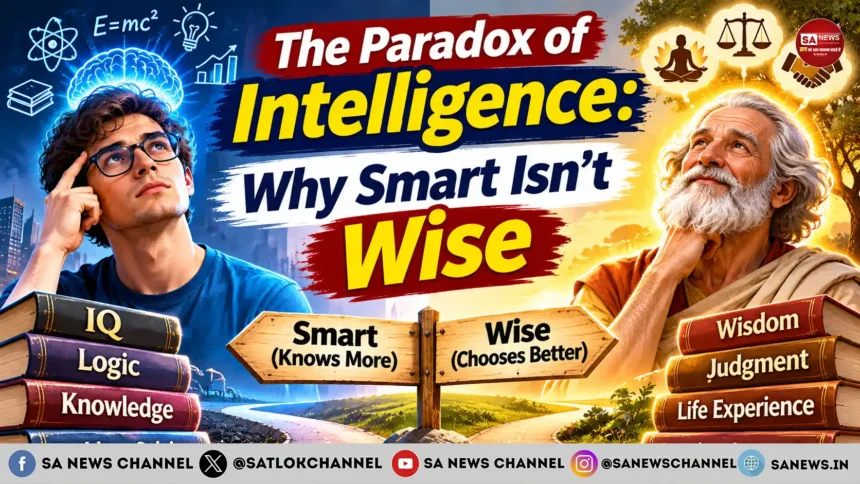
We can have incredible memories and solve complicated equations in seconds. But still struggle to make wise decisions about our relationships, finances, or careers. This is known as the paradox of intelligence. Since we now have a library in our pockets, despite having access to lots of information, we aren’t necessarily making wise decisions.
According to psychology, intelligence is our ability to learn, reason and solve problems. However, wisdom is our ability to use our intelligence humbly, fairly and with perspective. In this article, you’ll discover what the research says about the paradox of intelligence. Why smart people often fail to realise their mistakes and how you can develop habits to make you wiser.
What Is the Paradox of Intelligence?
The paradox of intelligence is when people fail to make wise decisions, despite having high cognitive abilities. Intelligent people are very good at creating great arguments. This means they can argue their conclusions (that they came to due to their emotions) very well.
While this isn’t a new concept (Socrates created a whole philosophy around knowing how little we know), in recent years (past two decades) psychologists have started measuring wisdom as a series of reasoning habits. Consistently showing that it is different to intelligence.
Intelligence vs Wisdom
Igor Grossman, a psychologist at the University of Waterloo who has helped pioneer scientific research into wisdom, explains that wisdom is a series of meta-cognitive habits. Using humility, acknowledging your limitations, considering other perspectives, accepting change and seeking compromise. Grossman’s research also found that there was minimal positive correlation between wise thinking and crystallised intelligence (knowledge).
At its simplest, intelligence asks can I solve it? Whereas wisdom asks am I even looking at this right?
| Dimension | Intelligence | Wisdom |
| What Does It Ask? | How can I solve this? | What am I missing and should I do something? |
| How is It Measured? | IQ tests, exams and problem solving speed | Scales measuring wise reasoning (humility, perspective, compromise) |
| In Relation To Ego | Can be used to justify current beliefs (boost ego) | Requires you to think outside of your ego |
| Best At | Quick and accurate answers to specific problems. | Making wise judgements on complex, personal and uncertain problems. |
| Risks | Over confidence. | Requires time to think. |
| Developed By | Learning and practicing. | Reflecting, distancing and diverse experiences. |
This shows why the two aren’t necessarily related. Intelligence works best with problems that have clear rules. However, many of the hardest decisions in life tend not to have any rules, meaning wisdom plays a part.
Why Smart People Often Fail To See Their Biases
A study published in 2012 by West, Meserve and Stanovich in the Journal of Personality and Social Psychology surprised many. Hundreds of university students were studied and tested on classic cognitive biases (anchoring bias, framing bias and myside bias). They also looked at the bias blind spot (the tendency to see others as biased more than yourself).
Interestingly, there wasn’t a negative correlation between cognitive ability and bias blind spot. In fact, there was a positive correlation with people with higher cognitive abilities having a bigger bias blind spot. They also found that having no bias blind spot did not protect people from biases.
It’s important to note that this study doesn’t say that smarter people are more biased. Many biases do decrease with higher cognitive abilities. However, it does show that while intelligence can help us avoid some errors, it doesn’t help us recognise the errors we make. This means that having a sharp mind can make you a convincing advocate for your opinions. This is the paradox of intelligence.
This can be seen in everyday life:
- You quickly notice the poor reasoning in your opponents argument but excuse it in your own.
- You assume they are wrong due to their lack of knowledge.
- You assume you have thought carefully as your answer was quick and confident.
Read More: Why We Are Addicted To Opinions And Allergic To Understanding
Solomon’s Paradox
Solomon, an ancient King in the Bible, was well known for giving wise advice. However, when making personal decisions his kingdom became chaotic. Grossman and Ethan Kross from the University of Michigan took inspiration from Solomon and named this pattern after him. Their research in 2014 found:
Participants in long term relationships were asked to reflect on a conflict in their relationship. They found that people used more wise reasoning when thinking about a friends conflict than their own. This shows that wisdom is heavily influenced by emotional distance.
They also found that adults aged between 60-80 weren’t any wiser when reasoning about their own conflicts than adults aged between 20-40. So we can’t assume that as we get older we become wiser. However, how you think about the problem will influence your wisdom.
A Simple Solution
However, the same research found that when participants took a detached approach to their own conflict (as though advising a friend) they used the same amount of wise reasoning as they did with other peoples problems. This is known as self-distancing. You can do this by talking about yourself in third person using your own name.
Next time you face a tough decision try:
- Talk about the situation as if it had happened to a friend.
- What would you advise them to do?
- Imagine looking back at the decision in a years time.
- Write down two different perspectives.
When Knowledge Increases But Attention Decreases
Without taking the time to reflect on your knowledge you won’t gain wisdom. Unfortunately in modern society our attention is changing. A study published in Nature Communications by researchers from Technische Universität Berlin, Max Planck Institute for Human Development, University College Cork and Technical University of Denmark found that we are becoming more distracted. Topics are more competitive and people’s interest in them increases and decreases quicker. They emphasised that this data is around collective attention and it is unclear how this affects individuals.
Similarly, personally we are becoming more distracted. A survey conducted by Morning Consult in 2024 found that around 31% of US adults use social media and doomscroll a lot/ some of the time (53% of Gen Z adults and 46% of millennials). The Reuters Institute found that 40% of respondents from 48 markets avoid the news sometimes/often (up from 29% in 2017). Many cited feeling in a bad mood and information overload.
This creates an odd situation where we are constantly exposed to information but aren’t really taking the time to process it. As wisdom requires slow thinking, it requires us to be calm.
Read More: The Myth Of Being ‘Informed’
Are We Really Becoming Smarter? The Reverse Flynn Effect
Throughout most of the twentieth century average IQ scores increased by around 3-5 points each decade (known as the Flynn effect). However, this has plateaued. Researchers Bratsberg and Rogeberg from Norway analysed around 730,000 test scores of Norwegian men and found that the Flynn effect peaked for those born in the mid 1970s. After this point scores began to fall by around 7 points per generation. As this occurred within the same family they concluded that it was due to environmental factors and not genetic.
A study conducted by Northwestern University in 2023 found a similar trend. Between 2006 and 2018, a large online sample from the US found that verbal reasoning, matrix reasoning, letter and number series scores decreased. However, 3D rotation scores increased. The lead author warned not to assume that Americans have become less intelligent. There are many factors to consider when taking the tests including motivation, nutrition, education and media exposure.
This means that while our IQ has increased it hasn’t necessarily made us wiser. However, our scores decreasing doesn’t mean we are becoming less wise. The reverse Flynn effect simply proves that our intelligence isn’t increasing forever. We need to actively work on developing good reasoning habits to make better decisions.
Data and Trends
Below is a table showing all the studies and surveys mentioned in this article.
| Year | Study/Survey | Key Findings | Source |
| 2012 | West, Meserve and Stanovich | No negative correlation between cognitive ability and bias blind spot. | Journal of Personality and Social Psychology. |
| 2014 | Grossman and Kross | People use more wise reasoning when thinking about a friends problems. Self distancing helps close the gap. | Psychological Science. |
| 2016 | Grossman, Gerlach and Denissen | People experienced more positive and fewer negative emotions during moments of wise reasoning. | Social Psychological and Personality Science. |
| 2018 | Bratsberg and Rogeberg | The Flynn effect reversed for Norwegian cohorts born after mid 1970s. | PNAS. |
| 2019 | Lorenz-Spreen et al | Attention to topics is becoming shorter and more competitive. | Nature Communications. |
| 2023 | Dworak et al | 3 out of 4 ability domains decreased in US adults between 2006-2018. | Intelligence. |
| 2024 | Morning Consult | 31% of US adults using social media doomscroll a lot/some (53% of Gen Z). | Morning Consult survey. |
| 2025 | Reuters Institute | 40% of respondents from 48 markets avoid the news at least sometimes. | Digital News Report. |
Overall, there is a consistent theme. The first two studies show that being clever doesn’t help your judgement. The latter studies show that we aren’t getting the time to reflect due to less attention and less calmness. However, the 2016 diary study shows that when people used more wise reasoning they felt happier.
How To Become Wiser
Grossman explains that wisdom is something people practice. While the benefits from each technique are minimal, researchers suggest that practising regularly can help. These habits will help reduce the paradox of intelligence in your everyday life.
- Distance yourself. When facing a personal conflict try to describe it in third person or from a years time.
- Assume your bias blind spot. Assume you are as biased as the person you disagree with. What evidence would change your mind?
- Seek out differing opinions. Ask someone with a different perspective to explain their views. Then repeat back their opinion so accurately that they agree.
- Schedule time to be calm. Try to schedule some device free time. Read one source in depth.
- Be flexible with your conclusions. As part of wise reasoning you should be able to accept change. So revisit your decisions when new facts arise.
Beyond the Paradox Of Intelligence
The paradox of intelligence teaches us that having more knowledge doesn’t necessarily make us wiser. As wisdom comes from being humble, distant and reflective. Research into the bias blind spot and Solomon’s Paradox shows that even the brightest minds need to take a step back.
Often this will lead to deeper questions. Why are we here? What really matters? What is beyond our data and information? Many readers will find these questions are thoughtfully answered in spiritual literature. You may want to take some time to reflect on these questions. If this resonates with you, you may want to read Gyan Ganga and Way of Living by Saint Rampal Ji Maharaj. Decide for yourself what they offer.
May your knowledge always be guided by wisdom.