


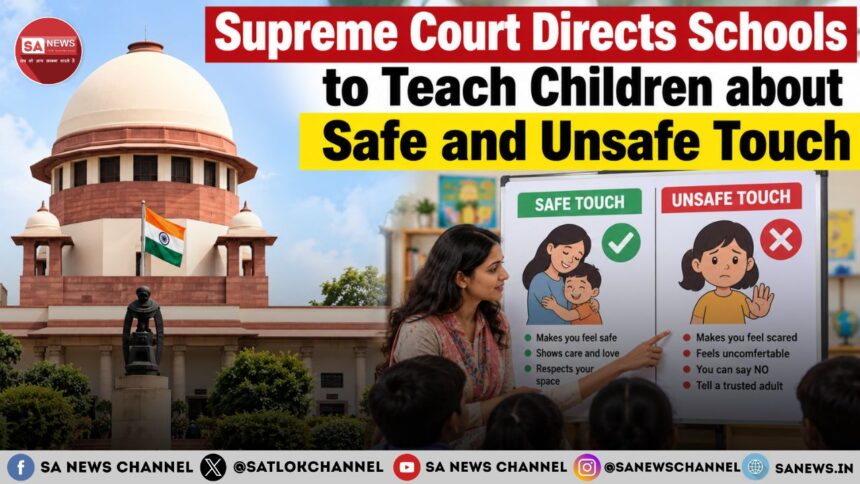
The Supreme Court of India has directed schools to take stronger measures to protect children against sexual abuse and online harassment. The Court mandated that children must learn about safe and unsafe touch, personal boundaries and consent from a young age. The Court also directed that teachers and school staff should be trained to detect grooming, sexual abuse, and online harassment.
- Why Children Must be Taught about Safe and Unsafe Touch
- Schools Must Teach Children about Online Safety
- Teachers Must be Trained on Child Abuse Detection
- Schools Must Display Child Protection Helpline Numbers
- Parents, Governments and Online Platforms must Collaborate
- How the Directions can Protect Children
- FAQs
The Supreme Court directed that schools should display child protection helpline numbers and provide children with counselling and psychological support. On October 15, 2026, a Bench comprising of Justice J.B. Pardiwala and Justice K. Vinod Chandran delivered the directions in Just Rights for Children Alliance & Anr. v. S. Harish & Ors. The Bench was hearing a petition concerning child sexual exploitation and abuse material (CSEAM) and the dissemination of such material via the internet.
Why Children Must be Taught about Safe and Unsafe Touch
Children must be taught about safe and unsafe touch to enable them understand personal boundaries and know when to seek help.
Simple teachings on the topic will enable children to identify undesirable behaviours, and equip them with the confidence to report uncomfortable situations to parents, teachers or another trusted adult. The Supreme Court directed that schools must emphasize on teaching children about consent, healthy relationships, personal boundaries and respect. Lessons on safe and unsafe touch should enable children to speak up confidently and without shame if they or someone they love is being harassed.
Schools Must Teach Children about Online Safety
The Supreme Court mandated that schools must include digital safety and age-appropriate sex education in the curriculum. The Court directed the National Council of Educational Research and Training (NCERT) and State Councils of Educational Research and Training (SCERTs) to collaborate with child psychologists, teachers, and parenting experts to develop relevant notes and manuals on the topic.
Children must be taught about the dangers of interacting with strangers, sharing personal information and sending private images online. The young ones should also learn about online grooming, harassment and how to report concerns to the appropriate authorities. The Court directed that schools should conduct regular digital safety workshops to improve children’s understanding of online safety.
Teachers Must be Trained on Child Abuse Detection
Teachers and other staff spend a significant portion of time with children and should be able to detect possible signs of harassment or abuse. The Supreme Court directed that schools should provide teachers with training on grooming, sexual abuse, online harassment and digital safety. School staff should also learn how to handle reports of abuse, maintain the privacy of the involved parties and report the matter to the relevant authorities.
The Protection of Children from Sexual Offences (POCSO) Act, 2012 contains detailed provisions on reporting sexual offences against children. For instance, Section 19 of the Act mandates every person present at the time of the offence to report it to the authority. On the other hand, Section 21 of the same Act imposes penalties on people who fail to report sexual offences.
Schools Must Display Child Protection Helpline Numbers
The Supreme Court directed that educational institutions should display child protection and cybercrime helpline numbers in classrooms, hostels, libraries, computer laboratories and other accessible places. Schools must also post the information on their websites for easy access. Relevant helpline numbers include:
Child Helpline: 1098
Cybercrime Helpline: 1930
Online complaints: National Cyber Crime Reporting Portal
The Court also directed that educational institutions must put in place appropriate safety filters to block access to abusive material. The safety measures should be implemented on computers, networks, hostels, childcare institutions, tuition centres, and coaching institutes.
Parents, Governments and Online Platforms must Collaborate
Parents, the government, and online platforms must collaborate to ensure that children are safe from harassment. Parents must have open communication channels with their children and educate them on personal boundaries, online safety and other related issues. It is vital for parents to allow children to discuss concerns without being judged or punished.
The Supreme Court also directed that governments should create public awareness on child safety. The Court directed online platforms to put up warning messages when children attempt to communicate with unknown adults or when searching for child sexual exploitation and abuse material.
The Union and State Governments were directed to provide free counselling, psychological support, and therapy to the victims for as long as they need. The governments should also develop follow-up mechanisms to ensure the wellbeing of the victims.
The Union Government was directed to file an affidavit concerning the progress of the directions before the Court at the next hearing on December 10, 2026.
How the Directions can Protect Children
The directions by the Supreme Court focus on abuse prevention and prompt response to help-seeking by children. Children must understand personal boundaries and how to report uncomfortable or threatening situations. Teachers should also be trained to detect warning signs and respond appropriately when approached by a child about harassment or abuse.
Parents should have open communication with their children to help them feel comfortable discussing boundaries, relationships or other concerns. The involvement of the government, parents and private organisations will significantly enhance child protection.
FAQs
What should schools teach children about safe and unsafe touch?
Schools should teach children about personal boundaries, consent, healthy relationships, and online safety.
Why must teachers receive child protection training?
Teachers should receive training to detect grooming, harassment, and abuse. The training should also equip them with the necessary skills to handle reports of abuse.
Which helpline numbers should parents and children know?
The Child Helpline number is 1098. On the other hand, the cybercrime helpline number is 1930.
How can parents help protect children from abuse?
Parents should have open communication with their children about personal boundaries and online safety. They should encourage children to report uncomfortable situations.