


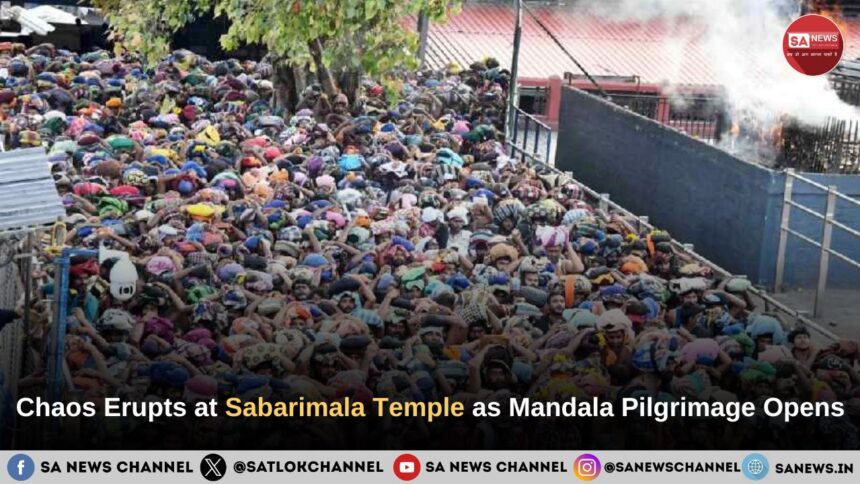
The 2025 Mandala-Makaravilakku pilgrimage at Sabarimala Temple, kerala, began on 16th November 2025, but the opening days quickly descended into disarray. An unexpected surge in footfall, severe shortages of basic facilities, health warnings and judicial intervention exposed deep flaws in the management of one of India’s largest annual pilgrimages. Explore in detail in this article.
- Highlights
- Dangerous Start to the Maladala Pilgrimage With Unprecedented Crowds at Sabarimala Temple
- Long Queues and Crumbling Facilities at Sabarimala Temple
- Authorities Rush to Sabarimala to Contain the Crisis
- Kerala High Court Intervenes in the Sabarimala Temple Pilgrimage
- Health Advisory: The ‘Brain-Eating Amoeba’ Concern
- Legal Dispute at Sabarimala Over Trek Routes for Mandala Pilgrimage
- Political Backlash
- When Faith Turns to Tragedy: What Lies Behind the Temple Stampedes?
Highlights
- Sabrimala Temple sees an unprecedented crowd of over 2,00,000 devotees just within two days of the opening of the Mandala-Makaravilakku pilgrimage.
- The Sabarimala Temple management struggled to contain the massive crowd.
- Unfortunately, one devotee lost her life due to suffocation which led to a heart attack.
- The Kerala court had to intervene and issue strong directives to the Sabarimala Temple management.
- This is yet another temple stampede situation that we have seen in recent times.
Dangerous Start to the Maladala Pilgrimage With Unprecedented Crowds at Sabarimala Temple
Within the first two days of the Mandala pilgrimage, almost two lakh devotees arrived at Sabarimala Temple, far exceeding the capacity of existing crowd-regulation systems. The virtual-queue and spot-booking mechanisms struggled to keep pace, causing massive bottlenecks along trekking paths and waiting areas. Several stretches within the Sabarimala compound experienced moments of near-stampede as the crowd moved unpredictably under pressure.
During this period, a 58-year-old woman from Kozhikode collapsed near Appachimedu while trekking towards Pampa and tragically passed away from a heart attack. The incident heightened concerns about the strain placed on elderly pilgrims amid suffocating crowds and limited medical access.
Long Queues and Crumbling Facilities at Sabarimala Temple
Pilgrims reported waiting between 10 to 15 hours to reach the Sabarimala temple steps. Incessant complaints about the lack of facilities and planning at the Sabarimala Temple have been reported.
- The pace of movement slowed drastically at certain choke points, dropping to less than half the expected flow rate.
- Thousands of devotees, many accompanied by children and elderly family members, remained stranded in serpentine queues without adequate drinking water.
- Complaints poured in about severe water shortages, poorly maintained bio-toilets and disorganised food distribution.
- Many devotees collapsed from dehydration and exhaustion, highlighting just how quickly the infrastructure buckled under the intense influx.
- Sanitation workers struggled to maintain toilets, and mess facilities operated by the Travancore Devaswom Board (TDB) faced logistical problems that restricted the distribution of meals.
The Travancore Devaswom Board (TDB) also reaffirmed that the situation quickly deteriorated as there was a delay in the central forces reaching the Sabarimala premises.
Authorities Rush to Sabarimala to Contain the Crisis
Acknowledging the failures in preparation, TDB President K. Jayakumar announced immediate corrective measures.
- These included deploying an additional 200 staff members to distribute drinking water and snacks at the Sabarimala Temple, and assigning 200 more workers to manage sanitation and cleaning duties.
- To ease congestion, authorities opened 20 dedicated queue complexes between Marakkoottam and Saramkuthi.
- Each complex can accommodate 500 to 600 pilgrims and provides resting areas, drinking water and food, offering a much-needed buffer during the heavy rush.
- Furthermore, facilities for devotees to wait at Nilackal have also been made.
Kerala High Court Intervenes in the Sabarimala Temple Pilgrimage
The Kerala High Court issued strong criticism against the TDB and government authorities for insufficient crowd control and the lack of essential services. Among its directives:
- It ordered that 200 rooms at Sannidhanam be reserved exclusively for pilgrims who booked online, a move intended to reduce chaotic spot bookings.
- The court also mandated uninterrupted supply of safe drinking water at Pampa, Sannidhanam and along the trekking route.
- Additionally, the court ordered the Sabarimala Temple management to cap the on-the-spot booking to 500, which is the daily booking.
- In totality, the daily bookings should not exceed 75,000 each day (online and spot bookings combined).
- Recognising the need for long-term transformation, the court directed the formation of a Sabarimala Infrastructure and Crowd Management Expert Committee.
- Comprising specialists in engineering, disaster management, environmental science and crowd behaviour, the committee is tasked with preparing a scientific masterplan to handle future pilgrim inflow more systematically.
The court has directed the TDB to submit its reply for this callousness by Friday, 21st November 2025.
Health Advisory: The ‘Brain-Eating Amoeba’ Concern
Amid the crowding crisis, the Karnataka government issued a public health advisory after cases of amoebic infection caused by ‘Naegleria fowleri’ were reported in parts of Kerala. Although not directly linked to Sabarimala, the advisory cautioned pilgrims, particularly those bathing in rivers or freshwater sources, to avoid letting water enter the nose, where the amoeba can enter the body.
Pilgrims were urged to use nose clips, keep their nostrils sealed during river baths and immediately seek medical attention if symptoms such as severe headache, fever, nausea or neck stiffness appeared within a week of exposure. Kerala’s health authorities issued similar guidance, warning devotees about the risks associated with warm, stagnant water.
Legal Dispute at Sabarimala Over Trek Routes for Mandala Pilgrimage
A separate controversy arose regarding the early opening of the forest trek route, known as the Kanana Patha. Petitions requested that the path be opened sooner to ease congestion, however, the Kerala High Court rejected this plea. The court held that the mode of reaching the temple is not an essential religious practice under constitutional protections.
Also Read: Midnight Chaos Erupts As Assailants Disrupt Peaceful Protest In Kolkata
The forest path passes through the ecologically sensitive Periyar Tiger Reserve, and the court stressed that any unregulated opening could endanger both the environment and the safety of pilgrims. The court also directed authorities to release seasonal data on the carrying capacity of the route, establish an integrated control room and issue real-time alerts to prevent overcrowding.
Political Backlash
As expected at the core of any controversy, the opposition leaders criticised the government and the TDB for what they described as ‘administrative failure’. They accused authorities of inadequately preparing for the expected pilgrim rush, citing insufficient water supply, poorly maintained sanitation and excessive waiting times. Many pilgrims were reportedly forced to abandon their journey due to the harsh conditions.
When Faith Turns to Tragedy: What Lies Behind the Temple Stampedes?
What was meant to be a sacred day of devotion has instead become a moment of deep mourning for the family of the 58-year-old woman who lost her life. A similar incident was also seen recently at the stampede at the Venkateswara Swamy Temple, Andhra Pradesh, where as many as 9 devotees were killed in the temple stampede. Such incidents have once again forced the world to confront a painful question. Why are such heart-wrenching incidents so common at places of worship?
A temple is believed to be the abode of God, a space where the faithful seek peace, forgiveness and divine grace. Yet, when lives are lost within its walls, a haunting doubt arises – does God truly dwell in temples built by human hands?
Devotees gather with pure hearts, believing that fasting and offering prayers to Lord Ayyappa would cleanse them of sins. But instead of washing away their sins, one lost her life, and the scare of a stampede still persists. When such devotees meet painful deaths in a place they consider divine, it compels humanity to question why Lord Ayyappa was unable to protect His own worshipper? Are these tragedies out of his will, or are they the result of our deviation from the true path of worship? Learn more about the truth of Sabarimala Temple in this eye-opening video:
Today, the tragedy at the temple stands not just as a reminder of human error in crowd management, but also as a mirror reflecting a deeper spiritual crisis, the absence of authentic guidance.
Until humanity finds and follows that Tatvdarshi Sant Who imparts the true path of worship as ordained in our holy scriptures, such sorrowful events may continue to occur, not only in temples but in every aspect of life.
True devotion is not in rituals, crowds or offerings, but in understanding and following the real commandments of God. Learn about the path that can end both physical and spiritual suffering, by listening to the spiritual discourses of the singular Tatvdarshi Sant of today – Jagatguru Tatvdarshi Sant Rampal Ji Maharaj on www.jagatgururampalji.org .