



Legacy of Rita Levi-Montalcini: The history of science often presents discovery as a linear path of success. However, the life of Rita Levi-Montalcini (1909–2012) tells a different story. It is a narrative where World War II bombings, racial persecution, and a makeshift laboratory in a bedroom are just as important as the sterile environment of a university. Levi-Montalcini discovered a new way to understand the human nervous system. Her identification of the Nerve Growth Factor (NGF) changed neuroscience forever. It proved that cells communicate through chemical signals to survive and grow.
To understand her Nobel Prize-winning work, we must look beyond biology. We must examine the Victorian restrictions of her childhood in Italy, her survival during the Holocaust, and her later years as a fierce politician in the Italian Senate. Her life philosophy focused on “imperfection.” She believed that errors and difficulties were not failures, but the necessary engines of progress. This article explores the comprehensive journey of a woman who built a scientific revolution from the shadows of war and rose to become a centenarian icon.
Part I: The Forge of Turin (1909–1938)
The Victorian Cage
Rita Levi-Montalcini was born on April 22, 1909, in Turin, Italy. She and her twin sister, Paola, were the youngest of four children. Her family was Jewish, cultured, and wealthy. Her father, Adamo Levi, was a mathematician and electrical engineer. Her mother, Adele Montalcini, was a talented painter.
Despite the love in their home, Adamo Levi ruled the family with strict, old-fashioned values. He believed strongly in Victorian social norms. In his view, a woman’s role was to manage a home and raise children. He believed that professional careers, especially in medicine or academia, would interfere with a woman’s primary duties as a wife and mother. Consequently, he made a decision that shaped Rita’s early life: he forbade his three daughters from attending university.
This decision devastated Rita. While her twin sister Paola found freedom in painting within the home, Rita felt suffocated. She had no desire for marriage or domestic life. She watched the women in her society and feared becoming like them. For a while, she drifted without purpose. She considered becoming a writer, inspired by the Swedish author Selma Lagerlöf, but she lacked a specific direction.
The Rebellion
By the time she turned twenty in 1930, Rita could no longer accept her father’s rules. In a moment of great courage, she confronted him. She told him that she would not accept the life he had planned for her. She demanded permission to pursue a professional career.
Adamo Levi realized he could not stop her. He recognized the same intellectual fire in her that he possessed. He told her, “I don’t approve, but I won’t stop you.”
However, Rita faced a massive problem. Because her father had not prioritized her education, she had attended a “finishing school” for young ladies. She did not have the high school background required for medical school. She lacked training in Latin, Greek, and advanced mathematics. To fix this, she hired private tutors. For eight months, she studied with desperate intensity. She compressed years of high school curriculum into less than a year. She passed her entrance exams and enrolled in the University of Turin Medical School in 1930.
The “Levi School”
At the university, Rita met the mentor who would define her scientific method: Giuseppe Levi. He was a professor of human anatomy (and no relation to Rita’s family). Giuseppe Levi was famous for his volatile temper and his brilliance. He was a strict “tyrant” in the lab who hated sloppy work and hated the Fascist government even more.

Giuseppe Levi’s laboratory was a unique place in history. Despite the pressure of the rising Fascist regime, this single room in Turin produced three future Nobel Prize winners:
- Salvador Luria: A pioneer in genetics and viruses.
- Renato Dulbecco: A virologist who studied cancer.
- Rita Levi-Montalcini: The discoverer of Nerve Growth Factor.
Under Giuseppe Levi, Rita learned a specific technique called silver staining. This method involves soaking brain tissue in silver nitrate. The silver turns the nerve cells (neurons) black, making them stand out clearly against a gold background.
This technique trained Rita’s eyes to see the tiny, beautiful details of how nerves connect. She graduated with top honors in 1936. She tried working as a doctor, but the limits of medicine in the 1930s frustrated her. She could diagnose patients, but she could rarely cure them. She realized her true passion was research and understanding how the nervous system builds itself.
Part II: The Robinson Crusoe of Science (1938–1947)
The Manifesto of Race
In 1938, Rita’s career hit a wall. The Italian Fascist dictator, Benito Mussolini, published the “Manifesto of Race.” This was followed by the Racial Laws. These laws declared that Jewish people were a “non-Aryan” race. The government stripped them of their civil rights.
The consequences were immediate. Universities fired Jewish professors. Hospitals banned Jewish doctors. Schools expelled Jewish children. The University of Turin fired Rita. The “Levi School” fell apart. Giuseppe Levi fled to Belgium, and Rita’s other colleagues fled to the United States. Rita tried to work in Belgium briefly, but as the threat of a Nazi invasion grew, she returned to her family in Turin in 1939.
The Bedroom Laboratory
Trapped in her house and treated as a second-class citizen, Rita made a defining choice. She refused to stop being a scientist. She later joked that she should thank Mussolini because he forced her to work in her bedroom, where she found her greatest joy.
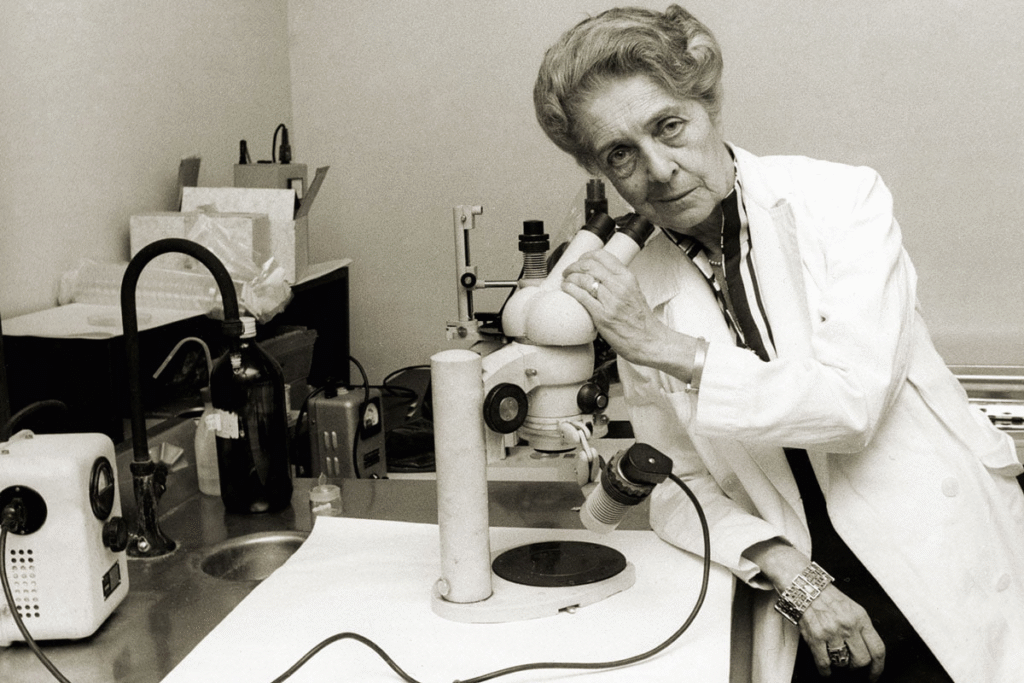
(Image Source)
She built a secret laboratory in her bedroom. Her setup was simple and improvised:
- The Microscope: She used a basic Zeiss binocular microscope.
- The Incubator: She built a small heater to keep chicken eggs at exactly 37°C.
- The Tools: She did not have surgical tools. She took sewing needles and ground them down on a stone until they were sharp enough to operate on tiny chick embryos.
- The Subjects: She asked local farmers for fertilized eggs, pretending she needed them to feed children. In reality, she used them for experiments.
The Scientific Duel
In this bedroom lab, Rita challenged the ideas of Viktor Hamburger, a famous scientist in the United States. Hamburger had removed limbs from chick embryos and noticed that the nerves connected to those limbs died. He believed the limb was necessary to create the nerves.
Rita repeated his experiments using her superior silver staining technique. She saw something different. She realized the nerves did grow even without the limb. However, because they had no target to connect to, they died afterward.
This led to her major hypothesis: The target (the limb) does not create the nerve. Instead, the target provides a “feeding” factor that keeps the nerve alive. The body creates too many neurons, and they compete for this factor. The winners survive; the losers die. This was the first evidence of “apoptosis,” or programmed cell death.
Surviving the War
The war made research terrifying. When Allied forces bombed Turin, Rita packed her microscope into a box and ran to the cellar. Eventually, the bombing forced the family to move to the countryside. She set up her lab again on a dining table.
In 1943, the Nazis occupied Northern Italy. The situation shifted from discrimination to a hunt for Jewish people. The Levi family fled to Florence and lived underground, using false names. During this time, Rita could not work. She survived day by day. After the Allies liberated Florence in 1944, she worked as a doctor in a refugee camp. She treated typhus and typhoid fever. The suffering she saw was overwhelming. It confirmed her decision that she was too emotional to be a clinical doctor. She wanted to return to the lab.
Part III: The American Odyssey (1947–1960)
The Invitation
In 1946, the war was over. Viktor Hamburger, the scientist in St. Louis, read the papers Rita had published in small Italian journals during the war. He was shocked. An unknown woman, working in a bedroom, had challenged his work. He invited her to Washington University in St. Louis for one semester to check her results.
Rita arrived in the United States in September 1947. She planned to stay for a few months. Instead, she stayed for thirty years.
The Halo Effect
In St. Louis, Rita proved her theory was correct: the target tissue controls nerve survival. But she needed to find the specific chemical responsible for this.
She found a clue in a mouse tumor called Sarcoma 180. When she grafted this tumor onto a chick embryo, the nerves grew wildly. They flooded the tumor. This suggested the tumor was releasing a powerful chemical signal.
To prove this, she needed a simpler test. In 1952, she flew to Rio de Janeiro to learn tissue culture. She carried two mice with tumors in her coat pocket on the plane. In Rio, she placed a piece of the tumor next to a cluster of nerve cells (a ganglion) in a dish.
The result was magic. Within 24 hours, a dense “halo” of nerve fibers exploded out of the ganglion, growing toward the tumor. It looked like a sunflower turning toward the sun. This “Halo Effect” was the first visual proof of the Nerve Growth Factor (NGF).
Read the discovery of nerve growth factor in detail here: Rita Levi-Montalcini: the discovery of nerve growth factor and modern neurobiology – ScienceDirect
Snakes and Saliva
Rita returned to St. Louis to identify the chemical. She worked with a biochemist named Stanley Cohen. They thought the factor might be DNA-related, so Cohen used snake venom to break down the DNA in the tumor extract.
The result was confusing. The snake venom caused more nerve growth than the tumor itself. They realized that the snake’s venom gland was full of NGF. This was a lucky break. It told them to look at similar glands in mammals. They checked the salivary glands of male mice and found massive amounts of NGF.
Because the mouse gland contained so much NGF, Cohen was able to purify the protein in 1954. By 1960, they had proven that NGF was essential for life. When they injected newborn mice with an antibody that blocked NGF, the nervous system was destroyed.
Part IV: The Scientific Revolution
Changing the Dogma
Before Levi-Montalcini, scientists believed the brain was “hard-wired” and genetic. They thought the nervous system followed a strict blueprint that did not change. Rita introduced the concept of plasticity.
Her “Neurotrophic Theory” changed everything. It established four main points:
- Production: Tissues secrete limited amounts of growth factors (like NGF).
- Competition: Neurons fight for these factors.
- Selection: Only neurons that connect and receive the factor survive.
- Regulation: This ensures the number of nerves perfectly matches the size of the body.
How it Works
NGF works like a key in a lock. It floats to a neuron and binds to a receptor on the surface called TrkA. This triggers a signal inside the cell that tells it to eat, grow, and survive. Interestingly, there is a second receptor called p75NTR. If NGF is missing, this receptor can send a signal for the cell to kill itself. It is a delicate life-or-death switch.
Medical Implications
Rita’s work did not stop at development. She discovered that NGF affects the immune system, linking the brain and the body’s defense system. She also found that the neurons which die in Alzheimer’s disease depend on NGF. This led to the hope that NGF could one day treat dementia.
Part V: Controversy and Recognition (1960s–1980s)
The Return to Rome
Rita lived a transatlantic life. In the 1960s, she began splitting her time between St. Louis and Rome, eventually setting up a research institute in Italy. She never married, viewing her work as her constant companion.
The Drug Scandal
Her career in Italy entered a difficult period involving the pharmaceutical industry. In 1975, she supported the science behind a drug called Cronassial. The drug company, Fidia, used her research to sell this drug for nerve problems. However, the drug was later linked to a severe condition called Guillain-Barré syndrome, which causes paralysis.
Countries like Germany banned the drug in 1983, but Italy waited until 1993. While Rita broke no laws, critics argued she was too close to the drug company. Her supporters argued she only vouched for the basic science, not the safety of the medicine. It was a complex lesson on the risks of mixing pure science with business.
The Nobel Prize
Despite the controversy, the importance of NGF was undeniable. In 1986, Rita Levi-Montalcini and Stanley Cohen won the Nobel Prize in Physiology or Medicine. She was 77 years old. It had taken decades for the world to catch up to the discovery she made in the 1950s.
Part VI: The Senator and The Icon (1990s–2012)
Senator for Life
In 2001, at the age of 92, Rita was appointed a “Senator for Life” in the Italian Parliament. This was not just an honorary title; she had a real vote. She took this job as seriously as her lab work.
The “Crutch” Incident
Her most famous political moment happened in 2006. The Italian government had a very slim majority. They needed every vote to pass the national budget. Rita, now 97, said she would vote for the budget only if the government stopped cutting funds for science.
(Image Source: Rita Levi-Montalcini in the Italian Parliament)
A right-wing politician named Francesco Storace mocked her. He sent her a pair of crutches and called her a “crutch” to a dying government. He said she was too old to decide the country’s future.
Also Read: The Nightingale of America: Story of Clara Barton
Rita’s response was elegant and lethal. She ignored the insult and addressed the Senate. She said, “I possess a mental capacity greater than when I was 20, enriched by experience.” She cast her vote, saved the government, and secured the money for science.
The Final Years
Rita Levi-Montalcini lived to be 103 years old. She was the first Nobel winner to reach the age of 100. Her daily routine was strict:
- Wake up: 5:00 AM.
- Diet: She ate once a day (lunch), usually just soup and an orange.
- Work: She dictated papers and held meetings until the very end.
She founded two major organizations. The first was a charity to give scholarships to women in Africa, believing education was the key to freedom. The second was the European Brain Research Institute (EBRI) in Rome, designed to keep neuroscience alive in Italy.
The Message of Immortality
Rita Levi-Montalcini died on December 30, 2012. She passed away in her sleep after a morning of work.
Her life was a testament to resilience. She transformed the limitations of her gender and her religion into fuel for her ambition. She proved that the brain is plastic, capable of growth and change, much like her own life. When asked about death, she offered a perspective that defined her legacy. She said, “Immortality is not the body, which will one day die… of importance is the message you leave to others. That is immortality.”
Through her discovery of NGF, Rita Levi-Montalcini left a message that is written into the biology of every living human being.
Immortality
Throughout history, humanity has pursued immortality through countless methods, from ancient rituals to modern science, yet none have succeeded. This failure has been met with endless explanations, both scientific and religious, and the Truth Supposedly Remained Unknown… Until Now.
The direct answer has finally been revealed, after centuries of searching and millennia of sacred texts. This truth was first brought forth by Kabir Saheb Ji, famously known as Saint Kabir, and is now being propagated by his incarnation, Saint Rampal Ji Maharaj.
The revelation is that we are living in a world governed by the Devil, not metaphorically, but demonstrably, a fact Sant Rampal Ji Maharaj has proven using all holy scriptures. To achieve genuine immortality, we must return to our origin: Satlok. This is a realm superior to any heaven, where true immortality resides.
Just as the scientific method requires a demonstrable claim, mathematical or physical proof, and repeatable experiments, Sant Rampal Ji Maharaj presented the claims of Kabir Saheb Ji (Saint Kabir) and then substantiated them using Holy Books, further supporting them with personal experience. Today, millions of devotees affirm this Truth, present on the channel SA TRUE STORY.
To fully comprehend this truth and see how it is proven, refer to “Creation of The Universe” by Sant Rampalji Maharaj.
FAQs:
1) What did Rita Levi-Montalcini discover?
Ans: She discovered the Nerve Growth Factor (NGF), a protein that regulates the growth and survival of nerve cells, proving the nervous system uses chemical signals to develop.
2) What are some interesting facts about Rita Levi-Montalcini?
Ans: She conducted her Nobel-winning experiments in a secret bedroom laboratory during World War II to hide from the Nazis and later saved the Italian government from collapsing by casting a decisive vote in the Senate at age 97.
3) Who is the longest-living Nobel laureate?
Ans: Rita Levi-Montalcini holds the record as the longest-lived Nobel Laureate in history, living to the age of 103.
4) Is the Nerve Growth Factor real?
Ans: Yes, Nerve Growth Factor is a scientifically proven protein essential for life, and doctors currently use it to treat specific eye conditions and research it for Alzheimer’s therapies.
5) Who was the first Nobel to reach 100?
Ans: Rita Levi-Montalcini was the first Nobel Prize winner in history to celebrate her 100th birthday.