


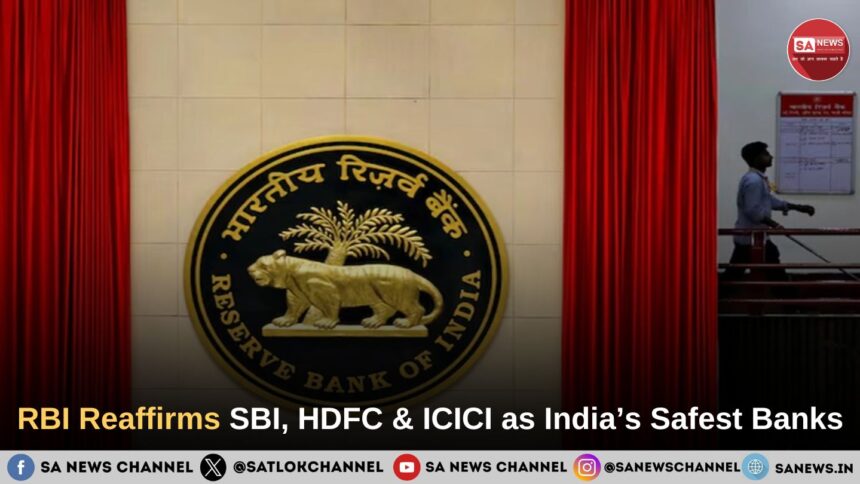
RBI Reaffirms: The Reserve Bank of India has reaffirmed State Bank of India (SBI), HDFC Bank and ICICI Bank as the country’s most systemically important lenders, categorising them as Domestic Systemically Important Banks (D-SIBs). This designation highlights their critical role in maintaining India’s financial stability and protecting the economy from large-scale disruptions. RBI has mandated higher Common Equity Tier 1 (CET1) capital buffers for these banks in line with Basel III norms, ensuring they can absorb financial shocks during periods of stress. The reaffirmation underlines why these institutions are widely regarded as the safest pillars of India’s banking system.
- Key Takeaways on RBI’s D-SIB Classification of India’s Safest Banks
- RBI’s Reaffirmation of Systemically Important Banks
- What D-SIB Status Means for India’s Banking System
- Why SBI, HDFC Bank and ICICI Bank Matter Most
- Capital Requirements and CET1 Buffers Explained
- Bucket Placement and Its Economic Implications
- Timeline for Revised Basel III Capital Norms
- Evolution of the D-SIB Framework in India
- Why RBI and Government Oversight Matters
- Strengthening the Pillars of India’s Financial Stability
- The Spiritual Perspective: True Security Through the Unique Knowledge of Tatvdarshi Sant Rampal Ji Maharaj Ji
- FAQs on RBI Reaffirming SBI, HDFC Bank and ICICI Bank as India’s Safest Banks
Key Takeaways on RBI’s D-SIB Classification of India’s Safest Banks
- RBI has reaffirmed SBI, HDFC Bank and ICICI Bank as D-SIBs, recognising their systemic importance to India’s financial system.
- D-SIBs are required to maintain additional CET1 capital beyond standard regulatory buffers to strengthen resilience.
- SBI is placed in Bucket 4 (0.80% CET1), HDFC Bank in Bucket 2 (0.40%), and ICICI Bank in Bucket 1 (0.20%).
- The framework aligns with global Basel III guidelines and aims to prevent contagion risks.
- Revised capital requirements will take effect from 1 April 2027, reinforcing long-term financial stability.
RBI’s Reaffirmation of Systemically Important Banks
The Reserve Bank of India has once again designated SBI, HDFC Bank and ICICI Bank as Domestic Systemically Important Banks, reflecting their scale, reach and interconnectedness within the Indian economy. These banks are considered so vital that any disruption in their operations could trigger widespread instability across financial markets. RBI’s reaffirmation signals continued regulatory focus on ensuring these institutions remain robust, well-capitalised and capable of withstanding economic stress.
Read RBI’s Report here.
What D-SIB Status Means for India’s Banking System
Banks classified as D-SIBs are regarded as essential to the smooth functioning of the financial system. Their failure could have severe consequences, including market volatility, erosion of public confidence and broader economic disruption. To mitigate such risks, regulators impose higher supervisory oversight and stricter capital requirements on D-SIBs. The framework ensures that these banks maintain sufficient loss-absorbing capacity, reducing the likelihood of systemic shocks that could impact depositors, investors and the wider economy.
Also Read: Silver Loan India 2026: RBI Rules, LTV Limits, Eligibility & Application Guide
Why SBI, HDFC Bank and ICICI Bank Matter Most
SBI, HDFC Bank and ICICI Bank collectively represent a significant share of India’s banking assets and credit flow. Their operations influence economic growth, liquidity conditions and financial inclusion.
While many assume government-owned banks are inherently safer, RBI’s classification highlights that two of India’s three safest banks are from the private sector. The country’s dependence on the financial health of these institutions is substantial, and even minor disruptions could affect GDP, stock markets and ordinary citizens’ savings.
Capital Requirements and CET1 Buffers Explained
Under RBI guidelines, systemically important lenders must maintain additional Common Equity Tier 1 capital over and above the Capital Conservation Buffer. CET1 capital represents the highest quality of capital, capable of absorbing losses during financial stress without disrupting normal operations. This requirement acts as a safeguard, ensuring that D-SIBs can continue functioning smoothly even during periods of economic turbulence. The approach aligns with Basel III norms, adopted globally to enhance banking sector resilience.
Bucket Placement and Its Economic Implications
RBI assigns D-SIBs to specific buckets based on their systemic footprint. SBI occupies the highest bucket among the three, reflecting its dominant size and reach. HDFC Bank and ICICI Bank follow in lower buckets, corresponding to their relative impact on the financial system. Each bucket determines the level of additional CET1 capital a bank must hold. This calibrated approach ensures proportional regulation while maintaining overall financial stability.
Timeline for Revised Basel III Capital Norms
The revised capital requirements under the D-SIB framework will come into effect from 1 April 2027. This phased implementation provides banks adequate time to strengthen their capital positions while ensuring compliance with international standards. By aligning domestic regulations with Basel III, RBI aims to safeguard India’s financial system from future contagion risks and reinforce depositor confidence.
Evolution of the D-SIB Framework in India
India introduced the D-SIB framework in 2014 to strengthen the resilience of its banking sector. SBI was the first bank to be included, followed by ICICI Bank and later HDFC Bank, reflecting their growing systemic importance over time. The framework has since become a cornerstone of India’s financial stability architecture, ensuring that critical institutions remain protected against economic shocks.
Also Read : RBI Savings Account Guidelines 2025-2026: Key Updates on ATM Fees, KYC & Cheque Clearance
Why RBI and Government Oversight Matters
Given their systemic importance, RBI and the Government of India have committed to close oversight of D-SIBs. In the event of financial stress, authorities are expected to intervene promptly to prevent disruptions. This regulatory assurance, combined with higher capital buffers, reinforces public trust and explains why keeping money in these banks is widely considered safe.
Strengthening the Pillars of India’s Financial Stability
RBI’s reaffirmation of SBI, HDFC Bank and ICICI Bank as Domestic Systemically Important Banks underscores their role as the backbone of India’s financial system. Through stricter capital requirements, bucket-based regulation and alignment with Basel III norms, policymakers have prioritised resilience over risk. These measures are designed to protect depositors, stabilise markets and sustain economic confidence. As India’s banking landscape evolves, the D-SIB framework continues to ensure that the country’s most critical lenders remain strong, secure and capable of supporting long-term growth.
The Spiritual Perspective: True Security Through the Unique Knowledge of Tatvdarshi Sant Rampal Ji Maharaj Ji
While financial stability and institutional safeguards are essential for economic security, true and lasting safety goes beyond material arrangements. According to the Spiritual Knowledge of Tatvdarshi Sant Rampal Ji Maharaj, human life is extremely precious and at the same time temporary, and mere financial protection cannot shield a soul from the cycle of birth, death, and suffering. He explains that although banks, systems, and capital buffers can protect money, only True Spiritual Knowledge can protect human life itself.
Tatvdarshi Sant Rampal Ji Maharaj emphasizes that the present human birth is granted by the grace of the Supreme God and should not be wasted in ignorance. If this invaluable life is spent without attaining True Bhakti, one may have to wander through the cycle of 84 lakh life forms again. His teachings guide people toward correct worship, moral living, and spiritual awareness, offering inner peace and ultimate salvation, something no economic system can provide.
For those seeking to understand the deeper truth of life and attain permanent security beyond the material world, the spiritual guidance of Tatvdarshi Sant Rampal Ji Maharaj Ji provides a clear, evidence-based path rooted in scriptures.
- Website: www.jagatgururampalji.org
- YouTube: Sant Rampal Ji Maharaj
- Facebook: Spiritual Leader Saint Rampal Ji
- X: @SaintRampalJiM
FAQs on RBI Reaffirming SBI, HDFC Bank and ICICI Bank as India’s Safest Banks
1. Why has RBI reaffirmed SBI, HDFC Bank and ICICI Bank as D-SIBs?
RBI has reaffirmed them due to their size, interconnectedness and critical role in maintaining India’s financial stability.
2. What does D-SIB status mean for banks in India?
D-SIB status means a bank is systemically important and must follow stricter supervision and higher capital requirements.
3. Which D-SIB bucket do SBI, HDFC Bank and ICICI Bank fall into?
SBI is in Bucket 4, HDFC Bank in Bucket 2, and ICICI Bank in Bucket 1 under RBI’s D-SIB framework.
4. Why are D-SIBs required to maintain higher CET1 capital?
Higher CET1 capital helps D-SIBs absorb financial losses during crises and prevents systemic risk to the economy.
5. When will the revised Basel III capital norms for D-SIBs take effect?
The revised Basel III capital requirements will take effect from 1 April 2027, as mandated by the RBI.