


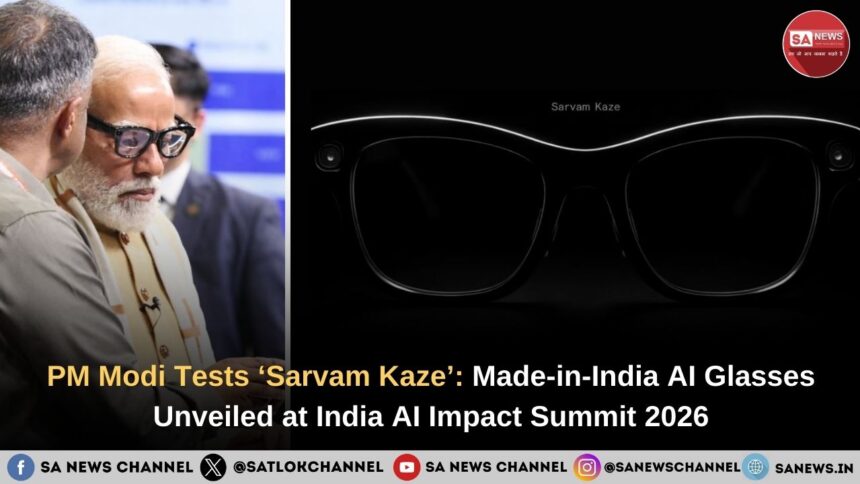
Prime Minister Narendra Modi was seen trying an AI-powered wearable device called Sarvam Kaze at the India AI Impact Summit 2026 in Delhi. Developed by Bengaluru-based startup Sarvam AI, the spectacles-like device is designed to listen, understand, and respond to user queries while capturing real-time visuals. Built entirely in India, it runs on the company’s in-house AI models optimized for Indian languages and regional contexts. The development comes as India accelerates its artificial intelligence ecosystem under the IndiaAI Mission, signalling a shift from being a user of AI technologies to a builder of indigenous AI products and foundational models.
- Key Takeaways on Sarvam Kaze AI Glasses
- PM Modi Tries Indigenous AI Wearable at National AI Summit
- What Is Sarvam Kaze?
- Built on an In-House AI Stack for Indian Languages
- Developer Platform Enables Custom Experiences
- Expected Public Availability in May 2026
- Sarvam AI’s Broader Work on Foundational Models
- Significance in the Context of the IndiaAI Mission
- India’s Shift From AI User to AI Builder
- A New Phase for Indigenous AI Innovation
- FAQs on Sarvam Kaze: PM Modi Wears Made-in-India AI Glasses
Key Takeaways on Sarvam Kaze AI Glasses
- Prime Minister Narendra Modi tested Sarvam Kaze at the India AI Impact Summit 2026
- Developed by Bengaluru-based startup Sarvam AI as a Made-in-India AI wearable
- Designed as a discreet spectacles-like device with cameras and microphones
- Can listen, understand, and respond to queries in real time
- Runs on Sarvam’s in-house AI stack optimized for Indian languages
- Processes data locally using the Sarvam Edge AI model for privacy and offline use
- Expected to be available to the public in May 2026
- Developed entirely in India as an indigenous alternative to global smart glasses
- Linked to broader goals of the IndiaAI Mission launched in March 2024
PM Modi Tries Indigenous AI Wearable at National AI Summit
At the India AI Impact Summit 2026, Prime Minister Narendra Modi was spotted wearing and testing an AI-powered wearable device developed by a homegrown startup. The device, called Sarvam Kaze, resembles regular spectacles but incorporates advanced artificial intelligence capabilities.
Images shared by Sarvam AI co-founder Pratyush Kumar show the Prime Minister testing the device’s real-time features while visiting the exhibition. The summit brought together policymakers, startups, researchers, and global technology leaders to discuss responsible and innovative AI development.
Also Read: AI Summit In New Delhi: India’s Leap Towards The AI Age
The appearance of the device at a high-profile national event underscores the growing focus on indigenous AI innovation in India.
What Is Sarvam Kaze?
Sarvam Kaze is an AI-powered wearable designed as a discreet, spectacles-like frame rather than bulky smart glasses. The device integrates embedded cameras and microphones within its arms, enabling hands-free interaction and capture of visual information.
Key capabilities include:
- Listening to user queries
- Understanding spoken commands
- Responding with audio feedback
- Capturing what the wearer sees in real time
The device supports real-time interaction, allowing users to receive instant summaries or responses based on their surroundings.
Unlike many competing wearables, Sarvam Kaze operates on Sarvam AI’s proprietary technology stack. It is positioned as India’s homegrown alternative to global products such as the Meta Ray-Ban smart glasses.
Built on an In-House AI Stack for Indian Languages
One of the defining aspects of the device is its focus on Indian linguistic and cultural contexts. Sarvam AI has developed foundational models tailored specifically for India’s diverse language landscape.
The glasses run on the Sarvam Edge AI model, which processes information locally on the device rather than relying heavily on cloud connectivity. This approach provides several advantages:
- Faster response times
- Enhanced user privacy
- Reduced dependence on internet connectivity
- Offline functionality
By optimizing the system for regional languages, the device aims to make AI interaction more accessible across India.
Developer Platform Enables Custom Experiences
Sarvam AI has also introduced a broader ecosystem around the wearable. Through the Sarvam Platform, developers can create custom applications and specialized experiences tailored to specific use cases.
Also Read: PM Modi Meets Mauritius PM Ramgoolam During India AI Impact Summit 2026 in New Delhi
This means the device is not limited to pre-installed features. Instead, it can support a wide range of AI-based applications depending on user needs.
Developers are expected to build solutions for areas such as:
- Personalized assistance
- Context-aware information delivery
- Industry-specific applications
- Multilingual interactions
The platform approach positions the device as both a consumer product and a foundation for AI innovation.
Expected Public Availability in May 2026
According to the company, Sarvam Kaze is likely to reach the market in May 2026. It is expected to be available to the public during that time.
From design to technical development, the entire product has been created in India. The company describes it as a completely indigenous AI product, reinforcing the “Made in India” narrative associated with the country’s technology ambitions.
Sarvam AI’s Broader Work on Foundational Models
Sarvam AI is among the teams developing foundational AI models tailored to Indian needs. Its work includes Large Language Models (LLMs) and speech technologies designed for local languages and applications.
These models are intended for practical uses such as:
- Voice interfaces
- Document processing
- Citizen services
The company has also introduced several related platforms and tools:
- Sarvam Akshar — Digitization of documents
- Sarvam Studio — Multilingual content creation platform
- Saaras V3 — Advanced speech recognition model
Together, these initiatives form a broader ecosystem aimed at strengthening India’s AI capabilities.
Significance in the Context of the IndiaAI Mission
The development is considered significant in light of the IndiaAI Mission launched by the central government in March 2024. The mission has a financial provision of Rs 10,372 crore.
The summit in Delhi highlights India’s ambition to move beyond adopting foreign AI technologies and toward building its own products and models. By showcasing indigenous innovations like Sarvam Kaze, the event signals a strategic push for technological self-reliance.
Participants at the summit included policymakers, startups, researchers, and global technology leaders, reflecting the collaborative nature of AI development.
India’s Shift From AI User to AI Builder
The unveiling of Sarvam Kaze represents a broader transition in India’s technology landscape. The country is increasingly positioning itself not only as a consumer of artificial intelligence but also as a developer of foundational technologies.
With products designed specifically for Indian languages, contexts, and infrastructure conditions, such innovations aim to address local needs while contributing to global AI advancements.
As initiatives under the IndiaAI Mission progress, developments like these are expected to play a role in shaping the future of AI deployment across sectors.
A New Phase for Indigenous AI Innovation
The demonstration of Sarvam Kaze at a national platform underscores the growing maturity of India’s AI ecosystem. By combining locally developed hardware with indigenous software models, the device reflects a comprehensive approach to technological development.
Its expected public release in May 2026 will be closely watched as a test of India’s ability to deliver consumer-ready AI products built entirely within the country. The broader ecosystem of language models, speech technologies, and developer tools surrounding the device indicates a long-term strategy rather than a single product launch.
FAQs on Sarvam Kaze: PM Modi Wears Made-in-India AI Glasses
1. What is Sarvam Kaze?
Sarvam Kaze is an AI-powered wearable device developed by Sarvam AI that looks like spectacles and can listen, understand, and respond to user queries.
2. Where was Sarvam Kaze showcased?
It was demonstrated at the India AI Impact Summit 2026 in Delhi, where Prime Minister Narendra Modi tested the device.
3. When will Sarvam Kaze be available to the public?
According to the company, the device is expected to be available in May 2026.
4. What makes Sarvam Kaze different from other smart glasses?
It runs on an in-house AI stack optimized for Indian languages and processes data locally for privacy and offline functionality.
5. What is the IndiaAI Mission linked to this development?
The IndiaAI Mission, launched in March 2024 with Rs 10,372 crore funding, aims to strengthen India’s artificial intelligence ecosystem.