

On 28 November 2025, Narendra Modi, Prime Minister of India, made a highly anticipated visit to the coastal temple town of Udupi in Karnataka – marking his first visit there since assuming his current term. The day was marked by a vibrant roadshow, spiritual ceremonies at the ancient Sri Krishna Mutt, and a historic mass recitation of the sacred Bhagavad Gita – the Laksha Kantha Gita Parayana. Here’s a detailed look at the event and its significance.
- PM Modi’s Grand Visit to Udupi: Key Highlights
- Roadshow and Warm Reception
- Spiritual Significance: Gita Chanting & Temple Rituals
- Temple Ceremonies: Honouring Tradition & Legacy
- Message & Significance: Cultural Heritage Meets Governance
- Broader Context & Aftermath
- Why Rituals Cannot Liberate: The Gita’s Hidden Message Revealed
PM Modi’s Grand Visit to Udupi: Key Highlights
- Udupi Turns Saffron Sea: PM Modi’s Grand Roadshow Draws Massive Crowds
- Laksha Kantha Gita Parayana: When Udupi Echoed with a Hundred Thousand Voices
- A Sea of Devotion in Udupi: PM Modi Leads Laksha Kantha Gita Chanting & Unveils Temple Treasures
- PM Modi’s Visit Blends Culture, Devotion & Development
- Tradition, Identity & Devotion: Inside PM Modi’s Spiritual Trail
- Beyond Rituals: The Gita’s True Path to Liberation Revealed
Roadshow and Warm Reception
- The Prime Minister landed at the helipad in Adi-Udupi and began a roadshow starting from Bannanje Narayana Guru Circle, passing through key city points before culminating at Kalsanka Circle.
- Thousands of people flocked the streets, waving tricolours, showering petals, and greeted him with loud cheers and chants – creating a “sea of saffron” and festooned with flags along the entire route.
- Modi stood on the running board of his vehicle, reciprocating the warmth by waving back and even throwing flowers to the crowd.
- To ensure safety, more than 3,000 police personnel – including SPG, anti-drone and counter-terror teams – were deployed across Udupi. Security protocols included bans on bags, drones, cameras, and other potentially risky items for attendees of the Gita recital.
Spiritual Significance: Gita Chanting & Temple Rituals
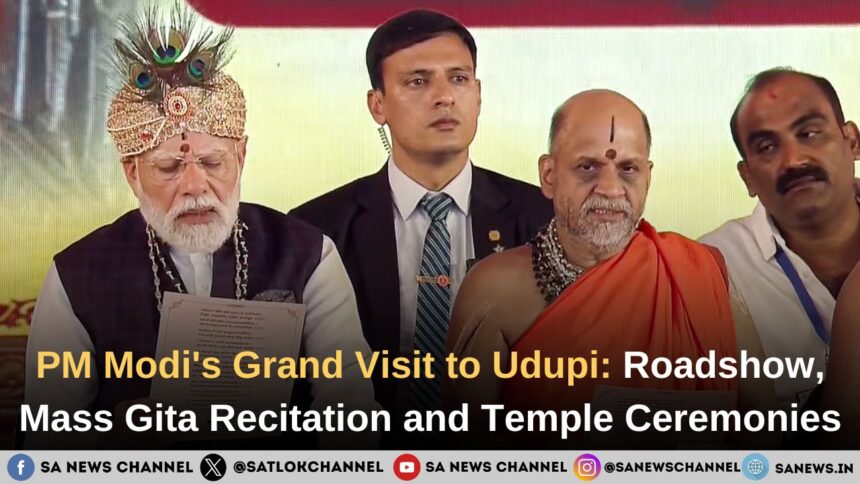
- At the heart of the visit was the Laksha Kantha Gita Parayana – a devotional gathering at Sri Krishna Mutt where around one lakh (100,000) devotees – including students, monks, scholars and citizens – came together to recite verses from the Bhagavad Gita in unison.
- Modi himself joined the recitation. He chanted verses from Chapter 15 (*Purushottama Yoga*) and later recited the final ten shlokas of the Gita.
- In his address, he described the collective chanting as spiritually uplifting and said participating with so many had given him “strength and blessings to serve better.”
Temple Ceremonies: Honouring Tradition & Legacy
- During the visit, Modi inaugurated the newly constructed Suvarna Teertha Mantapa, situated in front of the sanctum sanctorum of Sri Krishna Mutt.
- He also dedicated the Kanaka Kavacha – a golden covering for the sacred window Kanakana Kindi. This window holds profound significance because, according to tradition, the saint-poet Kanakadasa – denied entry to the temple due to his caste – was granted a darshan of Lord Krishna through this window.
- Upon arrival, Modi was accorded traditional honours – including “Poorna Kumbha Swagatham”, garlands, and symbolic Mudras (conch, chakra, gada, and padma) common to the Madhwa tradition. He also paid tribute to Kanakadasa and acknowledged the spiritual legacy of the Mutt.
Message & Significance: Cultural Heritage Meets Governance
- In his address, the Prime Minister highlighted the deep connection between the teachings of the Bhagavad Gita and India’s present and future social-development agenda. He appealed to people to adopt nine resolutions – including conserving water, planting trees (especially in mothers’ names), uplifting the poor, promoting local products, embracing natural farming and yoga, preserving manuscripts, and visiting sacred pilgrimage centres.
- He also praised Udupi’s historical role – citing its governance model under the earlier Bharatiya Jana Sangh, which later evolved into Bharatiya Janata Party. He underscored that Udupi’s cultural and spiritual ethos contributed to the broader national movement.
- Calling the mass Gita chanting a globally significant spiritual event, he remarked that such events reaffirm India’s rich cultural heritage in the eyes of the world.
Broader Context & Aftermath
- The visit also marked a continuity of tradition: the Sri Krishna Mutt – founded over 800 years ago by 13th-century philosopher Madhvacharya – remains a key centre of Sri Vaishnava (Dvaita) philosophy and practice.
- The ceremonies and the mass chanting have drawn attention beyond the religious sphere – merging spiritual heritage, culture, governance narratives, and national identity in a blend that resonates with many across India.
- His next scheduled visit was to a 550-year-old Mutt in Goa – Samsthan Gokarn Partagali Jeevottam Mutt – later the same day, underlining a tightly packed itinerary combining devotion and outreach.
Why Rituals Cannot Liberate: The Gita’s Hidden Message Revealed
Prime Minister Modi’s visit to Udupi and the large-scale recitation of the Gita may instill cultural pride, yet from the perspective of true spirituality-as explained by Sant Rampal Ji Maharaj- such ritualistic events do not lead the soul to liberation. The Bhagavad Gita itself clearly states that external rituals, group chanting, idol worship, and a show of devotion are not the way to attain God. Gita 7:20-23 states that those who worship other deities or engage in rituals other than the Supreme God will only experience temporary results. Similarly, Yajurveda 32:3 states that God cannot be attained through idol worship.
Also Read: International Gita Mahotsav (IGM) 2025: Spiritual Insights For A Modern World
The scriptures emphasize the need for a complete saint (Satguru) who imparts true knowledge and worship based on the scriptures (Gita 4:34). Without such initiation and the correct method of devotion, even the greatest spiritual ceremonies remain within the domain of Kaal Brahma, who binds souls to the cycle of birth and death (Gita 8:16).
Sant Rampal Ji Maharaj teaches that salvation is attained not through political posturing or public religious ceremonies, but through true devotion as prescribed in all sacred scriptures, such as chanting the name of a Tatvdarshi Saint. This alone leads to inner peace and ultimate liberation, beyond the influence of rituals, crowded sentiments, or cultural pretensions.